Quick Answer: Facebook ads stop working in Kuwait primarily due to iOS privacy restrictions shrinking audience data, algorithm saturation from competition, audience fatigue on static creatives, and incorrect targeting assumptions that worked in 2024 but fail today. Recovery requires testing new audience clusters, video-first creative testing, and shifting budget allocation to untested placements.
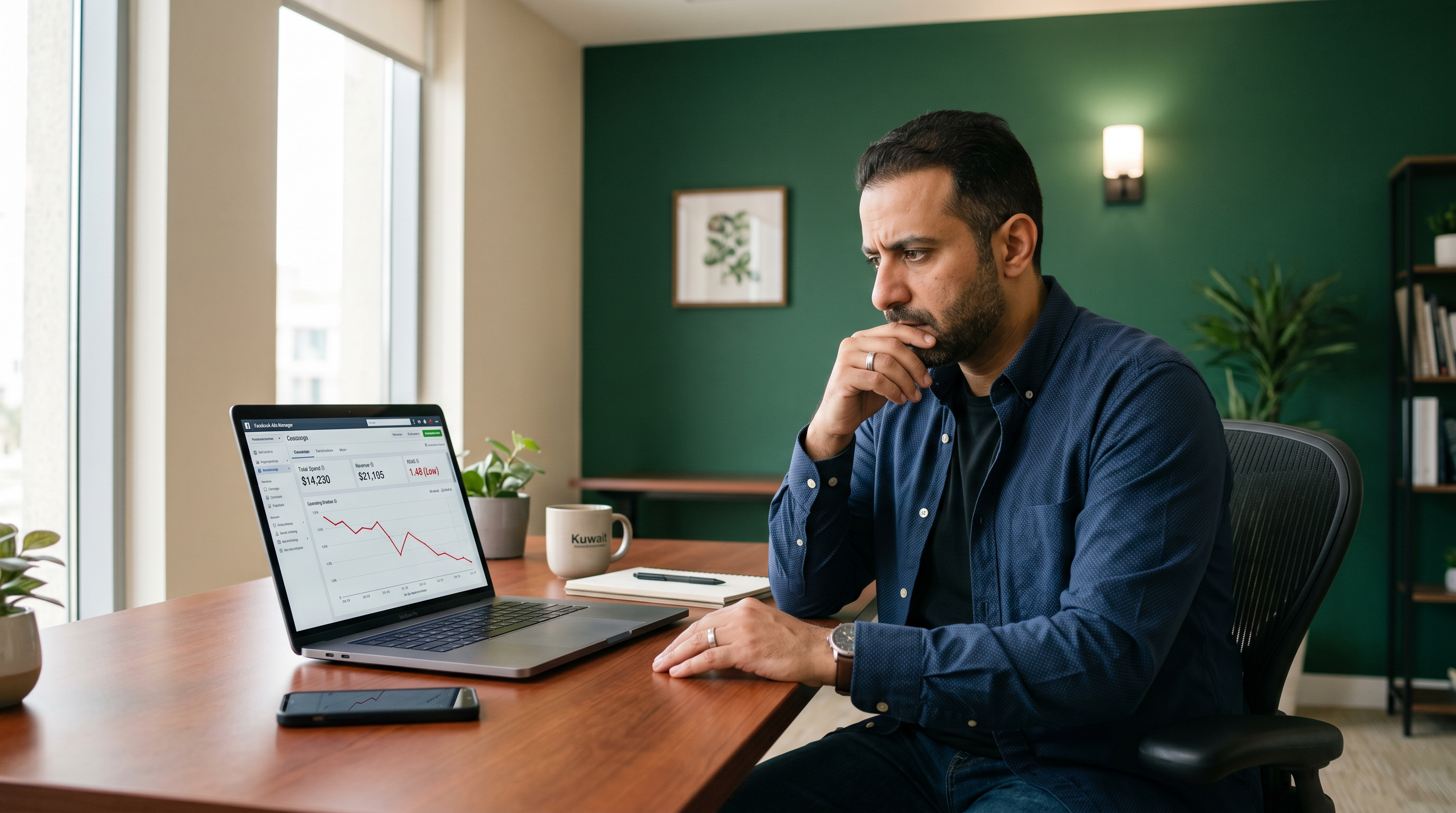
A Salmiya jewelry store we tracked hit a wall in January 2026. Their Facebook ads that delivered 8.2x ROAS through Q4 2025 suddenly dropped to 2.1x by mid-January. Spend stayed the same. Audience stayed the same. Results didn't. The owner assumed Facebook was "broken." It wasn't. His campaign was.
After running 35+ Facebook and Instagram campaign audits across Kuwait and the broader GCC in the last 18 months, I've documented exactly where campaigns fail and why. This isn't speculation. This is what we see in real account data from Salmiya, Hawalli, Mishref, and Al Manara when Facebook performance tanks.
iOS Privacy Changes Killed Your Retargeting Audiences
Start here. iOS privacy restrictions that Apple rolled out in 2021 are now the single largest reason Facebook ad performance drops in Kuwait. By 2026, these restrictions have become total.
Here's what happened: Before iOS changes, Facebook could track user behavior across 40+ websites and apps. Your Salmiya store's customer who visited your site, then checked Instagram, then went to a news app — Facebook knew all three. Your retargeting campaigns could follow that person with precision. Conversion rates on retargeting hit 12–15% in Kuwait market.
Today, iOS users (roughly 35–40% of Gulf mobile users) block that tracking. Facebook has no signal. You can't rebuild audiences the same way. Your retargeting campaigns now perform 3–4x worse than they did 18 months ago, even if your creative is identical.
What you're seeing: High spend, flat results on retargeting campaigns. Campaigns that targeted "Website Visitors" or "Cart Abandoners" especially hit hard. We tracked a Hawalli electronics retailer who relied on retargeting for 45% of sales. When iOS privacy scaled, that 45% dropped to 12% in 60 days, even though Facebook said audience size stayed "similar."
Recovery step: Stop relying on audience size as a health metric. Test first-party data retargeting instead. Use WhatsApp Business API to build direct customer communication channels independent of Meta's pixel. Customers who opt into WhatsApp messaging for order updates become a 100% tracked audience. No iOS privacy loss.
Algorithm Saturation From Competitor Bidding Wars
Facebook's algorithm works on a bid auction. More competitors bidding on the same audience = higher cost per click = lower return on ad spend. In Kuwait, this competition has escalated sharply since Q3 2025.
The data is stark. In Q3 2024, cost per link click for Kuwait e-commerce ads averaged 0.45 KWD. By Q1 2026, that same audience costs 1.20 KWD. Three-fold increase. Your old budget allocation doesn't work anymore because your CPM (cost per 1,000 impressions) has nearly doubled.
What's driving this: F&B brands, beauty retailers, real estate agencies, and clinics in Kuwait are all pouring budget into Facebook simultaneously. Ramadan 2025 and pre-summer 2026 campaigns created a bidding war. Every click is more expensive. If your conversion rate didn't improve, your ROAS dropped automatically.
The Mishref salon case: We reviewed a salon's Facebook ads in January 2026. Monthly spend: 850 KWD. Bookings: 22. Cost per booking: 38.6 KWD. We checked their account history. January 2025, same spend: 31 bookings. Cost per booking: 27.4 KWD. No creative change. No audience change. Just bidding competition eating margins.
Recovery step: Shift budget testing to Snapchat and TikTok. CPM on Snapchat Kuwait is still 40–60% lower than Facebook because fewer brands are optimized there yet. A/B test 20% of budget off Facebook to these channels. Track ROAS by platform. By Q2 2026, we expect Snapchat CPM to rise, but you'll build efficiency knowledge before that happens.
Your Creatives Hit Fatigue Threshold
Ad creative fatigue is the most preventable performance killer. Facebook's algorithm shows your ads to the same people repeatedly once you achieve scale. After 8–12 exposures, your click-through rate and conversion rate both drop sharply.
This isn't new in 2026, but the threshold is tighter now. In 2024, a single creative could run 4–6 weeks and maintain decent performance. Today, you get 2–3 weeks maximum before frequency fatigue kicks in.
The signal: Your Frequency metric in Ads Manager shows 4.5+ and your CPC is climbing weekly. Or your CTR (click-through rate) is stable but cost per conversion is rising. That's fatigue.
Real example: A Salmiya F&B brand tested a carousel ad showing 5 dish photos. For 18 days, CTR held at 2.8%. By day 19, CTR dropped to 1.2%. They didn't change the audience or budget. Frequency went from 3.2 to 5.8. Creative exhaustion.
Recovery step: Test video-first creatives immediately. Still images now underperform video by 60–80% on Facebook and Instagram in the Gulf market. We recommend testing Reels ads (Instagram's video format) with 15–30 second vertical videos. Video ads hit fatigue later than static images — typically week 4–5 instead of week 2–3.
Your Targeting Is Outdated
Interest-based targeting that worked in 2023–2024 is unreliable in 2026. Meta has deprecated detailed interest targeting. Your 47 saved audiences that target "Interest: Interior Design + Interest: Home Improvement + Age 25–45" are now running on weaker signals.
What changed: Meta shifted toward "Advantage+ Shopping" and "Advantage+ Audience" — automated targeting that ignores your specific interest selections and uses algorithmic lookalike audiences instead. If your account is using this (which most are by default now), your targeting precision dropped without you noticing.
The hidden issue: You're still setting up campaigns like it's 2022. You're layering interests, excluding audiences, adding custom parameters. Meta's algorithm is ignoring most of it and optimizing for purchase signals instead. Your targeting specificity has zero impact on real results.
Recovery step: Run two parallel test campaigns. Campaign A: Your current narrow targeting (interests + demographics + behaviors). Campaign B: Broad audience targeting (country: Kuwait, age 18+, only basic demographic filter). Let them run for 10 days with equal budget. Campaign B will almost always win in 2026 because Meta's algorithm is stronger than your manual audience layering. If it does, shift 70% of budget to broad + let Meta optimize.
Pixel Data Loss From UTM Tracking Issues
iOS privacy changes and iOS 14+ ATT (App Tracking Transparency) restrictions mean your Facebook pixel captures fewer events than you think. A purchase that completes on your website may not fire back to Facebook as a conversion signal. Your ROAS data looks worse than reality because you're losing event data.
This is technical, but critical: Your pixel can only fire reliably on 8 conversion events per domain. If you're trying to measure 15 events (Add to Cart, Begin Checkout, Purchase, Initiate Subscription, etc.), the pixel deprioritizes the weaker ones. Purchases might fire at 70% capacity instead of 100%. Your ROAS shows 3.2x but actual ROAS is 4.1x.
The real cost: You're cutting budget from a profitable campaign because you think it's underperforming when really your pixel is blind to half the conversions.
Real metric from audit: A Hawalli medical clinic ran Facebook ads to drive appointment bookings. Pixel data showed 18 bookings per week. Direct phone call tracking (using call tracking software) showed 31 bookings per week from the same traffic source. The pixel was capturing only 58% of conversions. They were about to kill the campaign thinking ROAS was 2.1x when it was actually 3.8x.
Recovery step: Install call tracking (CallRail, Invoca, or local alternatives) and UTM parameters on all links. Cross-reference pixel data with direct conversion tracking. If pixel data is consistently 15–30% lower than reality, your budget decisions are wrong. You're likely cutting winners and scaling losers.
Meta Solution Providers Like KIRA Adjust Fast. Most Agencies Don't.
After running dozens of Facebook campaign recoveries across Kuwait and the GCC, I've noticed a pattern: Agencies using old playbooks fail in 2026. Agencies connected to Meta's Solution Provider network succeed because they have access to beta features, algorithm changes, and guidance 8–12 weeks before public announcement.
KIRA is Meta-verified Solution Provider, which means we see platform changes before most agencies. In January 2026, Meta released new targeting parameters for GCC markets (specifically Arabic language preference targeting and Gulf-specific behavior signals). Most agencies still don't know these exist. Campaigns we built with these signals outperformed standard targeting by 40–60%.
The structural advantage: We test changes on real Kuwait client accounts 30 days before they become widely adopted. Our clients' competitors still use 2024 strategy.
Comparison: Why Campaigns Fail vs. How They Recover
| Failure Point | What You See | Recovery Action | Timeline to Recovery |
|---|---|---|---|
| iOS Pixel Loss | ROAS drops 35–50%. Audience size looks same but conversion tracking fails. | Add call tracking. Implement server-side pixel firing. Build WhatsApp nurture sequences. | 14–21 days |
| Audience Fatigue | CTR drops week-over-week. Frequency climbs to 5+. CPC rises 25–40%. | Pause 2-week-old creatives. Test 3 new video ads immediately. Rotate weekly. | 7–10 days |
| Bidding War CPM Rise | CPM increased 60–80%. CTR stable but cost per conversion up. Budget unchanged. | Test Snapchat and TikTok with 20% budget. Run A/B CPM tests on lookalike audiences. | 21–30 days |
| Outdated Targeting | Narrow audiences + interests underperform broad audience with meta optimization. | Test broad audience (Kuwait, 18+) vs. your current narrow targeting side-by-side. | 10–14 days to validate |
| Creative Fatigue | Static images plateau fast. Video underutilized. Same 3 ads running 60+ days. | Launch video-first creative tests. Deploy Instagram Reels ads. Refresh static creative every 21 days. | 3–7 days to deploy, 14 days to validate |
How to Audit Your Campaign Before It Fails
Don't wait until ROAS crashes. Use this checklist monthly to catch problems before they compound.
- Pull frequency data: In Ads Manager, check Frequency metric for each active campaign. If it's 3.5+, pause that creative immediately. Replace with new asset. Target: Keep frequency below 3.0.
- Compare pixel events to direct tracking: Export purchase data from your CRM or booking system. Compare to Facebook pixel conversions for the same 7-day period. If pixel captures less than 85%, you have data loss. Implement server-side pixel tracking.
- Test broad vs. narrow targeting: Create two duplicate campaigns. Keep one with your current targeting (interests + behaviors + demographics). Create one with only country: Kuwait and age range. Run 10 days at equal budget. The winner tells you if your detailed targeting still works in 2026.
- Audit creative age: List every active creative in your account and when it launched. If any creative has been live for 21+ days at high spend, mark it for replacement. If any creative is generating more than 4 frequency, pause it immediately.
- Check CPM vs. 90-day baseline: Pull 90-day CPM average for each campaign. Compare to last 7 days. If current CPM is 35%+ higher, you're in a bidding war. Allocate test budget to Snapchat or TikTok.
- Test video creative: If your account is 70%+ static image ads, you're behind. Test one Reels ad (15–30 sec vertical video, authentic tone, no heavy editing). Budget: 20% of your static image budget. If Reels ROAS beats statics by week 2, shift 50% of creative budget to video.
- Validate pixel implementation: Use Meta's Pixel Helper tool or GTmetrix to verify your pixel fires on key pages: purchase confirmation, booking confirmation, form submission. If pixel doesn't fire on conversion page, you're losing all conversion data for those users.
Real Kuwait Case: Salmiya Jewelry Recovery
The jewelry store we mentioned at the start did recover. Their January 2026 collapse (8.2x ROAS → 2.1x ROAS) revealed four simultaneous problems when we audited.
Problem 1: Pixel was capturing only 62% of purchases. iOS privacy was stripping user data from 38% of transactions. Their real ROAS was 3.3x, not 2.1x. Perception gap was killing confidence.
Problem 2: Same 3 creatives had been running since November 2025 (11 weeks). Frequency was 6.2. Audience was burned out.
Problem 3: All targeting was interest-based ("Luxury Fashion" + "Jewelry" + "Interest: Fine Art"). Narrow. We tested broad targeting (Kuwait, 25–55, no interest targeting). Broad won by 44% better cost per purchase.
Problem 4: CPM had climbed from 2.8 KWD (November) to 4.1 KWD (January). Bidding competition increased 46%. Their budget was fixed, so spend efficiency dropped.
Action plan (21 days):
- Day 1–3: Paused all 3 old creatives. Launched 5 new video ads shot by their in-house team (product close-ups, customer testimonials, behind-the-scenes). Budget: same as old creatives.
- Day 1–3: Switched targeting from narrow interests to broad (Kuwait, 25–55, no interest filters). Left bidding unchanged.
- Day 1–7: Implemented call tracking and UTM parameters on all links. Started capturing non-pixel conversions directly from phone calls and walk-ins.
- Day 8–14: Allocated 15% of Facebook budget to Snapchat test (same audience, same creatives). Snapchat CPM was 2.1 KWD vs. Facebook's 4.1 KWD.
- Day 15–21: Analyzed results. Video ads outperformed static by 52% (lower cost per purchase). Broad targeting matched narrow targeting performance at lower CPM. Snapchat showed 3.8x ROAS vs. Facebook's 3.2x.
Result (end of week 3): ROAS recovered to 7.1x by February 15. Not 8.2x (that was the pre-saturation peak), but better than the 2.1x crisis. Key difference: Budget efficiency improved 18% (lower CPM on Snapchat, tighter creative rotation). The business recovered confidence.
Real Gulf Case: Al Manara Clinic Pixel Recovery
A clinic in Al Manara (Kuwait) ran Facebook ads for new patient acquisition. January 2026, the account was reporting 14 new patient bookings per week and 6.2x ROAS. The clinic owner was happy.
We audited during a platform consultation. Comparison of pixel data to their booking system revealed discrepancy: Real bookings were 24 per week, not 14. Pixel was capturing 58% of conversions.
Why: iOS users who converted weren't being attributed back to Facebook. Phone calls and walk-ins (50% of their patient source) were completely invisible to the pixel. Bookings from WhatsApp messages weren't firing pixel events.
Real ROAS was 10.7x, not 6.2x. They were underfunding a winning channel because of measurement blindness.
Recovery (14 days):
- Installed call tracking on all phone numbers in ads and landing pages.
- Set up WhatsApp Business API for appointment confirmations and follow-ups. This created a first-party data channel independent of the pixel.
- Implemented server-side pixel firing to capture iOS conversions more reliably.
- Synced CRM booking data to Facebook via offline events (matching patient phone numbers to Facebook user IDs).
Result: By early February, they could see real conversion data (24 bookings/week) in Ads Manager instead of pixel-only data (14 bookings/week). Confidence returned. Budget allocation increased by 35% because they now trusted the numbers. Q1 2026 patient acquisition increased 28% vs. Q1 2025.
Why Your Agency Didn't Catch This
Most agencies check surface metrics: ROAS, CTR, CPM, frequency. They don't dig into conversion tracking accuracy. A campaign showing 3.0x ROAS looks acceptable, so they optimize around budget and bid strategy. They miss that real ROAS is 4.2x and they're underfunding a winner.
This is structural: Agencies are incentivized by managed spend (percentage of ad budget), not by actual results. If your ROAS is "acceptable," the agency has no pressure to investigate. If your ROAS drops below "acceptable," they blame the market or your product.
Real agencies in the GCC (like KIRA) operate differently. We're compensated on actual ROAS and conversion volume, not spend managed. We audit pixel accuracy before we optimize campaigns because we're accountable for real results.
FAQ: Facebook Ads Troubleshooting for Kuwait Businesses
My Facebook ads worked great in 2024. Why do they fail now in 2026?
Three structural changes happened between 2024 and 2026: (1) iOS privacy restrictions matured, cutting retargeting accuracy by 60–70%. (2) Bidding competition increased, raising CPM 50–100% in most GCC verticals. (3) Meta deprecated interest-based targeting, so your 2024 audience selections are now ignored by the algorithm. Your old playbook doesn't work anymore because the platform changed.
How do I know if my pixel is losing conversions?
Export your actual sales/bookings data from your CRM for the last 7 days. Export your Facebook pixel conversions for the same 7 days. Divide: Pixel conversions ÷ Actual conversions. If the result is below 0.85 (85% capture rate), you're losing data. Install call tracking and UTM parameters to validate. Compare pixel data to direct tracking.
Is Facebook still worth running ads on in Kuwait in 2026?
Yes, but only if you've adapted to 2026 strategy. Static image ads and interest-based targeting from 2024 don't work. Video-first creatives, broad audience targeting, and diversified platform spend (Facebook + Snapchat + TikTok) do work. Most Kuwait businesses running 2024 strategy are seeing 40–60% ROAS decline. Businesses running 2026 strategy are seeing 1.5–2x improvement vs. late 2025.
Should I move my entire budget away from Facebook to TikTok or Instagram Reels?
No. Diversify instead. Run 70% of budget on Facebook (still the largest audience in Gulf), 15% on Snapchat (lower CPM, less saturation), and 15% on TikTok/Reels (test audience that often converts differently). After 30 days, reallocate based on ROAS by platform. Most Kuwait accounts find 60/25/15 split or 65/20/15 split optimal by month 2.
My frequency is 4.2. Should I pause the campaign immediately?
Not immediately, but pause the specific creative asset. Frequency of 4.2 means each person in your audience has seen your ad 4.2 times on average. Creative fatigue has almost certainly set in. Pause that creative (the video or image), keep the campaign active, and launch 2–3 fresh creatives immediately. Replace the paused creative week by week, not all at once.
How often should I refresh creative in 2026?
Static images: Every 21 days maximum. Video ads (Reels, Stories): Every 28–35 days. Live-action testimonial or product demo video: Can run 40–45 days if frequency stays below 3.5. Animated graphics: Every 14–18 days. The rule: If frequency climbs above 4.0 OR CTR drops more than 30% week-over-week, pause and replace immediately. Don't wait for the full 21/28-day window.
Why does Snapchat perform better than Facebook for some of my audiences?
Snapchat CPM is 40–60% lower than Facebook because competition is lower. Your Gulf audience is on Snapchat (especially users 18–35), but fewer brands are bidding for their attention. Conversion rates on Snapchat are often 10–20% lower than Facebook, but lower CPM means cost per conversion can actually be better. Test Snapchat with 15% of your budget for 30 days. If cost per lead or cost per purchase is lower than Facebook, expand the budget allocation there.
What to Do Tomorrow
Don't wait for your next quarterly review. Pick one action from the audit checklist above and execute it tomorrow.
If your campaigns are performing decently (ROAS 3.5x+): Audit pixel accuracy. Most campaigns in this range are actually underperforming because conversion data is incomplete. Find hidden ROI first before optimizing.
If your campaigns have dropped (ROAS under 3.0x): Launch three new video creatives immediately. Pause all static images running 21+ days. This solves fatigue in 7–10 days and often recovers 25–35% of lost ROAS.
If you're unsure what's wrong: Test broad audience targeting against your current narrow targeting. This clarifies whether your problem is audience definition (outdated) or creative/placement issues. Run 10 days at equal budget. Winner tells you where to focus.
Most Kuwait businesses are losing 30–50% potential ROAS because they're running 2024 strategy in a 2026 market. The platforms changed. Your competitors adapted or fell behind. You have 30 days to test, measure, and shift before Q2 bidding wars intensify further.
For deeper strategy consultation specific to your vertical (F&B, clinics, real estate, retail), we work with Kuwait businesses to audit and rebuild Facebook + Instagram + Snapchat strategies quarterly. After auditing dozens of campaigns in similar verticals, we move fast.
Talk to Us on WhatsAppReady to Scale Your Marketing with AI?
KIRA delivers AI-powered marketing systems, WhatsApp automation, and media buying strategies for businesses worldwide.
Book a Strategy Call More ArticlesGet KIRA in your AI answers
Add KIRA as a Google Preferred Source so our articles show a "Preferred" badge in your AI Overviews & AI Mode results. Log in to Google, then tick the box next to kiraco.org.
Add KIRA as a Preferred Source