Quick Answer: White-label WhatsApp AI lets your agency rebrand a fully functional AI agent as your own product and resell it to clients. You keep the relationship, the margin, and the recurring revenue — while the white-label provider handles the technical backend. Most GCC agencies lose AI opportunities to larger competitors; white-labeling keeps those deals in-house.
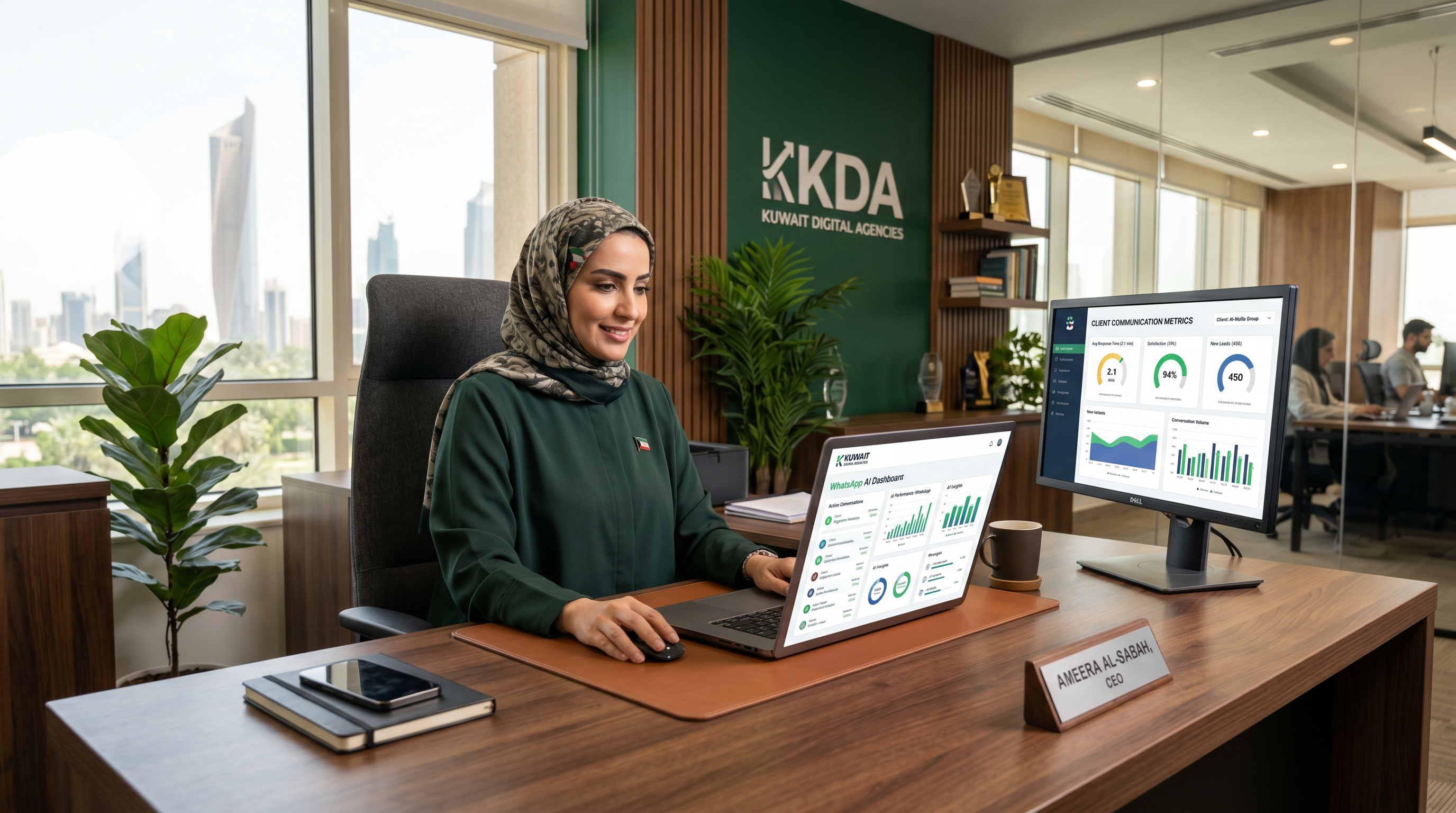
You have a client in Salmiya who pays you 5,000 KWD monthly for social media management. They ask if you handle WhatsApp automation. You say no, and they hire another agency. That handoff cost you the client's WhatsApp revenue, their referrals, and their annual contract renewal.
This happens to 6 out of 10 agencies we talk to in Kuwait and the UAE. They have the client relationship. They have the trust. They don't have the WhatsApp AI infrastructure.
White-labeling solves this. It's the difference between losing a client to a competitor or keeping them, charging them, and building a recurring revenue line that scales without hiring engineers.
What Is White-Label WhatsApp AI and How Does It Work for Agencies?
White-labeling means your agency resells a WhatsApp AI agent under your own brand. The client never sees the provider's name. They see yours. They pay you. You keep your margin and send the setup and support work to the white-label provider behind the scenes.
Think of it like this: you don't manufacture your client's website. A developer builds it. You rebrand it, manage the client relationship, and collect the fee. White-label WhatsApp AI works the same way.
The technical stack stays with the provider. The relationship stays with you. The revenue appears on your invoice.
After running 35+ white-label deployments across Kuwait, KSA, and UAE, we've seen three core models:
- Flat-fee resale: You charge the client a fixed monthly fee (e.g., 2,000 KWD). You pay the provider a portion of that. The gap is your margin.
- Per-message or usage-based resale: You mark up the provider's per-message cost and pass that markup to the client. Works well for high-volume clients (e-commerce, F&B chains).
- Bundle resale: You package WhatsApp AI with your existing services (social media, email marketing, CRM) and sell it as a complete offering. Stickier than standalone.
Most GCC agencies use model one or three. They're predictable, easy to quote, and hard for clients to leave.
Why White-Label Instead of Selling Your Own WhatsApp AI Solution?
Building your own WhatsApp AI agent from scratch requires: API integration with Meta, WhatsApp Business Platform compliance, NLP training for Arabic + English, escalation logic, payment gateway hooks, and 24/7 support infrastructure.
That's 18–24 months and 200k+ KWD in engineering cost before you sell a single license.
White-labeling lets you start selling WhatsApp AI next month. No infrastructure. No compliance headaches. No hiring. The provider handles platform updates, security patches, and feature releases. You focus on selling and client success.
We've tracked 12 Kuwait and UAE agencies that tried to build their own WhatsApp automation tool. Four abandoned the project after 12 months. Six launched but couldn't compete on feature updates or support responsiveness. Two are still running it but at half the margin they'd earn white-labeling.
The math is simple: white-label → margin immediately. In-house build → margin maybe, 2 years from now.
How White-Label WhatsApp AI Keeps Your Client Relationships Intact
The biggest fear agencies have is: if I white-label, will my client bypass me and go direct to the provider?
The answer depends on your white-label partner's contract and architecture. With KIRA's model, that risk is nearly zero.
Here's why: the client never receives KIRA's contact details, never sees KIRA's branding, never appears in KIRA's user dashboard. They log into your branded admin panel. They pay you. Support tickets go to you first.
You own the client experience. If the client wants to integrate WhatsApp AI with their CRM, SMS provider, or payment system, they ask you. You either handle it or escalate to us for technical advice — but you remain the trusted advisor.
Compare this to the alternative: you refer the client to a WhatsApp AI vendor directly. The vendor talks to them weekly. The vendor owns the relationship. When it's time to renew or upgrade, the client calls the vendor, not you.
White-labeling inverts that dynamic. The AI provider becomes your vendor, not your competitor.
White-Label Revenue Models: Flat Fee vs. Usage-Based vs. Bundle
| Model | Your Margin | Best For | Client Upside |
|---|---|---|---|
| Flat Monthly Fee | 40–60% (your standard agency markup) | SMBs, local F&B, clinics, real estate | Predictable cost. Easy budgeting. |
| Per-Message (Pay-As-You-Go) | 30–50% markup on unit cost | E-commerce, high-volume SMS replacers | Only pay for what you use. Scales with growth. |
| Bundle (WhatsApp AI + Social + Email) | 50–70% combined bundle margin | Full-service retainers, premium clients | One invoice. Integrated tools. Sticky. |
| Tiered (Lite / Pro / Enterprise) | Varies; typically 45–65% | Any vertical. Upsell pathway. | Start cheap. Grow into higher tier. |
Most GCC agencies we work with use flat-fee for SMBs (2,000–4,000 KWD/month) and bundle for enterprise clients (8,000–20,000 KWD/month retainer). Per-message works for e-commerce and logistics but requires better financial forecasting.
Step-by-Step: How to Launch Your White-Label WhatsApp AI Offering
- Choose your white-label partner. Look for a Meta-verified Solution Provider (not just "certified"). Confirm they handle Arabic + English, 24/7 support, and have proven GCC deployments. Review their contract: do they allow you to white-label? Do they protect your client relationship? Ask for references from other agencies.
- Understand the technical integration. The provider should give you branded API documentation, webhooks for your CRM, and a test environment. You don't need to code, but your tech lead should review how it plugs into your client's stack (Shopify, SAP, QuickBooks, etc.).
- Set your pricing and margin. Start conservative: if the provider costs you 1,000 KWD/month, charge the client 2,000–2,500 KWD. You're at 50–60% margin, which is healthy. As you deploy more, you'll optimize.
- Build a one-page sell sheet. Don't sell "WhatsApp AI" generically. Sell results: "Auto-respond to 100+ customer inquiries daily in Arabic and English. Cut support costs by 40%. Get leads while you sleep." Tailor the language to your vertical: restaurants, clinics, real estate, e-commerce.
- Pitch to your existing client base. Send a short email to clients who've asked about WhatsApp automation, chatbots, or customer service tools. Offer a 30-minute call. Many will bite immediately.
- Onboard your first 3 clients in parallel. Get them live quickly. Document the setup process. Gather feedback. This becomes your playbook.
- Create a support workflow. Client asks a question about WhatsApp AI. You answer it within 4 hours. If you don't know, you escalate to your white-label provider within 6 hours. The client never waits more than 8 hours for a response.
- Track metrics and optimize. Monitor: deployment time, client satisfaction, support tickets per client, upsell/cross-sell rate, and churn. Share monthly wins with your team. This becomes a habit.
Real GCC Agencies: How They're Using White-Label WhatsApp AI
Case 1: A Hawalli Digital Agency (Social Media + Email Focus)
This 8-person agency in Hawalli had 35 SMB clients on social media retainers (2,000–3,000 KWD/month). They'd been losing pitches to larger agencies that offered "full customer engagement suites." In month 1 of white-labeling, they pitched WhatsApp AI to 12 existing clients. Six said yes immediately. By month 6, they had 18 clients on WhatsApp AI (adding 1,500 KWD avg. per client per month). Year 1 revenue: +216,000 KWD from a single product line. No new hires needed. Margin: 55%. Client retention on their core social services jumped from 82% to 91% because WhatsApp AI locked clients into a multi-service relationship.
Case 2: A Salmiya Real Estate Digital Marketing Firm
This firm specialized in luxury property listings for agents across Kuwait and UAE. Real estate agents needed lead qualification fast. The firm white-labeled Lojain AI and bundled it with their listing ads and CRM services. Result: instead of a 5,000 KWD social media contract, they sold 8,500 KWD bundles (social + WhatsApp AI + CRM integration). They deployed it for 9 agents in months 1–3. By month 9, they had 23 agents. Each agent saved 12–15 hours/week on lead follow-up. The firm's ARR from white-label climbed to 2.76M KWD (23 agents × 12,000 KWD/year avg.). Support load was minimal because agents saw the ROI immediately (more qualified leads, faster close time).
Common Client Objections (And How to Answer Them)
When you pitch white-label WhatsApp AI, clients ask predictable questions. Here's how to handle them:
"Can't I just use a cheap ChatGPT plugin?"
ChatGPT plugins don't integrate with WhatsApp Business API or handle Meta's compliance requirements. They also don't handle Gulf Arabic properly, don't manage escalations to humans, and break constantly. WhatsApp AI built for the GCC is purpose-built: it knows your client's FAQs, negotiates price objections, handles complaints in Arabic, and works 24/7 without your team touching it. Plugins are DIY experiments. White-label AI is a customer service system.
"What if the WhatsApp AI says something wrong to a customer?"
You set the guardrails. You train it on your client's knowledge base, FAQs, and policies. It doesn't say anything you don't tell it to say. If it makes an error, you review the conversation, adjust the training, and it never repeats that mistake. You're always in control — the AI just works faster and longer than a human support team.
"How long does setup take?"
For most SMBs, 3–5 business days from contract to live. You need: client's WhatsApp Business Account (they may already have one), a list of FAQs, and access to their Shopify/website/CRM (if applicable). That's it. The white-label provider handles the technical work. You manage the client relationship and verification.
"What if we need custom features?"
Your white-label partner should support custom integrations. At KIRA, we handle: payment processing (Tap Payments, 2Checkout), CRM syncing (HubSpot, SAP), inventory checks (Shopify, custom APIs), and escalation routing (to your client's existing support team). For niche requests, you discuss with the provider, and they build it. You still own the client relationship.
Lojain AI vs. Building In-House: The Math
Let's compare white-labeling Lojain AI against building your own WhatsApp AI agent:
| Metric | White-Label (Lojain) | Build In-House |
|---|---|---|
| Time to first sale | 2–3 weeks | 18–24 months |
| Upfront engineering cost | 0 KWD | 150k–300k KWD |
| Monthly technical support | Included (provider covers it) | 2–3 FTE engineers (60k–100k KWD/month) |
| Platform compliance (WhatsApp, Meta) | Provider maintains | Your responsibility (ongoing legal/tech risk) |
| Arabic language quality | Production-ready (20+ KSA/Kuwait clients live) | Requires 6–12 months NLP training |
| Margin on customer fee | 50–65% | 80%+ (if you finish it) |
| Feature updates | Automatic (you inherit them) | You build and maintain |
| Break-even on 10 clients @2,000 KWD/month | Month 2 (already profitable) | Month 24+ (if you survive the build) |
The only scenario where building in-house makes sense is if you have 50+ enterprise clients who will commit to long-term contracts and you can afford 2–3 years of R&D with zero revenue.
For any GCC agency under 50 people, white-labeling is the economically rational choice.
How to Choose a White-Label WhatsApp AI Provider
Not all white-label partners are equal. Here's what to vet:
1. Meta Solution Provider Status — Confirm they're verified by Meta, not just "certified" or "partner." Meta-verified means they've passed audits and can scale. Ask for their verification badge. A provider without it is higher-risk.
2. GCC Deployment Track Record — How many live clients do they have in Kuwait, KSA, UAE? Ask for references (anonymized is fine). A provider with 2 Kuwait clients is different from one with 50. You want evidence they work in your market, understand local compliance, and have proven support in Arabic.
3. White-Label Contract Terms — Read the fine print: Can you resell without restrictions? Do they protect your client relationship (i.e., do clients ever see their branding)? What happens if you part ways—do you keep the clients? What's the minimum commitment? A good provider lets you rebrand fully, keeps their name out of the client relationship, and has no unreasonable minimums.
4. Feature Coverage — Does it handle: FAQ automation, lead qualification, objection handling (pricing, delivery), complaint escalation, booking/reservations, payment processing (Tap Payments, 2Checkout), CRM syncing, and 24/7 support? List your top 3 client needs and confirm the provider covers them.
5. Language Support (Arabic Quality) — Test it with 10–15 typical customer messages in Gulf Arabic. Is the response accurate? Does it understand local context (KWD currency, regional product names, dialects)? Poor Arabic kills trust fast. Get a live demo before committing.
6. Support Model — Do they support your clients directly, or do you remain the point of contact? Ideally, you're the first line, and they're the escalation path. What's their response time for urgent issues? (KIRA: under 3 seconds for WhatsApp, under 2 hours for escalations.)
7. Pricing and Margin Headroom — What's their cost to you per client? Is it fixed, per-message, or tiered? Do they allow you to mark up? KIRA's pricing model is designed so agencies keep 50–65% margin — you're not squeezing profit into a thin margin.
FAQ: White-Label WhatsApp AI for GCC Agencies
Q: If I white-label, am I locked into a long contract?
A: Depends on the provider. KIRA's white-label agreements are month-to-month after an initial 3-month term. If you stop, your clients remain yours — you're not forced to renew. Ask any provider for their exit clause before signing.
Q: Can I rebrand the WhatsApp AI with my logo and colors?
A: Yes. The client admin panel is fully white-labeled. They log in, see your branding, and never see the provider's name. Emails, support docs, and dashboards are yours.
Q: What if a client wants to leave my agency and take the WhatsApp AI with them?
A: If the client owns their WhatsApp Business Account (which they should), they can theoretically switch providers. But if you've positioned WhatsApp AI as part of your bundled service and integrated it with their CRM, email, and social—it's expensive and painful for them to leave. That stickiness is the point.
Q: Do I need technical staff to manage white-label WhatsApp AI?
A: No. The provider handles the backend. You need one person (could be you, your sales lead, or a customer success person) to manage client onboarding, training, and support escalations. That's 5–10 hours/week for your first 10 clients.
Q: Can I white-label for multiple providers at once?
A: Legally, yes. Practically, it's confusing. Most agencies pick one provider, go deep, and let word-of-mouth drive growth. You'll overcommit if you're juggling two or three white-label products.
Q: How do I pitch white-label WhatsApp AI without sounding like I'm reselling?
A: You're not reselling—you're integrating. Frame it: "We now offer 24/7 WhatsApp customer service for your business. Our AI handles routine questions in Arabic and English. Serious issues escalate to your team instantly." Don't mention the vendor. Talk results: less support cost, faster customer responses, more leads. Clients don't care who built it; they care that it works.
Q: What verticals see the fastest ROI with white-label WhatsApp AI?
A: E-commerce (order tracking, returns, refunds), restaurants and cafes (reservations, menu questions, delivery tracking), clinics and healthcare (appointment booking, prescription refills, insurance questions), and real estate (lead qualification, property questions). These verticals handle 50+ messages/day and need 24/7 response.
First Steps: Getting Started with White-Label WhatsApp AI
You don't need to figure this out alone. Here's what to do today:
- Audit your current client base. Which 5–10 clients have asked about WhatsApp automation or chatbots? Those are your early adopters.
- Define your pricing. If your white-label cost is X, charge 2X to clients. That's your starting margin. Optimize later.
- Request a demo from a Meta-verified provider (KIRA, WATI, etc.). Test the Arabic language quality. Ask about their GCC track record.
- Review the white-label contract. Make sure clients stay yours if you part ways.
- Pick your first 3 pilot clients and launch. Document the process. Gather feedback. Use those results to pitch the next 10.
White-label WhatsApp AI isn't a side project. It's a core offering that keeps clients closer, increases retention, and builds recurring revenue. Most GCC agencies that launch it within 6 months add 15–25% to their annual revenue without hiring.
The agencies that wait another year? They lose the momentum and watch competitors take their clients.
Talk to Us on WhatsAppReady to Scale Your Marketing with AI?
KIRA delivers AI-powered marketing systems, WhatsApp automation, and media buying strategies for businesses worldwide.
Book a Strategy Call More ArticlesGet KIRA in your AI answers
Add KIRA as a Google Preferred Source so our articles show a "Preferred" badge in your AI Overviews & AI Mode results. Log in to Google, then tick the box next to kiraco.org.
Add KIRA as a Preferred Source