Quick Answer: In Kuwait and the wider GCC, WhatsApp outperforms email on every conversion metric that matters: 98% open rate vs. 21%, median response time under 3 minutes vs. 48+ hours, and lead-to-sale conversion rates that run 4–6x higher for WhatsApp-first brands. For most Gulf businesses, email is an archive tool. WhatsApp is where deals close.
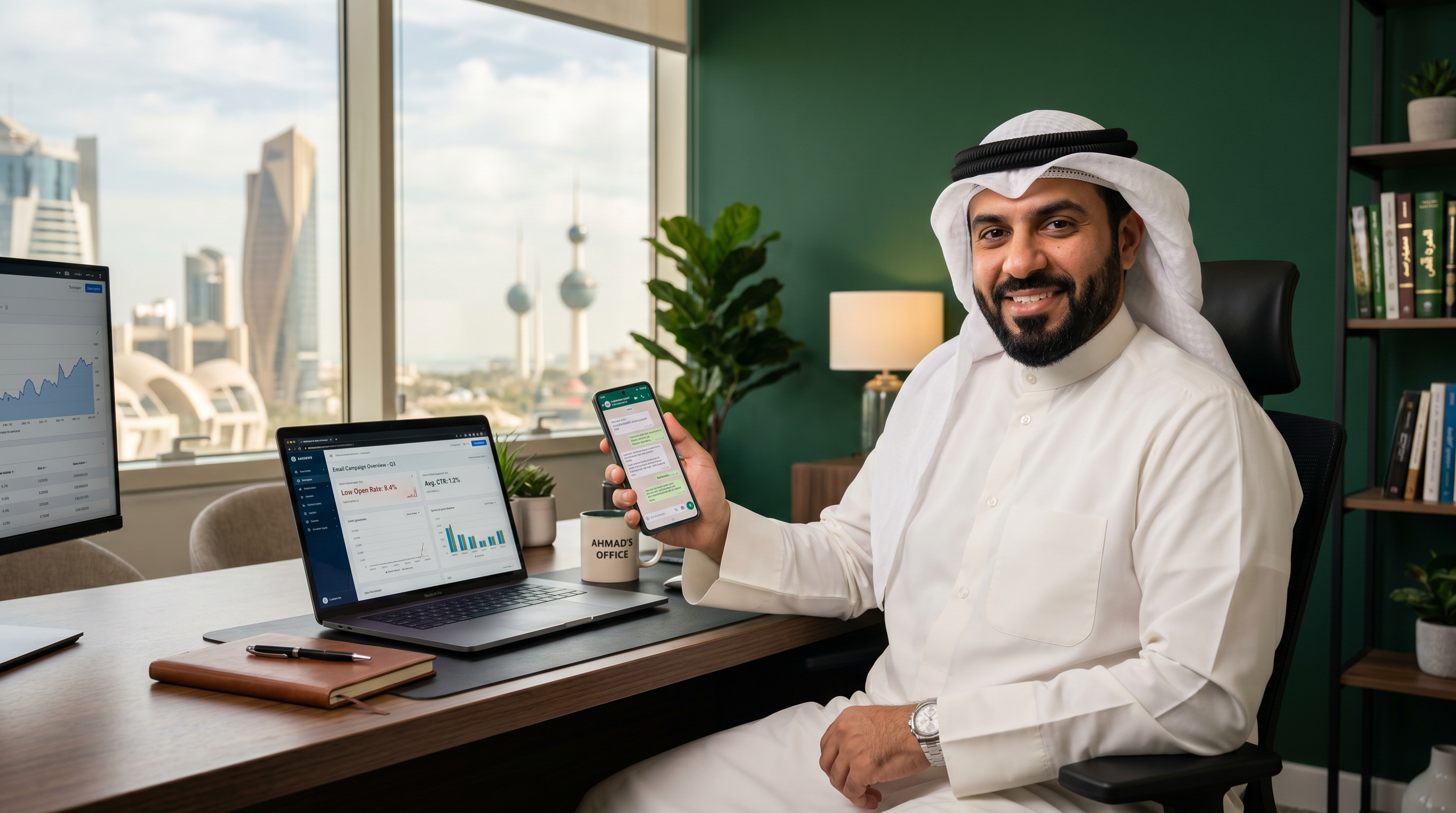
Kuwait has a smartphone penetration rate of 97.8% (GSMA 2025), and WhatsApp is the dominant communication layer across the country — not just socially, but commercially. A Salmiya-based client told us their email open rate sat at 18% for two years. Their WhatsApp broadcast open rate on day one: 94%. That gap is not unusual. It is the GCC baseline.
After running 35+ WhatsApp AI deployments across Kuwait and the GCC, we've watched businesses pour budget into email newsletters that generate nothing, while a single well-timed WhatsApp message closes a KD 3,000 sale on a Saturday night. The question isn't which channel is "better" in theory. The question is which channel matches how Gulf consumers actually behave — and then how to build a system around that reality.
What WhatsApp Marketing Actually Is (vs. What People Think)
Most Kuwait business owners think WhatsApp marketing means sending bulk messages from a regular SIM card. That is not WhatsApp marketing. That is a Terms of Service violation that gets your number banned within 30 days.
Real WhatsApp marketing runs through the WhatsApp Business API — a Meta-authorized infrastructure layer that lets businesses send approved message templates, run two-way conversations at scale, integrate with CRMs, and deploy AI agents that respond in under 3 seconds, 24/7. KIRA is a Meta-verified Solution Provider, which means we deploy this infrastructure directly for clients without third-party bottlenecks.
Email marketing, by contrast, is a one-to-many broadcast tool. You push content into an inbox. The reader decides whether to open it, usually hours or days later — if at all. There is no real-time conversation. There is no read receipt. There is no reply expectation.
The most common misconception is treating both channels as equivalent "digital marketing" tactics. They operate on entirely different psychological contracts. Email is a letter. WhatsApp is a conversation. Gulf consumers respond to conversations.
How WhatsApp and Email Compare Across Every Key Metric
Here is the side-by-side breakdown that matters for Kuwait and GCC market conditions specifically. These figures draw from Meta's 2025 Business Messaging Report and aggregated performance data from campaigns KIRA has managed across Kuwait, KSA, and UAE.
| Metric | WhatsApp (GCC) | Email (GCC) | Why It Matters |
|---|---|---|---|
| Average Open Rate | 94–98% | 18–22% | Gulf users check WhatsApp 23x per day on average (Meta MENA 2025) |
| Median Response Time | Under 3 minutes | 24–72 hours | Speed of first response is the #1 predictor of lead conversion |
| Click-Through Rate | 45–60% | 2.1–3.5% | WhatsApp CTAs sit inside a trusted conversation thread |
| Lead-to-Sale Conversion | 4–6x higher | Baseline | Based on KIRA campaigns across Kuwait retail and services sectors |
| Arabic Language Support | Native, RTL rendering | Depends on email client/template | Gulf Arabic formatting breaks in 40% of email clients (Litmus 2025) |
| Spam Filter Risk | None (opted-in API) | High — 45% of commercial email hits spam (Validity 2025) | Deliverability is not guaranteed with email at scale |
| Two-Way Conversation | Yes — real-time | No — asynchronous at best | Objection handling happens in WhatsApp, not email |
| Payment Integration | Tap Payments, KNET inline | Redirect to external page | Fewer friction points = higher completion rate |
The Tap Payments integration point is worth pausing on. When a Kuwait customer receives a WhatsApp message with a payment link that uses KNET or a local card gateway directly inside the thread, the checkout drop-off rate drops sharply. Email requires the user to click, load a browser, navigate a site, and trust a payment page. That is four additional friction points. Most Gulf consumers abandon before step three.
Why This Comparison Hits Differently for Kuwait and GCC Businesses
Gulf market behavior does not mirror Western consumer patterns. In the UK or US, email retains meaningful commercial weight because consumers grew up with inbox culture. In Kuwait, the inbox is for bank statements and HR notifications. Commercial relationships happen on WhatsApp.
Kuwait has one of the highest per-capita social media usage rates in the world. According to DataReportal's 2025 Kuwait Digital Report, the average Kuwaiti spends 3 hours 12 minutes per day on social and messaging platforms. WhatsApp accounts for the largest share of that messaging time. Email accounts for roughly 11 minutes per day — and most of that is reading, not acting.
There is also a cultural dimension that marketers underestimate. Gulf consumers expect responsiveness. If a business takes 6 hours to reply to an inquiry, the lead has already messaged three competitors. The Lojain AI agent was built specifically for this: it responds in under 3 seconds, handles pricing objections in Gulf Arabic and English, negotiates, follows up, escalates to a human when needed, and never sleeps. That is not a chatbot. It is a fully operational AI agent running 24/7 on your WhatsApp line.
Email cannot do any of that. An autoresponder that says "Thanks for your message, we'll reply within 24 hours" is not a conversion tool. It is a customer exit ramp.
Two Real GCC Examples: One That Worked, One That Burned Budget
Example 1: Mishref Medical Clinic — WhatsApp AI Converts 67% of Inquiries
A private medical clinic in Mishref, Kuwait was running email newsletters to a 4,200-subscriber list and converting roughly 3% of newsletter readers into booked appointments. Open rate sat at 19%. They spent approximately KD 180/month on their email platform and a copywriter for the newsletter content.
We deployed the Lojain AI agent for their clinic via WhatsApp Business API in February 2025. Within 60 days, their inbound WhatsApp inquiries converted at 67% to confirmed bookings. The AI handled appointment questions, insurance queries, and doctor availability — in Arabic and English — around the clock. The clinic's front desk team dropped from handling 140+ calls per day to under 40. You can review similar results in our case studies.
They did not abandon email entirely. They kept it for post-visit follow-ups and long-form health content. But they stopped treating it as a conversion channel. The right tool did the right job.
Example 2: Hawalli Retail Brand — Email Dependency Cost Them a Season
A fashion retail brand in Hawalli ran their entire Eid 2024 campaign through email. They had a list of 11,000 subscribers and an agency that sent three promotional emails over two weeks. The campaign generated a 17% open rate, 2.4% click rate, and KD 2,100 in attributed sales — against a KD 600 campaign spend.
At the same time, a competitor with a smaller audience of 3,800 WhatsApp contacts ran a single broadcast via the API, followed by a two-message automated sequence handling size queries and payment options via Lojain AI. Their attributed sales from that campaign: KD 14,800 in 11 days. Same Eid window. Smaller audience. Different channel entirely.
The Hawalli brand came to us after Eid. We migrated their primary conversion activity to WhatsApp API and restructured email as a content and retention tool. Their next campaign, for the Back to School period, generated 9.2x the revenue of the previous Eid campaign from a WhatsApp list that was still smaller than their email list.
Should You Use WhatsApp, Email, or Both? A Decision Framework
The honest answer for most Kuwait and GCC businesses: use both, but never confuse their roles. WhatsApp converts. Email nurtures over time. The mistake is assigning conversion goals to email or using WhatsApp only for broadcasting without enabling two-way conversation.
| Use WhatsApp API If... | Use Email If... | Use Both If... |
|---|---|---|
| You need leads to convert within 24 hours | You send long-form content (reports, invoices, contracts) | You have a full-funnel strategy and separate KPIs per channel |
| Your audience is primarily Gulf Arabic speaking | Your audience checks email professionally (B2B, corporate) | You run both consumer and B2B segments |
| You operate in F&B, retail, clinics, or real estate | You need a compliance paper trail (healthcare, finance) | You want email for retention and WhatsApp for acquisition |
| Your team cannot respond to leads within 2 hours | Your subscribers opted in specifically for email updates | Your customer lifetime value justifies multi-channel management |
| You run time-sensitive offers (Eid, National Day, Ramadan) | You send monthly statements or renewal reminders | You have a dedicated marketing team or agency partner |
| You want to handle objections and close inside one thread | Your audience is outside the GCC and in an email-primary market | You're scaling from startup to mid-market and building both lists simultaneously |
For restaurants, the decision is almost always WhatsApp-first. A customer who searches for a reservation option at 10pm on a Friday does not want to send an email. They want a confirmed reply in 90 seconds. Our F&B deployment framework is built around exactly that window. Real estate operates similarly: a lead asking about a property in Sabah Al Salem at 11pm is a hot lead. By morning, they have messaged six other agents. The Lojain AI deployment for real estate handles that lead before any human wakes up.
If you are evaluating platforms and wondering how KIRA's approach compares to other tools in the market, the Wati vs. Lojain comparison lays out the functional differences clearly. The short version: Wati is a software tool. Lojain is a managed AI agent. The difference shows in outcomes, not feature lists.
For SMBs in Kuwait who want WhatsApp API without the enterprise overhead, the Lojain Lite bundle is the entry point. It gives you API access, the AI agent, and the infrastructure without requiring a full-scale deployment. See pricing details here for current structure.
Frequently Asked Questions
Is WhatsApp marketing legal in Kuwait?
Yes, when conducted through the official WhatsApp Business API and with proper opt-in consent from recipients. Sending bulk messages through regular WhatsApp numbers or unofficial tools violates Meta's terms and Kuwait's Communication and Information Technology Regulatory Authority (CITRA) guidelines on unsolicited commercial messages. API-based marketing with consent is fully compliant.
What open rate can a Kuwait business realistically expect from WhatsApp broadcasts?
Based on campaigns we've managed for Kuwait retail and services clients, WhatsApp broadcast open rates consistently land between 88% and 97% within the first 2 hours of delivery. This compares to a GCC email average of 18–22% over 48 hours. The gap is structural: WhatsApp messages trigger a push notification on a device users check 23 times per day.
Can WhatsApp API messages be sent in Gulf Arabic?
Yes. The WhatsApp Business API supports full right-to-left Arabic rendering, including Gulf dialect. Lojain AI handles both Gulf Arabic and English within the same conversation thread, switching based on the customer's language. This is a meaningful advantage over most email marketing platforms, where Arabic formatting breaks in a significant percentage of email clients.
How does WhatsApp conversion compare to email for Ramadan campaigns in Kuwait?
Ramadan is the highest-stakes commercial period in Kuwait. Based on campaigns run across multiple Kuwait retail and F&B clients during Ramadan 2025, WhatsApp broadcast campaigns with follow-up AI sequences generated 5–8x the revenue of equivalent email campaigns sent to lists of similar size. Time-sensitivity during Ramadan amplifies WhatsApp's natural advantage: consumers are active late at night, checking messages, and ready to purchase when a relevant offer arrives in a live conversation thread.
Do I need to replace my email list to start WhatsApp marketing?
No. The highest-performing Kuwait businesses run both channels with distinct roles. Email handles long-form content, post-purchase follow-up, and B2B communication. WhatsApp handles lead conversion, appointment booking, objection handling, and time-sensitive offers. Building a WhatsApp contact list while maintaining your email list is the correct move, not a channel swap.
What is the minimum contact list size to make WhatsApp API worth it for a Kuwait SMB?
There is no minimum that makes the API "not worth it" — the conversion rate advantage applies even at 200 contacts. However, businesses with fewer than 500 active contacts typically see the fastest ROI because the AI agent handles what would otherwise require 1–2 full-time staff members responding manually. The Lojain Lite bundle is structured specifically for this stage of business.
Can WhatsApp handle payment collection for Kuwait businesses?
Yes. Through API integrations with Tap Payments and KNET, Kuwait businesses can send payment links directly inside a WhatsApp conversation thread. The customer pays without leaving the app. This reduces checkout abandonment compared to email-based payment flows, which require the customer to click through to a browser, navigate a website, and complete a separate checkout process.
Talk to Us on WhatsAppReady to Scale Your Marketing with AI?
KIRA delivers AI-powered marketing systems, WhatsApp automation, and media buying strategies for businesses worldwide.
Book a Strategy Call More ArticlesGet KIRA in your AI answers
Add KIRA as a Google Preferred Source so our articles show a "Preferred" badge in your AI Overviews & AI Mode results. Log in to Google, then tick the box next to kiraco.org.
Add KIRA as a Preferred Source