Quick Answer: A WhatsApp bot follows fixed scripts and breaks when customers go off-menu. A WhatsApp AI agent understands context, handles Arabic and English, negotiates pricing, resolves complaints, and follows up — all without a human. Kuwait businesses using AI agents like Lojain report response times under 3 seconds, 24/7, compared to the GCC average of 4–11 hours for human-staffed teams.
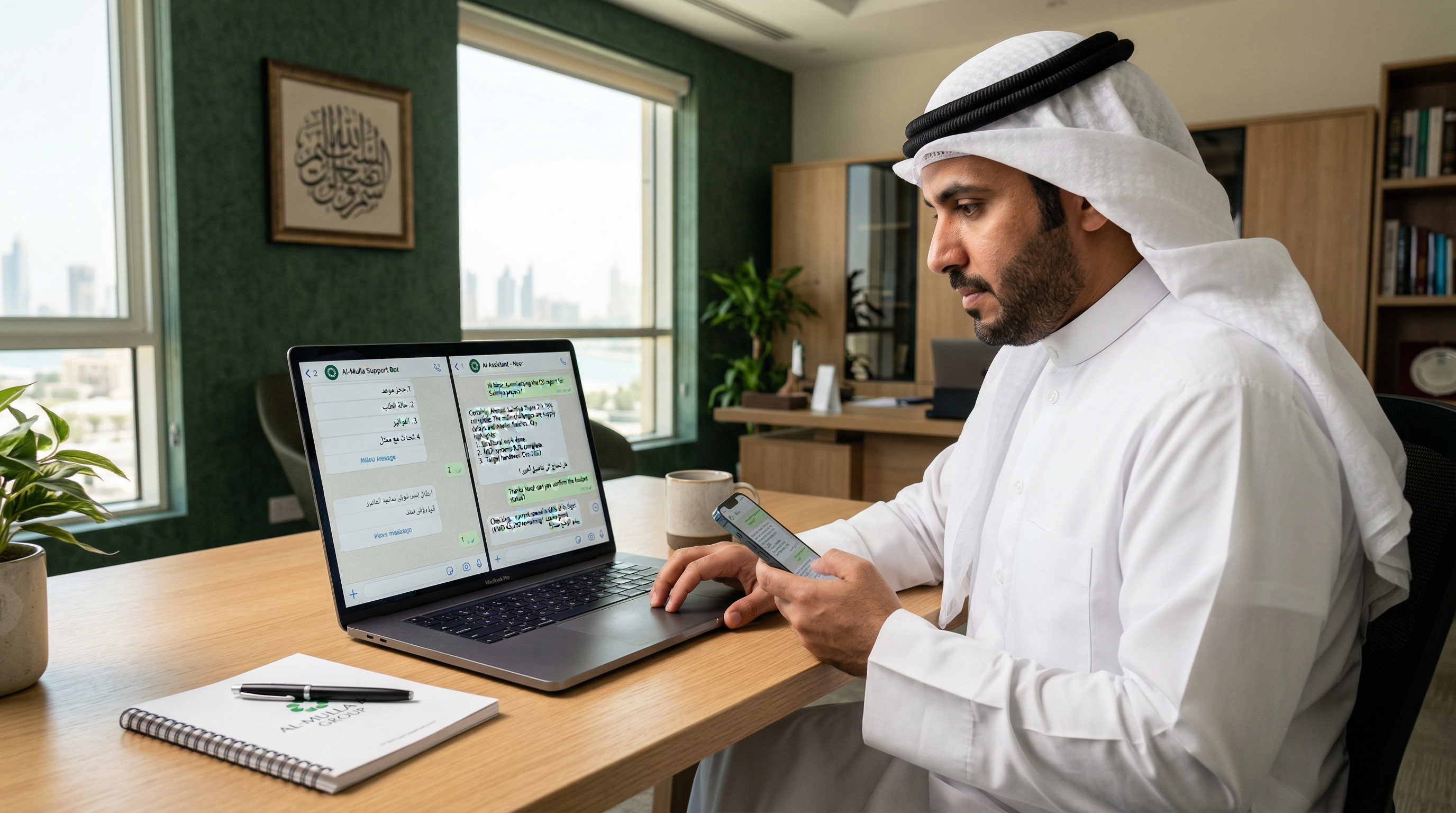
A Rumaithiya medical clinic tracked this for 90 days: their WhatsApp bot answered 61% of inbound messages correctly. The other 39% either got a generic fallback response or dropped completely. That 39% was mostly warm leads asking specific questions about package pricing and appointment availability. They switched to a WhatsApp AI agent in Q4 2024. Lead capture went from 61% to 94% within 45 days. The difference was not the platform — it was the intelligence layer sitting on top of it.
This article breaks down exactly what separates a bot from an AI agent, why it matters specifically for Kuwait buyers who expect fast, personal Arabic responses, and how to know which one your business actually needs.
What is a WhatsApp bot and how does it actually work?
A WhatsApp bot is a rule-based system. Someone builds a decision tree: if the customer says X, reply with Y. If they say Z, send them to menu option 3. The logic is linear and the bot can only respond to what it has been pre-programmed to handle.
Bots work fine for narrow, predictable use cases: sending order confirmations, sharing a PDF menu, answering "what are your opening hours". They break the moment a customer types something unexpected — which is most of the time in Kuwait, where customers mix Arabic and English in a single sentence, use Gulf slang, and ask layered questions like "is there a discount if I book two sessions and pay cash today?"
A bot reads that question and either sends a fallback message ("Sorry, I didn't understand. Please choose from the menu below") or routes to a human who may or may not respond within the hour. Either way, the moment is lost.
What is a WhatsApp AI agent and how is it different?
A WhatsApp AI agent does not follow a script. It understands intent. It reads the customer's full message, identifies what they want, pulls relevant information from your business context, and responds in natural language — in Arabic, English, or Gulf Arabic dialect.
After running 35+ WhatsApp AI deployments across Kuwait and GCC markets, we see the same pattern every time: the biggest conversion gains do not come from faster replies alone. They come from the AI agent's ability to handle objections in real time. When a customer says "your competitor is cheaper," the AI agent does not panic or route to a human. It responds with your value proposition, offers a relevant comparison, or surfaces a promotion — immediately, at 2am on a Friday.
This is why we do not call Lojain AI a chatbot. Lojain AI is a WhatsApp AI agent built specifically for GCC businesses. It handles pricing objections, complaint escalation, multi-step follow-up sequences, and lead qualification — in Gulf Arabic and English, 24/7, without a human in the loop for standard interactions.
WhatsApp bot vs AI agent: side-by-side comparison for Kuwait businesses
| Feature | WhatsApp Bot | WhatsApp AI Agent (Lojain) |
|---|---|---|
| Response logic | Fixed decision tree | Intent-based, contextual |
| Arabic support | Basic or none | Gulf Arabic + English, mixed sentences |
| Handles price objections | No | Yes — trained on your pricing logic |
| Complaint resolution | Escalates everything | Resolves standard complaints, escalates complex ones |
| Follow-up sequences | None or manual | Automated, multi-step, timed |
| Lead qualification | Basic keyword matching | Conversational, multi-turn |
| Average response time | Instant for scripted paths, fails off-script | Under 3 seconds, any message type |
| Tap Payments / payment link integration | Rarely supported | Yes — sends payment links in conversation |
| Meta Solution Provider required | Not always | Yes — KIRA is Meta-verified |
| Best for | Simple FAQs, order notifications | Sales, service, retention, full customer journey |
Why Kuwait customers specifically reject bot experiences
Kuwait buyers have high expectations for responsiveness. A 2023 Meta GCC Commerce report found that 78% of Gulf consumers expect a response to a WhatsApp inquiry within 10 minutes. If they do not get one — or they get a generic bot message — 54% move to a competitor without telling you.
Gulf Arabic is also not a single dialect. Kuwaiti customers write in a mix of formal Arabic, Kuwaiti colloquial, transliterated Arabic in Latin script, and English. A standard bot trained on Modern Standard Arabic will misread most of these messages. An AI agent trained on Gulf Arabic patterns handles them correctly.
There is also a negotiation culture factor. Kuwait customers frequently ask for discounts, test prices, or request custom packages before they buy. A bot cannot negotiate. An AI agent can — and for businesses running on the WhatsApp Business API, this is the difference between a conversation that converts and one that goes silent.
Real Kuwait results: bot vs AI agent in practice
A Salmiya beauty salon had been running a WhatsApp bot for 14 months before they contacted us. Their bot handled appointment bookings through a fixed menu and pushed a weekly broadcast. Conversion from WhatsApp inquiry to booked appointment sat at 28%. Average response to off-script questions was 3.5 hours because those fell through to a human team member who handled WhatsApp part-time.
We deployed Lojain AI in October 2024. Within 60 days, their WhatsApp-to-booking conversion rate reached 61%. The AI agent handled Arabic price negotiation for combo packages, sent automatic follow-ups to customers who asked about pricing but did not book, and escalated only genuine complaints to the salon manager. The human team's WhatsApp workload dropped by 70%. You can review similar outcomes in our case studies.
A second example: a Mishref F&B chain with three locations was using a bot to handle delivery inquiries. The bot could confirm order status but could not handle complaints about wrong orders, cold food, or missing items. These complaints averaged 23 per week, each requiring a human to step in. After switching to an AI agent, complaint resolution that previously needed human intervention dropped to 4 per week — the AI handled refund offers, replacement scheduling, and apology messages within the conversation. Customer satisfaction scores (tracked via post-conversation survey) went from 3.1 to 4.4 out of 5 in 45 days. For more on what this looks like in F&B specifically, see our restaurant solutions page.
How to switch from a WhatsApp bot to an AI agent: step-by-step
- Audit your current bot conversations. Pull 30 days of chat logs. Tag every message that received a fallback response or was escalated to a human. That volume is your AI agent opportunity size.
- Map your top 10 objections and questions. In Kuwait F&B, retail, clinics, and real estate, these are almost always: price, availability, comparison to competitors, complaint handling, and payment options. Document the ideal response to each.
- Verify your WhatsApp Business API access. AI agents run on the WhatsApp Business API, not the standard WhatsApp Business app. If you are not currently on the API, your deployment partner needs to be a Meta-verified Solution Provider. KIRA holds that verification.
- Build your AI agent knowledge base. This includes your product catalog, pricing logic, complaint resolution policies, escalation triggers, and any promotions. The more specific the input, the more accurate the agent output.
- Configure Gulf Arabic language rules. Set the agent to detect Kuwaiti dialect, mixed-language messages, and transliterated Arabic. Test with real sample conversations from your old bot logs.
- Run a parallel test for 2 weeks. Route a portion of new inquiries through the AI agent while keeping your bot live for existing threads. Compare response accuracy, conversion rate, and escalation volume.
- Go live and set escalation thresholds. Define which situations the AI agent escalates to a human — typically: legal complaints, high-value custom orders above a set threshold, and repeat unresolved issues. Everything else, the agent handles.
Does your Kuwait business need a bot or an AI agent?
Not every business needs an AI agent. If your WhatsApp use is purely transactional — order confirmations, delivery tracking, static FAQ replies — a well-built bot may be sufficient. The cost and setup time is lower.
If your WhatsApp channel is where you close sales, handle service issues, negotiate prices, or retain customers, a bot will actively cost you money in lost leads. The Rumaithiya clinic example at the start of this article is not unusual. We see that 30–40% lead drop rate consistently across Kuwait SMBs running basic bots on high-intent traffic.
For clinics specifically, the stakes are higher. Patients asking about procedures, pricing, and doctor availability need accurate, empathetic responses — not menu options. Our clinic-specific solution addresses exactly this use case. For smaller businesses that want AI agent capability without enterprise setup, the Lojain Lite bundle is built for that entry point.
What to look for in a WhatsApp AI agent provider in Kuwait
Four things matter when you are evaluating providers in the Kuwait market. First: are they a Meta-verified Solution Provider? This is not a marketing claim — it is a verified status that determines what API features you can access. KIRA is Meta-verified. Many local resellers are not.
Second: do they have Gulf Arabic training data? An AI agent trained primarily on English or Egyptian Arabic will perform poorly with Kuwaiti customers. Ask for proof of dialect coverage before signing.
Third: can they integrate with your existing payment stack? In Kuwait, Tap Payments is the dominant gateway. Your AI agent should be able to send Tap payment links inside the WhatsApp conversation to close sales without redirecting the customer to a separate browser session.
Fourth: what does escalation look like? The best AI agents know their limits. An agent that tries to handle everything — including genuine legal complaints or distressed customers — will cause more damage than a bot. Ask to see the escalation logic before deployment.
If you want to see how Lojain AI compares to other platforms in the market, the Wati vs Lojain comparison covers the technical and commercial differences in detail.
FAQ: WhatsApp bot vs AI agent in Kuwait
What is the difference between a WhatsApp chatbot and a WhatsApp AI agent?
A WhatsApp chatbot follows a pre-built script and can only respond to inputs it was programmed to handle. A WhatsApp AI agent understands natural language, interprets customer intent, handles objections, and responds accurately to messages it has never seen before. For Kuwait businesses, the AI agent handles Gulf Arabic, mixed-language messages, and real-time price negotiations.
Can a WhatsApp bot handle Arabic conversations in Kuwait?
Basic bots can handle Modern Standard Arabic if it is explicitly programmed. They typically fail with Kuwaiti dialect, transliterated Arabic written in Latin characters, and mixed Arabic-English sentences. An AI agent trained on Gulf Arabic handles all three accurately.
How much does a WhatsApp AI agent cost in Kuwait compared to a bot?
Bot solutions are generally lower in upfront cost but generate hidden losses through unqualified leads, missed sales, and human escalation overhead. AI agent pricing depends on message volume, business size, and features required. For current options, visit the KIRA pricing page or contact us directly for a quote based on your actual message volume.
Do I need the WhatsApp Business API to use an AI agent in Kuwait?
Yes. AI agents require the WhatsApp Business API, not the standard WhatsApp Business app. The API provides the infrastructure for multi-agent handling, automation, and analytics. You need to work with a Meta-verified Solution Provider to access the API — KIRA holds that verification for Kuwait and GCC clients.
How long does it take to deploy a WhatsApp AI agent in Kuwait?
A standard deployment for a Kuwait SMB typically takes 2–3 weeks from kickoff to live. This includes API verification, knowledge base build, Gulf Arabic configuration, and parallel testing. Larger deployments with complex escalation flows or multi-location setups take 4–6 weeks.
What types of Kuwait businesses benefit most from a WhatsApp AI agent?
The highest ROI deployments we see are in clinics, salons, F&B chains, real estate agencies, and retail brands with active WhatsApp sales channels. Any business where WhatsApp is a primary lead or service channel — and where staff are spending more than 2 hours per day on repetitive WhatsApp replies — is a strong candidate for an AI agent.
Can a WhatsApp AI agent send payment links to Kuwait customers?
Yes. When integrated with Tap Payments, a WhatsApp AI agent can send payment links directly inside the conversation — after confirming an order, booking, or service package. The customer pays without leaving WhatsApp. This removes one of the biggest friction points in GCC e-commerce conversion.
If you want to know whether your current WhatsApp setup is costing you leads, send us your monthly WhatsApp inquiry volume and we will give you a direct assessment — no pitch deck.
Talk to Us on WhatsAppReady to Scale Your Marketing with AI?
KIRA delivers AI-powered marketing systems, WhatsApp automation, and media buying strategies for businesses worldwide.
Book a Strategy Call More ArticlesGet KIRA in your AI answers
Add KIRA as a Google Preferred Source so our articles show a "Preferred" badge in your AI Overviews & AI Mode results. Log in to Google, then tick the box next to kiraco.org.
Add KIRA as a Preferred Source