Quick Answer: WhatsApp automation for Kuwait businesses means using the official WhatsApp Business API — through a Meta-verified Solution Provider like KIRA — to auto-respond, qualify leads, handle complaints, and follow up 24/7 without adding headcount. Kuwait businesses using this system typically see response times drop from hours to under 3 seconds and lead conversion rates climb 30–50% within the first 90 days.
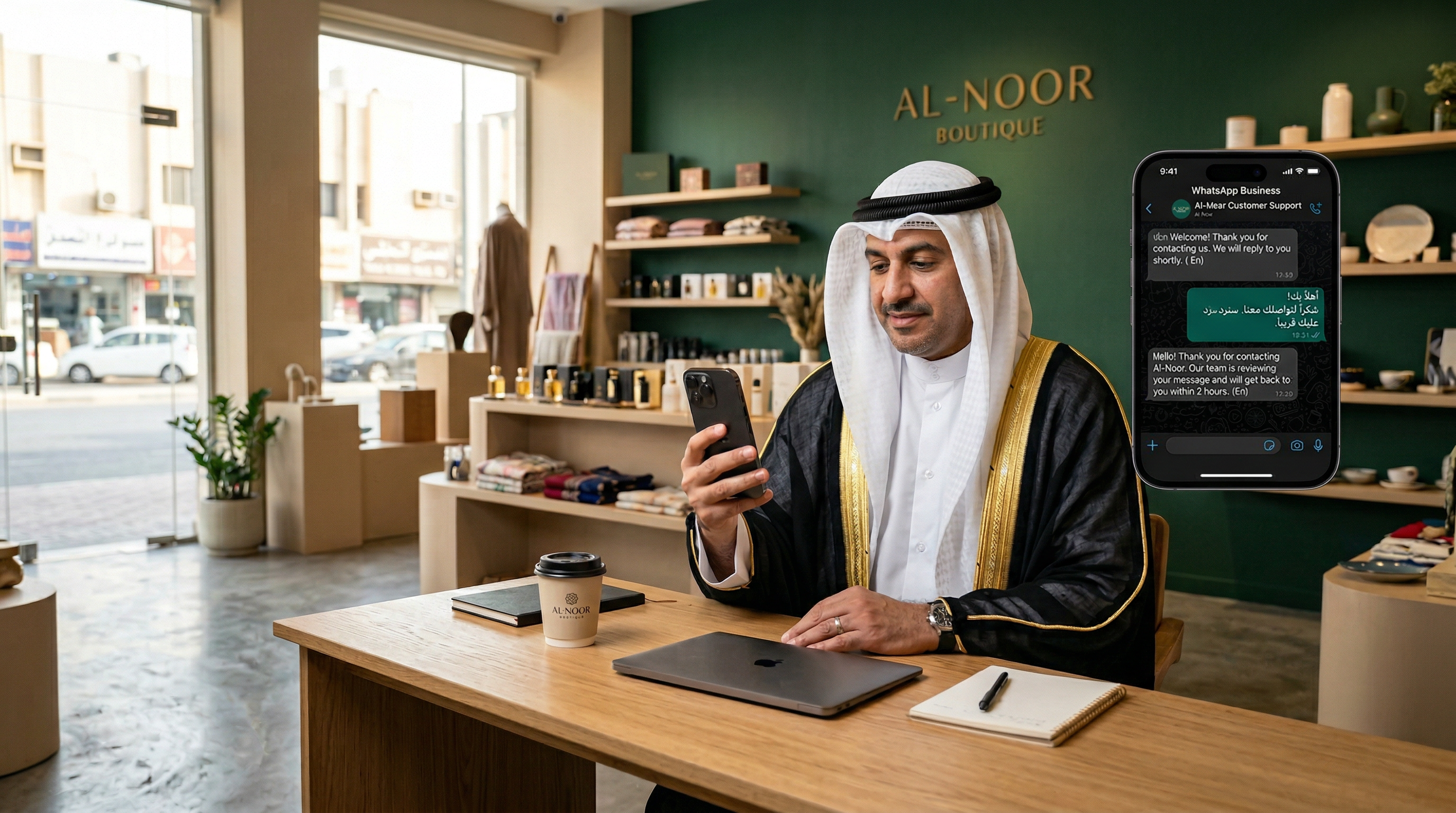
Kuwait has an 89% WhatsApp penetration rate among smartphone users — one of the highest in the GCC (Meta GCC Market Report, 2024). That means when a customer wants to book, buy, or complain, they open WhatsApp first. They do not email. They do not call. And when your business takes 4 hours to reply, they have already messaged your competitor. After running 35+ WhatsApp AI deployments across Kuwait and GCC, the pattern is consistent: slow replies kill revenue, and automation fixes that without hiring a single extra person.
What Is WhatsApp Automation and How Does It Work for Kuwait Businesses?
WhatsApp automation is not an auto-reply message you set up in the regular WhatsApp Business app. That tool is for sole traders with low volume. Real automation runs through the WhatsApp Business API — a back-end connection that lets you attach AI agents, CRM systems, and workflow logic to your business number.
The API gives your number the ability to send and receive structured messages, trigger flows based on customer responses, segment contacts by behavior, and escalate to a human agent when needed. KIRA is a Meta-verified Solution Provider in Kuwait, which means we access the API directly through Meta's official partner program — not through a reseller chain that adds cost and latency.
The key distinction: a basic chatbot follows a script. An AI agent like Lojain AI reads context, handles pricing objections, negotiates, manages complaints, and follows up in Gulf Arabic and English — at 3 a.m. on a Friday. That is the operational difference between automation that frustrates customers and automation that closes deals.
Why Kuwait Businesses Specifically Need WhatsApp Automation Now
WhatsApp's message category pricing structure — introduced in mid-2023 and updated through 2024 — changed the economics of WhatsApp marketing in the GCC. Messages now fall into four buckets: utility, authentication, marketing, and service. Each carries a different cost per conversation. Kuwait businesses that send unstructured broadcast blasts are now paying marketing-tier rates for messages that could qualify as lower-cost utility or service conversations.
Smart automation routes message types correctly, keeps you in the cheaper conversation categories where appropriate, and ensures your marketing messages only trigger when there is genuine intent. Businesses that ignore this are overpaying by 30–60% on their WhatsApp messaging costs, based on account audits we have run for Kuwait retail and clinic clients.
There is also a staffing reality. Hiring a customer service rep in Kuwait costs between KD 250–450 per month for entry-level, plus benefits, NSSF contributions, and management overhead. A fully deployed WhatsApp AI agent handles the equivalent workload of 3–4 staff members at a fraction of that cost — and it never calls in sick before a public holiday.
What Is the Best WhatsApp Business API Provider in Kuwait?
The Kuwait market has several players: DoubleTick, Kait, Al-Mulla Media, and newer entrants from UAE and KSA. The right question is not who is the biggest — it is who provides the API with local support, Gulf Arabic AI capability, and integration with Kuwait-specific payment infrastructure like Tap Payments and KNET.
| Provider | Meta-Verified | Gulf Arabic AI | Kuwait Payment Integration | Local Support (Kuwait) | AI Agent (not just chatbot) |
|---|---|---|---|---|---|
| KIRA (Lojain AI) | Yes | Yes — handles dialect | Tap Payments, KNET | Yes — Kuwait-based team | Yes |
| DoubleTick | Yes | Limited | No native Kuwait integration | No — India-based support | No — rule-based flows only |
| Kait | Yes | Basic | Partial | Kuwait presence, limited | No |
| Wati | Yes | No | No | No | No |
| Trengo | Yes | No | No | No | Partial |
If your customers write in Kuwaiti Arabic — and they do — you need a system that understands dialect, not just Modern Standard Arabic. See our full breakdown in the Wati vs Lojain comparison for a technical side-by-side.
How to Set Up WhatsApp Automation for Your Kuwait Business
- Audit your current WhatsApp volume. Count how many inbound messages your team handles daily. Categorize them: booking requests, product questions, complaints, payment follow-ups. This tells you exactly what to automate first.
- Apply for the WhatsApp Business API through a Meta-verified Solution Provider. Do not apply directly through Meta's self-serve portal if you need local support — the process is slower and you get no onboarding help. A verified provider like KIRA handles the business verification, number porting, and Meta approval within 3–7 business days for Kuwait-registered entities.
- Map your conversation flows before touching any software. Write out the 5–10 most common customer journeys in plain language. What does a new lead ask? What do existing customers complain about? What triggers a purchase decision? This is your AI training foundation.
- Configure your AI agent with Kuwait-specific context. Gulf Arabic dialect, local holidays (National Day, Eid, Gergian season), local payment options (Tap Payments, KNET, MyFatoorah), and Kuwait delivery zone logic all need to be built into the agent — not added later.
- Connect your existing systems. WhatsApp automation is most powerful when it pulls from your CRM, checks your booking calendar, updates your order management system, and triggers your loyalty program. Standalone WhatsApp tools that do not integrate are a ceiling, not a solution.
- Run a 2-week parallel test. Keep one human agent handling conversations alongside the AI. Compare resolution time, customer satisfaction signals, and conversion rates. The data from this phase calibrates your AI's escalation triggers.
- Go live and monitor escalation rate weekly. A well-configured AI agent for a Kuwait business should escalate fewer than 15% of conversations to a human within 60 days. If your rate is higher, the flows need refinement — not more staff.
Real Kuwait Business Results: Two Case Studies
A Salmiya medical clinic running dermatology and aesthetic services was managing 200–300 WhatsApp inquiries per day with two reception staff. Average first response time was 2.5 hours. The clinic lost an estimated 40% of new patient inquiries to competitors before staff could respond. After deploying Lojain AI through KIRA's clinic automation program, first response dropped to under 3 seconds. The AI handled appointment booking, pre-consultation questions, and insurance pre-screening. Within 8 weeks, new patient bookings increased by 34%, and the two reception staff shifted entirely to in-clinic patient management. The clinic has not hired additional admin staff despite a 40% volume increase.
A Hawalli women's fashion retailer with both a physical store and an Instagram-driven ordering model had a specific problem: customers would DM on Instagram, get redirected to WhatsApp, and then wait 3–6 hours for a price or size confirmation. Cart abandonment on WhatsApp was estimated at 55%. After connecting their product catalog to Lojain AI and enabling instant WhatsApp responses with live inventory data, the abandonment rate dropped to 18% in the first month. The AI handled size queries, fabric questions, and delivery timeline objections in Gulf Arabic. Monthly WhatsApp-driven revenue increased by KD 4,200 in month two compared to pre-automation baseline. Total deployment time from brief to live: 11 days.
More verified results are available in our Kuwait and GCC case study archive.
WhatsApp Automation for Specific Kuwait Industries
The mechanics of WhatsApp automation are the same across sectors, but the conversation flows, compliance requirements, and integration points differ significantly by industry.
Restaurants and F&B: The high-volume, time-sensitive nature of food orders makes automation non-negotiable at scale. A Mishref F&B chain running 4 concepts out of one kitchen ghost model used WhatsApp automation to handle order intake, estimated delivery time updates, and reorder prompts. See our restaurant automation guide for the full flow architecture.
Real estate: Kuwait property inquiries have a long nurture cycle. Lojain AI qualifies leads by budget, location preference, and timeline — then routes only serious buyers to agents. This cut wasted agent time by 60% for one Rumaithiya-based brokerage. Our real estate automation page covers the lead scoring logic in detail.
Clinics and healthcare: HIPAA-equivalent data handling, appointment reminders, and no-show reduction are the primary use cases. The Salmiya case above is representative of what most private clinics achieve within 60 days.
SMBs and solo operators: Not every Kuwait business needs a full enterprise deployment. The Lojain Lite bundle gives smaller businesses API access, basic AI flows, and WhatsApp broadcast capability without the enterprise setup cost.
Common WhatsApp Automation Mistakes Kuwait Businesses Make
The first mistake is using the free WhatsApp Business app and calling it automation. That tool has no API access, no broadcast to non-saved contacts, and no AI capability. It is a starting point for micro-businesses, not a scalable system.
The second mistake is buying a WhatsApp tool and skipping the conversation design phase. Technology without mapped flows produces a broken customer experience. Customers hit dead ends, escalations spike, and the business concludes that automation does not work. The failure is always in the design, not the platform.
The third mistake is ignoring Gulf Arabic. If your AI agent responds to a Kuwaiti customer in formal Egyptian-dialect Arabic or stilted MSA, the customer notices immediately and trust drops. Dialect matching is not optional in Kuwait — it is table stakes for acceptance.
The fourth mistake is treating WhatsApp automation as a cost-cutting exercise instead of a revenue tool. The businesses that get the highest return use automation to respond faster, follow up more persistently, and recover abandoned leads — not just to reduce headcount.
How Much Does WhatsApp Automation Cost in Kuwait?
WhatsApp automation costs in Kuwait have two components: the platform or provider fee, and Meta's per-conversation charges. Meta's conversation pricing varies by message category — marketing conversations carry a higher rate than utility or service conversations. Kuwait falls under Meta's GCC pricing tier.
Beyond Meta's fees, provider pricing varies based on whether you need a basic broadcast tool, a flow builder, or a full AI agent deployment. KIRA's full pricing structure is available at kiraco.org/pricing — we do not bury costs in sales calls.
The ROI frame matters more than the cost number. If your business currently loses 30% of leads to slow response, and your average order value is KD 50, the math on automation pays out in weeks, not quarters.
Frequently Asked Questions: WhatsApp Automation Kuwait
Is WhatsApp Business API legal for businesses in Kuwait?
Yes. WhatsApp Business API is fully legal to use in Kuwait for business communications. Businesses must comply with Meta's Commerce Policy and ensure they have opt-in consent from customers before sending outbound marketing messages. There are no Communications and Information Technology Regulatory Authority (CITRA) restrictions specific to WhatsApp API use for standard commercial messaging.
Can WhatsApp automation handle Arabic conversations in Kuwait dialect?
Basic rule-based tools cannot — they respond in whatever language you hard-code. AI agents like Lojain AI are trained on Gulf Arabic including Kuwaiti dialect, which means they understand colloquial phrasing, respond naturally, and do not produce robotic MSA that customers immediately distrust. Dialect capability is one of the primary differentiators between providers in the Kuwait market.
How long does it take to deploy WhatsApp automation for a Kuwait business?
Meta API approval for a Kuwait-registered business typically takes 3–7 business days when processed through a Meta-verified Solution Provider. Full deployment — including AI flow configuration, CRM integration, and staff training — takes 10–21 days depending on business complexity. Simple deployments for single-location SMBs can go live in under 2 weeks.
What is the difference between WhatsApp Business app and WhatsApp Business API?
The WhatsApp Business app is a free mobile application designed for small businesses with low message volume. It has no broadcast capability to unsaved contacts, no API access, no AI integration, and only one active user at a time. The WhatsApp Business API is a back-end infrastructure connection that supports multiple simultaneous agents, AI automation, CRM integration, broadcast messaging to opted-in contacts, and advanced analytics. The API requires a registered business and a Meta-verified provider to access.
Can WhatsApp automation integrate with Kuwait payment platforms like KNET or Tap Payments?
Yes, when built correctly. KIRA's Lojain AI deployments include native integration with Tap Payments and can trigger KNET payment links within a WhatsApp conversation. This means a customer can receive a payment request, complete the transaction, and get a confirmation — all inside WhatsApp without leaving the app. This flow reduces payment drop-off significantly compared to directing customers to external checkout pages.
What types of messages can I send with WhatsApp automation in Kuwait?
WhatsApp API messages fall into four Meta-defined categories: marketing (promotions, offers), utility (order updates, booking confirmations), authentication (OTPs), and service (customer-initiated conversations you respond to within 24 hours). Each has different pricing. Marketing messages require explicit opt-in. Service conversations, where the customer initiates, carry the lowest cost and have the most flexible content rules within the 24-hour window.
How do I measure the ROI of WhatsApp automation for my Kuwait business?
Track four numbers: first response time (before vs. after), lead-to-conversion rate on WhatsApp-originated inquiries, volume of conversations handled without human intervention, and monthly revenue attributed to WhatsApp-originated orders. Most Kuwait businesses running Lojain AI see measurable shifts in all four within 30 days. Set your baseline in week one and review weekly for the first 60 days.
If your Kuwait business is still relying on manual WhatsApp replies, you are losing leads every hour your team is offline. The fix is not hiring more staff — it is building a system that works while you sleep.
Talk to Us on WhatsAppReady to Scale Your Marketing with AI?
KIRA delivers AI-powered marketing systems, WhatsApp automation, and media buying strategies for businesses worldwide.
Book a Strategy Call More ArticlesGet KIRA in your AI answers
Add KIRA as a Google Preferred Source so our articles show a "Preferred" badge in your AI Overviews & AI Mode results. Log in to Google, then tick the box next to kiraco.org.
Add KIRA as a Preferred Source