Quick Answer: WhatsApp automation for clinics in Kuwait uses an AI agent connected to the WhatsApp Business API to handle appointment bookings, reminders, FAQs, and follow-ups 24/7 — responding in under 3 seconds without a human receptionist. Kuwait clinics report 40–70% reductions in missed leads and front-desk call volume within the first 60 days of deployment.
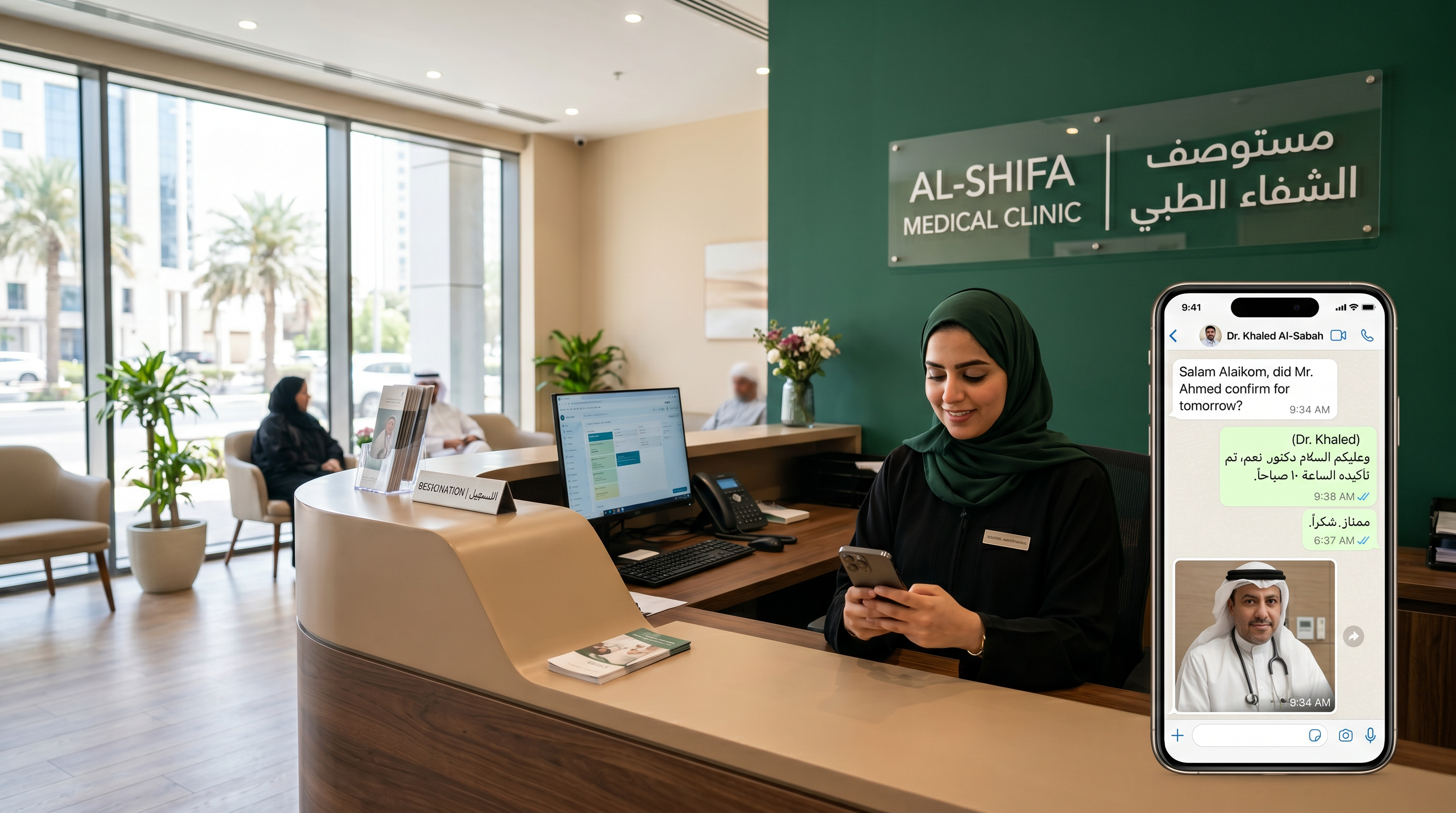
A dermatology clinic in Salmiya was losing an estimated 30 new patient inquiries every week. Not because the service was bad. Because the receptionist finished her shift at 5 PM and WhatsApp messages sent after hours sat unread until morning — by which time the patient had already booked with a competitor two blocks away. The clinic owner didn't have a staff problem. She had a response-time problem. WhatsApp automation fixed it in 11 days.
That scenario plays out across Kuwait's private healthcare sector daily. A 2023 survey by the Arab Social Media Report found that 73% of Gulf consumers prefer WhatsApp over phone calls for service inquiries. For clinics, that preference has a direct revenue implication: the first provider to respond wins the booking. If your first response takes 4 hours, you are not competing.
What WhatsApp Automation Actually Is (vs. What Clinic Owners Think)
Most clinic managers hear "WhatsApp automation" and picture a rigid menu — press 1 for appointments, press 2 for directions. That is a keyword-response system from 2018. It breaks the moment a patient types something outside the script, which they always do.
What modern WhatsApp automation actually refers to is an AI agent connected to the WhatsApp Business API, a Meta-verified infrastructure layer that allows high-volume, structured messaging without the limitations of a standard WhatsApp Business app. The AI agent reads natural language, understands intent in both Arabic and English, and responds the way a trained human receptionist would — except it works at 2 AM on a Friday and handles 40 conversations simultaneously.
The distinction matters because clinics that deploy basic chatbots often report poor results and conclude "automation doesn't work for healthcare." It works. Keyword menus don't. An AI agent like Lojain AI handles pricing objections, explains procedures, escalates to a human doctor when clinical questions arise, and closes the appointment booking — all within a single conversation thread.
KIRA is a Meta-verified Solution Provider. That status means the WhatsApp Business API connections we deploy operate under Meta's official partner infrastructure — higher message limits, verified sender badges, and broadcast capabilities that standard accounts cannot access.
How WhatsApp Automation Works for a Kuwait Clinic
| Component | What It Does | Kuwait Clinic Example |
|---|---|---|
| WhatsApp Business API Connection | Connects the clinic's WhatsApp number to an official Meta-verified infrastructure, enabling automation, CRM integration, and multi-agent access | A Rumaithiya dental clinic routes all incoming messages through one number, visible to the receptionist and the AI agent simultaneously |
| AI Agent (Natural Language) | Reads patient messages in Arabic or English, identifies intent, and responds appropriately — booking, FAQ, pricing inquiry, complaint | A patient types "كم سعر تنظيف الأسنان" at 11 PM — the agent replies with the service details and offers to book the next available slot |
| Appointment Logic + Calendar Sync | Checks real-time availability, confirms slots, and sends reminders 24 hours and 2 hours before the appointment | A physiotherapy clinic in Jabriya reduced no-shows by 38% after activating automated day-before reminders |
| Escalation Protocol | Detects clinical questions, emotional distress signals, or high-value patients and routes to a human immediately | When a patient mentions chest pain or an urgent symptom, the agent flags the conversation and alerts the on-call coordinator within seconds |
| Post-Visit Follow-Up | Sends automated care instructions, review requests, and rebooking prompts after the appointment | A pediatric clinic in Mishref collects 3x more Google reviews per month using a post-visit WhatsApp message sent 2 hours after discharge |
After running 35+ WhatsApp AI deployments across Kuwait and GCC healthcare clients, we see one consistent pattern: clinics that integrate the AI agent with their booking system outperform those that use it only for FAQs. The booking integration is where the revenue impact becomes measurable.
For clinics evaluating the WhatsApp Business API setup process, the technical onboarding typically takes 5–10 business days. The AI training phase — feeding the agent your service list, pricing structure, and common patient questions — takes another 3–5 days. Most Kuwait clinics are fully operational within two weeks.
Why This Matters Specifically for Kuwait and GCC Healthcare
Kuwait's healthcare market has a structural pressure that makes automation more urgent here than in Western markets. The private clinic density in areas like Salmiya, Hawalli, and Bneid Al-Gar means patients have 8–12 viable alternatives within a 2-kilometer radius for most specialties. Loyalty is thin. Speed of response is often the only differentiator a patient experiences before their first visit.
Gulf consumer behavior adds another layer. Kuwaiti patients frequently message clinics outside business hours — particularly between 9 PM and midnight, when household decisions about health appointments get made. A 2022 Meta GCC Business Messaging report found that 58% of WhatsApp business inquiries in the Gulf arrive outside standard working hours. If your clinic has no after-hours response capability, you are invisible during your highest-demand window.
The bilingual requirement is non-negotiable. Kuwait's patient base splits roughly between Arabic-speaking Kuwaiti nationals and a large English-preferring expatriate community. An automation system that handles only English — or only formal Arabic — will mishandle a significant portion of incoming conversations. Lojain AI processes Gulf Arabic dialects, not just Modern Standard Arabic, which is the difference between a natural conversation and one that frustrates the patient into silence.
For clinics already running paid acquisition through Meta Ads or Snapchat Kuwait, the connection between advertising and WhatsApp automation is direct. Click-to-WhatsApp ads send leads into a conversation thread. If that thread gets an immediate, intelligent response, conversion rates climb. If it goes to a queue, the cost per acquired patient rises and ROAS drops. The KIRA clinics solution connects both layers — acquisition and conversation — into one system.
Two Real GCC Clinic Examples
Example 1: The Salmiya Dermatology Clinic That Recovered Lost Leads
A dermatology and aesthetics clinic in Salmiya came to KIRA after noticing a pattern in their Meta Ads data: high click volume, decent landing page visits, but a conversion rate to actual bookings that hovered below 12%. The clinic was spending KD 1,800 per month on paid traffic and booking fewer than 22 new patients from it.
The diagnosis was simple. Patients clicked the ad, sent a WhatsApp message asking about pricing or procedure details, and received no reply until the next morning. By then, 68% had moved on. We deployed Lojain AI on their WhatsApp number with full integration to their booking calendar and a custom response library covering their 14 most-asked questions — including pricing ranges for Botox, laser hair removal, and chemical peels.
Within 45 days: new patient bookings from the same ad spend rose to 61 per month. Conversion rate moved from 12% to 34%. The front desk reported a 55% drop in incoming calls because patients were getting answers on WhatsApp without needing to escalate. The clinic did not increase its ad budget. It fixed the response layer.
Example 2: The Hawalli Dental Clinic That Misused Automation
Not every deployment goes smoothly, and the failure cases are instructive. A dental clinic in Hawalli set up a basic WhatsApp automation using a third-party tool that was not connected to the WhatsApp Business API — they were running it through a modified WhatsApp Web session, which violates Meta's terms of service. The system sent templated replies but could not read natural language, escalate intelligently, or sync with their appointment system.
Patients would ask a follow-up question after the first automated reply and receive the same opening message again. Three patients complained on Google in a single month that the clinic "doesn't respond properly." The clinic owner told us the experience convinced him automation was a bad idea for healthcare — when the actual problem was that he had used a non-API tool that functioned like a broken answering machine, not an AI agent.
After migrating to a proper WhatsApp Business API setup with Lojain AI, the same clinic saw its Google rating recover from 3.8 to 4.5 stars within 90 days, driven partly by the post-visit review request sequence and partly by patients noting "fast and helpful replies" in their reviews. The tool was never the problem. The implementation was.
You can review more documented outcomes across Kuwait healthcare and other sectors on the KIRA case studies page.
Should Your Clinic Use WhatsApp Automation? A Decision Framework
| Condition | Use WhatsApp Automation | Consider Waiting or Adjusting First |
|---|---|---|
| Inquiry volume | You receive 20+ WhatsApp inquiries per day | Fewer than 10 daily messages — manual handling is still manageable |
| After-hours pattern | More than 30% of your messages arrive after 6 PM | Nearly all inquiries come during staffed hours only |
| Lead leakage | You can identify unanswered messages that did not convert to bookings | You have no visibility into inquiry-to-booking conversion |
| Staff capacity | Receptionist spends more than 2 hours per day on repetitive WhatsApp replies | One staff member handles comfortably under 30 minutes of messaging per day |
| Ad spend active | You run Click-to-WhatsApp or any paid social campaigns | All patients come via referral only — no paid traffic driving WhatsApp volume |
| Multi-language patient base | Your patients message in both Arabic and English | Monolingual patient base with very consistent, simple inquiry types |
Clinics that hit three or more "Use it" conditions in the table above are leaving revenue on the table every week they delay. The math is not complicated: if your average patient lifetime value is KD 200 and you are losing 25 leads per week to slow response times, that is KD 5,000 per week in recoverable revenue.
For smaller clinics or those testing automation for the first time, the Lojain Lite Bundle offers an entry point that covers the core functions — AI responses, appointment booking, and reminders — without the full enterprise configuration. You can also compare how KIRA's approach stacks up against other providers at the Wati vs. Lojain comparison page.
Frequently Asked Questions
Is WhatsApp automation compliant with Kuwait health data regulations?
WhatsApp Business API deployments through a Meta-verified Solution Provider use end-to-end encrypted messaging, which meets the baseline data handling requirements for private healthcare communication in Kuwait. KIRA's deployments do not store clinical records within the messaging layer — the AI agent captures booking intent and routes to your existing system. Consult your clinic's legal advisor for MOH-specific compliance questions, as regulations are updated periodically.
Can the AI agent handle Arabic patient messages accurately?
Yes. Lojain AI processes Gulf Arabic dialects, including Kuwaiti colloquial Arabic, not just formal Modern Standard Arabic. This matters because patients write the way they speak. A patient typing "متى عندكم موعد فاضي" gets the same accurate response as one typing "I'd like to book an appointment." The agent switches languages mid-conversation if the patient switches, which is common in Kuwait's bilingual population.
What happens when a patient asks a clinical question the AI can't answer?
The escalation protocol is a core function, not an afterthought. Lojain AI identifies clinical questions, medication inquiries, or any message that exceeds its defined scope, and immediately transfers the conversation to a flagged human queue. The patient receives a message confirming a team member will respond shortly. The on-call coordinator or doctor receives an alert. No patient message falls through without acknowledgment.
How long does it take to set up WhatsApp automation for a Kuwait clinic?
From contract signing to live deployment, the typical timeline for a Kuwait clinic is 10–14 business days. This covers WhatsApp Business API verification through Meta (5–7 days), AI agent training with your service catalog and FAQ library (3–5 days), and booking calendar integration testing (1–2 days). Clinics with an existing digital booking system integrate faster than those building their scheduling process from scratch.
Will automation reduce the personal feel that patients expect from a private clinic?
The data says the opposite happens. Patients report higher satisfaction when they receive an immediate, accurate response at 10 PM than when they wait 12 hours for a human reply. The AI agent uses the clinic's name, mirrors the communication style you define during training, and escalates immediately when a patient shows any sign of distress or frustration. Slow responses feel impersonal. Fast, intelligent responses feel attentive — regardless of whether a human typed them.
Does this work if my clinic already uses a specific booking software?
Most Kuwait clinic management systems support API-level integration or at minimum a calendar sync. During the onboarding process, KIRA's technical team maps your existing booking tool to the automation layer. If your system does not support direct API integration, we configure a manual handoff workflow where the AI agent captures the booking request and pushes it to your team in a structured format for confirmation. Either way, the patient experience remains continuous.
What is the difference between a WhatsApp chatbot and the AI agent KIRA deploys?
A chatbot operates on fixed decision trees — if the patient's message does not match a programmed keyword, it fails or loops. An AI agent reads natural language, understands context across multiple messages in a conversation, and generates responses based on intent rather than exact phrasing. The practical difference: a chatbot breaks when a patient asks a question slightly outside the script. Lojain AI does not break — it reads the intent and responds accordingly, or escalates when appropriate.
If your clinic is losing bookings to slow WhatsApp response times, the fix is not hiring another receptionist. The fix is a system that responds in under 3 seconds, every hour of the day, in the language your patient is writing in. That system exists and it is live across Kuwait clinics right now.
Talk to Us on WhatsAppReady to Scale Your Marketing with AI?
KIRA delivers AI-powered marketing systems, WhatsApp automation, and media buying strategies for businesses worldwide.
Book a Strategy Call More ArticlesGet KIRA in your AI answers
Add KIRA as a Google Preferred Source so our articles show a "Preferred" badge in your AI Overviews & AI Mode results. Log in to Google, then tick the box next to kiraco.org.
Add KIRA as a Preferred Source