Quick Answer: WhatsApp Business API lets Kuwait and GCC businesses send automated messages, handle unlimited conversations, and integrate AI agents into a single inbox. With 98% WhatsApp penetration in Kuwait (Statista, 2024), it is the highest-ROI customer channel available to Gulf businesses today. The right setup cuts response time to under 3 seconds and removes manual follow-up entirely.
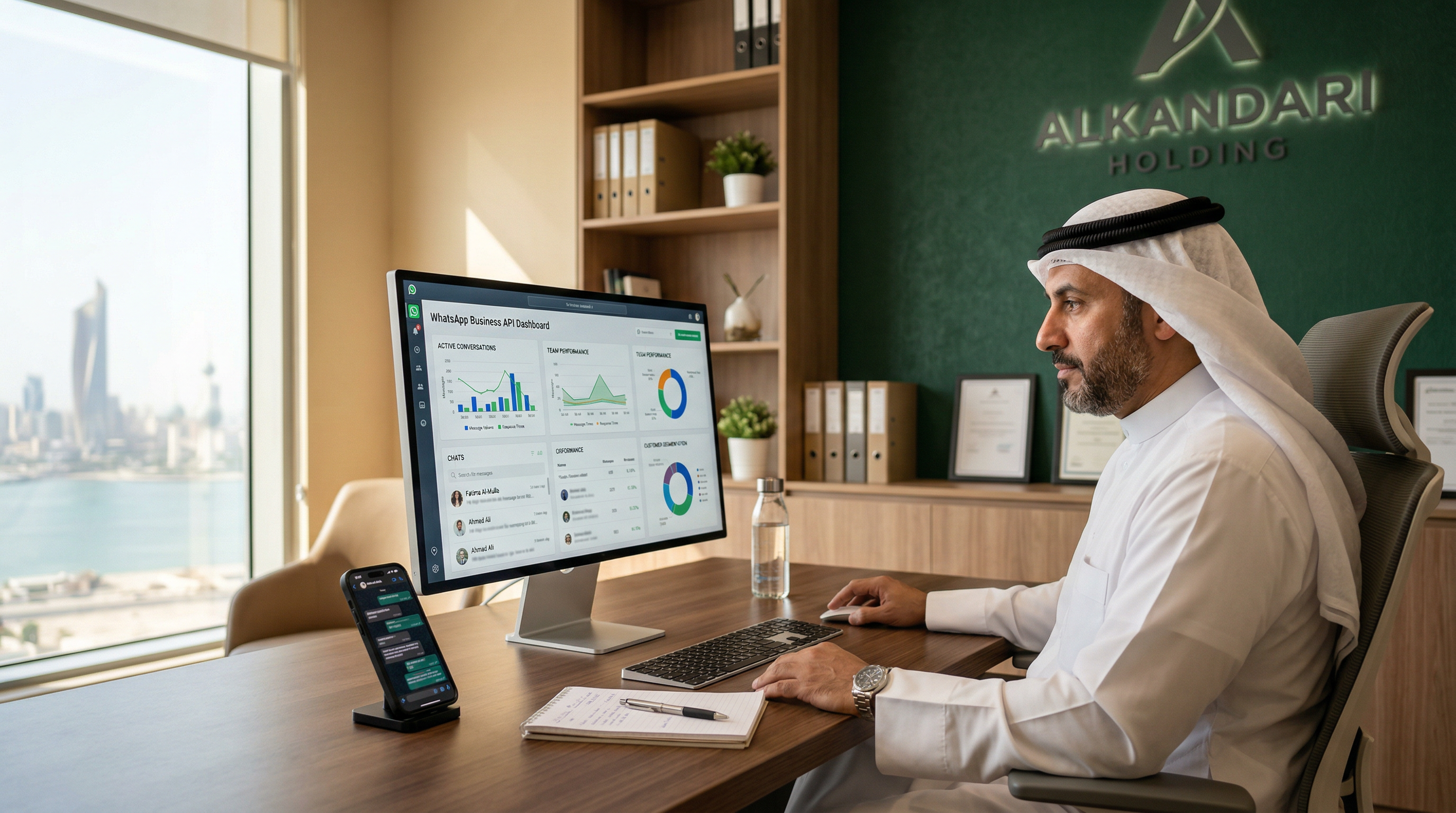
Kuwait has a customer service problem most founders refuse to say out loud: leads arrive on WhatsApp at 11 PM, nobody responds until 9 AM, and by then the customer bought from a competitor. A 2024 Meta GCC study found that 78% of Gulf consumers expect a WhatsApp reply within 5 minutes. The average Kuwait SMB responds in 4.5 hours. That gap is where revenue disappears. This guide closes it.
What Is WhatsApp Business API and How Does It Differ from the Regular App?
The WhatsApp app you download from the App Store handles one device, one agent, one conversation at a time. WhatsApp Business API is the infrastructure layer that sits behind enterprise and mid-market deployments. It connects to your CRM, your AI agent, your payment gateway, and your analytics stack.
The core differences matter for Gulf operations specifically. The regular WhatsApp Business app cannot send template messages at scale, cannot assign conversations across a team, and cannot trigger automated flows based on customer behavior. The API does all three. KIRA is a Meta-verified Solution Provider, which means we access the API directly through Meta's official partner channel — not through a third-party reseller chain that adds latency and cost.
| Feature | WhatsApp App | WhatsApp Business App | WhatsApp Business API |
|---|---|---|---|
| Simultaneous agents | 1 | 1 (limited multi-device) | Unlimited |
| Automated replies | Basic away message | Basic quick replies | Full AI agent + flows |
| CRM integration | None | None | Full API integration |
| Broadcast messages | 256 contacts max | 256 contacts max | Unlimited (template-based) |
| Payment integration | None | None | Tap Payments, KNET, etc. |
| Analytics dashboard | None | Basic read rates | Full conversation analytics |
| Gulf Arabic support | Manual | Manual | Native with AI agent |
| Response time | Human-dependent | Human-dependent | Under 3 seconds (with AI) |
WhatsApp API Conversation Categories and Kuwait Pricing Structure
Meta restructured WhatsApp API pricing in 2023 into four conversation categories. Understanding these categories determines your monthly cost, your campaign strategy, and which message types you can send without customer initiation. Every Kuwait business running the API needs to know these before going live.
The four categories are: Marketing (promotional messages you initiate), Utility (transactional updates like order confirmations), Authentication (OTP and verification messages), and Service (conversations the customer starts). Kuwait-specific rates from Meta's official pricing page sit between $0.016 and $0.059 per conversation depending on category — with service conversations the cheapest and marketing the most expensive. For full details on how this affects your deployment cost, see our pricing breakdown page.
The practical implication: route as many inbound leads as possible into service conversations. When a customer messages you first, you pay the service rate. When you message them cold, you pay the marketing rate. A well-designed WhatsApp AI flow pushes customers to initiate contact through click-to-WhatsApp ads, keeping your per-conversation cost at the lower tier.
How to Set Up WhatsApp Business API in Kuwait: Step-by-Step
After running 35+ WhatsApp AI deployments across Kuwait and the GCC, the setup failures we see are almost always in steps 3 and 5. Most people skip business verification or submit incorrect display name formats and spend weeks in Meta's review queue. Follow this sequence precisely.
- Register a Meta Business Manager account. Use your commercial registration (CR) details. Your business name on Meta must match your CR exactly. Mismatches trigger manual review that can take 3–6 weeks in Kuwait.
- Verify your business on Meta. Upload your CR, civil ID of authorized signatory, and a utility bill or bank statement showing the business address. Meta's GCC verification team processes Kuwait documents in Arabic or English.
- Choose a Meta-verified Solution Provider. This is where most businesses make their most expensive mistake. Going through an unverified reseller means you do not have a direct Meta relationship, cannot escalate issues, and often pay inflated per-message rates. KIRA is a Meta-verified Solution Provider. See how we compare to other platforms like Wati.
- Get a dedicated phone number. This must be a number not currently registered to any WhatsApp account. Kuwait mobile numbers (with +965 prefix) or a landline both work. The number cannot be reused on personal WhatsApp once registered to the API.
- Submit your display name for approval. Meta requires the display name to reflect your actual brand. Generic names like "Kuwait Store" or names that include "WhatsApp" are rejected. Approval takes 24–72 hours for compliant names.
- Build and submit message templates. All outbound messages you initiate must use pre-approved templates. Submit templates in both English and Gulf Arabic. Bilingual templates get higher delivery rates in Kuwait because Meta's spam filter scores language-audience match.
- Integrate your AI agent or CRM. Connect the API to your inbox tool, CRM, or AI agent. For full AI handling of objections, negotiations, and follow-ups in Arabic and English, see Lojain AI's feature set.
- Test in sandbox before going live. Send test conversations across all four message categories. Confirm delivery receipts, read rates, and escalation triggers are working correctly. Going live with untested flows costs you the first 48 hours of real leads.
Best WhatsApp API Provider in Kuwait: What to Actually Compare
The question most Kuwait businesses ask is "which platform is cheapest?" The right question is "which setup converts the most leads at the lowest cost per acquisition?" Those answers are different. A platform that charges less per message but has no Arabic AI capability forces you to hire human agents for Gulf Arabic conversations, which costs more than the per-message savings.
The comparison that actually matters across GCC deployments comes down to five factors: Meta verification status, Arabic language handling, payment gateway integration (Tap Payments and KNET are non-negotiable in Kuwait), response time SLA, and whether the "AI" is a rule-based chatbot or an actual AI agent that handles pricing objections and negotiations. Lojain AI is an AI agent, not a chatbot. That distinction matters when a customer says "your competitor is cheaper" at 2 AM on a Friday.
| Criteria | KIRA / Lojain AI | Wati | Generic WhatsApp Tools |
|---|---|---|---|
| Meta-verified Solution Provider | Yes | Yes | Usually No |
| Gulf Arabic AI responses | Native | Template-only | None |
| Handles pricing objections | Yes (AI agent) | No (rule-based) | No |
| Tap Payments / KNET integration | Yes | No | Rarely |
| Response time | Under 3 seconds | Varies | Human-dependent |
| Kuwait support team | Yes | No | No |
| GCC case studies | 35+ deployments | Limited | None |
Kuwait Case Study: How a Salmiya Clinic Cut No-Shows by 41%
A dermatology clinic in Salmiya was losing an estimated KD 3,200 per month to no-shows and late cancellations. Their front desk handled appointment confirmations manually over WhatsApp, which meant reminders went out inconsistently and patients who wanted to reschedule often just ghosted instead of replying.
We deployed Lojain AI on their WhatsApp Business API in 11 days. The AI agent sends a confirmation immediately after booking, a 48-hour reminder with a reschedule option, and a 2-hour pre-appointment check-in. Patients who reply "can we reschedule" get handled entirely by the AI agent in Gulf Arabic or English, with calendar slots shown inline. Within 90 days, no-show rate dropped from 34% to 20% — a 41% reduction. Monthly recovered revenue exceeded KD 2,800. For clinics considering this setup, see our healthcare-specific deployment guide.
Kuwait Case Study: A Hawalli F&B Chain Recovered 28% of Abandoned Orders
A fast-casual restaurant chain operating across three Hawalli locations was getting significant drop-off in their online ordering flow. Customers would start an order on their website, reach the payment step, and abandon. The team had no automated recovery mechanism — just a weekly manual export and occasional follow-up calls that converted almost nothing.
We integrated their ordering system with WhatsApp Business API and Lojain AI. When a customer abandons at checkout, Lojain sends a WhatsApp message within 8 minutes with their order summary and a Tap Payments link. If there is no response in 2 hours, a second message offers a small complimentary add-on. The AI handles any question about the order, including "do you have this allergen-free?" in Arabic. In the first 60 days, 28% of previously abandoned orders converted. Monthly incremental revenue from recovery alone reached KD 4,100 across the three locations. See more results like this on our case studies page or explore our F&B-specific solutions.
WhatsApp API for Small Businesses in Kuwait: Is It Worth the Setup?
The honest answer is: it depends on your monthly conversation volume. If you are handling fewer than 200 WhatsApp conversations per month, the API may be over-engineered for your current stage. The regular WhatsApp Business app covers basic needs below that threshold.
Above 200 conversations per month — which includes most Kuwait salons, clinics, retail stores, and service businesses running any paid ads — the API pays for itself in recovered response time alone. A business owner spending 3 hours daily on WhatsApp replies is paying themselves or a staff member to do work that an AI agent handles in under 3 seconds. For SMBs who want API functionality without the enterprise deployment complexity, our Lojain Lite bundle is built specifically for that entry point.
WhatsApp API Integration with Meta Ads in Kuwait
The highest-performing lead generation setup in Kuwait right now combines Meta Ads (Facebook and Instagram) with click-to-WhatsApp objectives and an AI agent on the receiving end. When the ad click opens a WhatsApp conversation, that conversation is classified as a service-tier interaction — the lowest-cost category. The AI agent responds instantly, qualifies the lead, and moves them toward booking or purchase without any human involvement unless escalation is triggered.
Based on campaigns we have managed for Kuwait retail and F&B clients, click-to-WhatsApp campaigns with AI agent follow-up consistently outperform link-click campaigns to landing pages by 2.3x on cost per qualified lead. The reason is friction: a WhatsApp conversation feels personal and immediate. A landing page form feels like work. Gulf consumers, in particular, have a documented preference for conversational commerce over form-fill flows. This is the architecture behind KIRA's media buying results — most agencies celebrate 2–3x ROAS, KIRA's floor is 7x. Learn more about how we structure these campaigns on our WhatsApp Business API service page.
Common WhatsApp API Mistakes Kuwait Businesses Make
The most expensive mistake is sending marketing-category template messages to cold lists without proper opt-in documentation. Meta's spam detection in the GCC has tightened significantly since Q3 2023. Accounts with block rates above 2% get flagged, and accounts above 5% get suspended. A suspended WhatsApp Business API number is not recoverable — you lose the number and must restart the verification process with a new one.
The second most common mistake is deploying a rule-based chatbot and calling it an AI setup. Rule-based systems break the moment a customer asks something outside the decision tree. In Kuwait, where customers frequently mix Arabic and English in the same sentence, a rigid rule-based system drops conversations constantly. Lojain AI handles code-switching between Gulf Arabic and English natively, including pricing objections, complaints, and negotiations — not just FAQ responses.
The third mistake is ignoring conversation analytics. The WhatsApp API generates data on open rates, response rates, drop-off points, and conversion paths. Kuwait businesses that review this data weekly improve their template approval rates and conversion flows within 30 days. Those that ignore it keep paying for conversations that go nowhere.
FAQ: WhatsApp API GCC Guide
What is the cost of WhatsApp Business API in Kuwait?
Meta charges per conversation, not per message. Kuwait rates vary by conversation category: service conversations (customer-initiated) cost approximately $0.016 per conversation, while marketing conversations (business-initiated) cost approximately $0.059. You also pay a platform or solution provider fee for the software layer above the API. For a detailed cost breakdown relevant to Kuwait business sizes, see our pricing page.
How long does WhatsApp API approval take in Kuwait?
Business verification typically takes 5–14 business days for Kuwait-registered businesses if all documents match your commercial registration. Display name approval takes 24–72 hours for compliant names. Phone number registration is immediate once verification is complete. Total time from application to live deployment is typically 2–3 weeks when done through a Meta-verified Solution Provider.
Can I use WhatsApp API for Arabic and English conversations in the GCC?
Yes. WhatsApp API supports full bilingual operation. The important distinction is whether your AI agent or automation layer handles Gulf Arabic natively versus just translating English templates. Gulf Arabic includes dialect variations, code-switching, and cultural context that standard Arabic NLP models miss. Lojain AI is built for Gulf Arabic specifically, not Modern Standard Arabic.
What is the difference between a WhatsApp chatbot and an AI agent?
A chatbot follows a fixed decision tree. It breaks when a customer asks something outside the programmed options. An AI agent like Lojain understands intent, handles objections, negotiates, escalates when appropriate, and responds to free-text questions in Arabic or English. For customer-facing commerce in Kuwait, the difference in conversion rate between the two is significant — typically 3–5x on lead-to-sale conversion.
Do I need a Meta Business Manager to use WhatsApp API?
Yes. WhatsApp Business API requires an active, verified Meta Business Manager account. The phone number you register must be linked to that account. Without business verification, you cannot access template messaging, bulk sending, or API-level integrations. This step cannot be skipped or workaround.
Can WhatsApp API integrate with Tap Payments and KNET in Kuwait?
Yes. WhatsApp Business API supports payment link generation within conversations. KIRA integrates Tap Payments and KNET directly into Lojain AI flows, allowing customers to complete purchases inside WhatsApp without being redirected to an external checkout. This reduces payment drop-off by removing the friction of leaving the conversation environment.
Is WhatsApp API suitable for real estate businesses in Kuwait?
Real estate is one of the highest-ROI use cases for WhatsApp API in Kuwait. Lead response time is the single largest driver of conversion in Gulf real estate, and properties sell or rent based on who responds first. An AI agent that qualifies buyer intent, sends property details, and schedules viewings within seconds of inquiry has a direct impact on closed deals. See our real estate deployment guide for specifics.
If you are running a Kuwait or GCC business and losing leads to slow response times, the WhatsApp API setup described in this guide is the most direct fix available. The technology is not experimental — it is deployed across clinics, restaurants, retailers, and real estate firms in Kuwait right now, producing measurable results within 30–90 days of go-live.
Talk to Us on WhatsAppReady to Scale Your Marketing with AI?
KIRA delivers AI-powered marketing systems, WhatsApp automation, and media buying strategies for businesses worldwide.
Book a Strategy Call More ArticlesGet KIRA in your AI answers
Add KIRA as a Google Preferred Source so our articles show a "Preferred" badge in your AI Overviews & AI Mode results. Log in to Google, then tick the box next to kiraco.org.
Add KIRA as a Preferred Source