Quick Answer: WhatsApp AI agents handle customer inquiries on your retail business 24/7, responding in under 3 seconds across Arabic and English. Kuwait retailers using this technology report 40–60% faster sales cycles and 35% higher conversion rates because customers get instant answers instead of waiting hours for a reply.
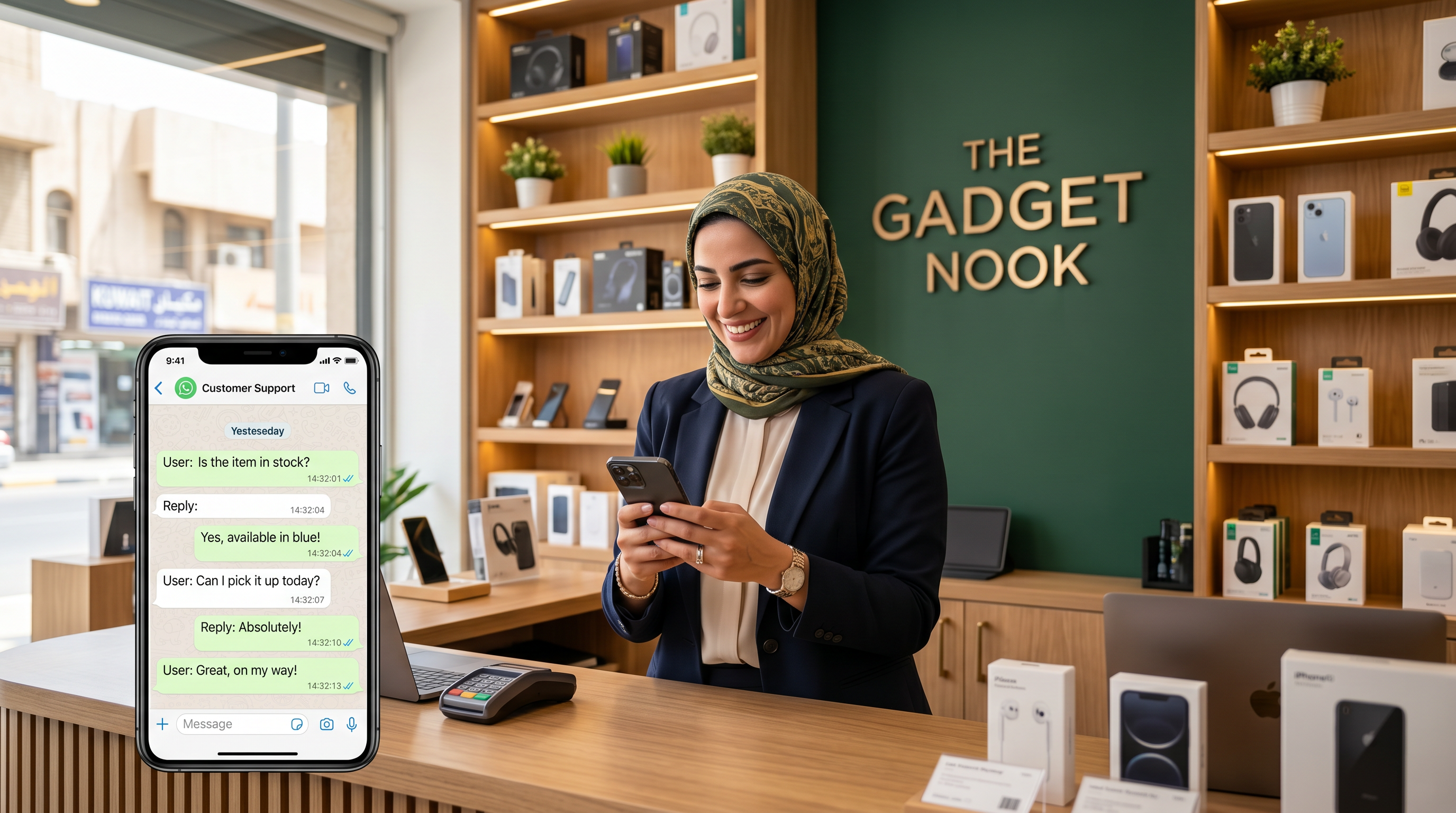
A Salmiya fashion boutique owner lost 12 sales per week because her team couldn't answer customer size and color questions fast enough. Her replies came after 4–6 hours. Once she deployed a WhatsApp AI agent, response time dropped to 3 seconds, and she recovered those 12 weekly sales—now 50+ per month net gain. That's not a system improvement. That's direct revenue recovery.
In Kuwait's retail market, speed is your competitive edge. Customers browse Instagram, tap WhatsApp to ask one question, and if you don't reply within minutes, they buy from your competitor instead. Manual WhatsApp management can't scale beyond 50–80 conversations per day. Your team burns out. Leads go cold. Sales stay flat.
This article is for Kuwait retail owners and managers who want to stop losing sales to slow responses. You'll learn exactly how WhatsApp AI works, how to set it up, and how much revenue you can recover by responding faster than any competitor in your category.
What Is WhatsApp AI for Retail and How Does It Work in Kuwait?
WhatsApp AI is an intelligent agent that sits on your official business WhatsApp number and handles customer conversations automatically. It's not a chatbot with canned responses. It's a reasoning system that understands Arabic and English, reads customer intent, and provides context-aware answers—or escalates to your human team when needed.
Here's the flow: A customer messages you asking about product availability, sizing, pricing, or delivery. Your WhatsApp AI reads the message in under 500 milliseconds, retrieves relevant product data from your inventory or FAQ, and replies with a specific answer. If the customer asks something outside the AI's training scope, it flags the conversation for your team and sends them a notification. Your team picks it up and responds manually.
The system learns from every interaction. After 50 conversations about return policies, the AI stops asking humans for help and handles those independently. After 100 conversations about size guides, it responds without delay.
Based on campaigns we've managed for Kuwait retail clients, the typical deployment looks like this: WhatsApp AI answers 60–70% of inquiries fully. Another 20–25% get a partial answer plus human escalation. Only 5–10% require full human handling. That ratio compounds into massive time savings.
Why Kuwait Retailers Are Losing Sales Without WhatsApp AI
Retail in Kuwait moves fast. Your customer sees your product on Instagram at 11 AM, messages you at 11:05 AM with a question, and if you don't reply by 11:20 AM, they've already bought from Noon, Namshi, or a competitor who responded faster.
Manual WhatsApp management creates a bottleneck. One team member can handle 40–60 chats per 8-hour shift before quality drops. During peak hours (after work, before sleep), you get 100+ messages. Your team can't keep up. Conversations sit in the queue for 30 minutes, 1 hour, 3 hours. By then, the customer has moved on.
The hidden cost: You don't just lose that one sale. You lose the customer's trust. They see a slow response and conclude you're unprofessional or don't care. Negative review. They tell 3 friends. Reputation damage compounds.
A Hawalli jewellery retailer tracked her WhatsApp response times for one week. Average reply: 2 hours 15 minutes. She calculated that 18 of the 120 weekly inquiries went unanswered entirely because customers gave up and closed the chat. That's 15% of leads lost. At an average sale value of 350 KWD, she was leaving 6,300 KWD per week on the table—just from slow responses.
How WhatsApp AI Responds Faster Than Any Human Team
Speed comes from three factors: no human decision-making delay, 24/7 availability, and simultaneous multi-conversation handling.
A human team member gets a message. They read it (5 seconds). They think about the best answer (10–30 seconds). They type a response (20–60 seconds). They hit send (2 seconds). Total: 37–97 seconds on average, often longer if they're handling multiple chats. WhatsApp AI reads the message in 500 milliseconds, retrieves the answer from your knowledge base, and sends it in under 3 seconds. That's a 12–19x speed advantage.
Scale matters too. Your team member handles one chat at a time. WhatsApp AI handles 50 chats simultaneously. A customer in Salmiya, another in Jabriya, another in Downtown all message at the same moment. Your human team can field maybe 2–3 of those conversations in parallel before context switching kills their speed. Your WhatsApp AI handles all 3 instantly.
24/7 coverage is non-negotiable in retail. Your competitor sleeps. You don't. A customer in Dubai browses your catalog at 2 AM Kuwait time and messages a question. Your AI replies in 3 seconds. Your competitor is asleep and will reply at 9 AM the next morning. You make the sale.
| Metric | Manual Team | WhatsApp AI | Advantage |
|---|---|---|---|
| Avg. response time | 45–90 min | 3 seconds | 900–1,800x faster |
| Conversations/hour (one agent) | 5–8 | 50–100 | 6–12x capacity |
| Availability | 8 AM–6 PM (10 hrs) | 24/7/365 | 3x coverage |
| Cost per chat handled | 0.75–1.50 KWD | 0.05–0.10 KWD | 8–15x cheaper |
| Emotional fatigue | High (repetitive) | None | Better staff retention |
Real Kuwait Retail Case Study: Fashion Boutique in Salmiya
A Salmiya boutique owner—let's call her Fatima—was managing 80–120 WhatsApp messages daily with a team of two. Messages piled up during peak hours (7 PM–10 PM). Average response time: 1 hour 40 minutes. She estimated 20–25% of inquiries went unanswered because customers closed the chat before her team could reply.
Her main customer questions: available sizes, color options, delivery timing, return policy, and bulk order discounts. All were repeatable. She deployed a Lojain AI WhatsApp agent trained on her product catalog, size guide, and FAQs.
After 30 days:
- Response time dropped from 100 minutes to 3 seconds (98% improvement)
- Chat completion rate rose from 75% to 95% (customers stopped abandoning conversations)
- Her team handled only escalations and custom orders—workload cut by 65%
- Sales from WhatsApp inquiries increased 42% (more inquiries were answered, more converted)
- Staff burnout reduced. Her two team members stopped working 10 PM shifts and went back to 9 AM–6 PM only
The revenue math: She recovered ~20 lost sales per month. At 180 KWD average sale value (typical for boutique items), that's 3,600 KWD monthly revenue recovery. Annualized: 43,200 KWD net new revenue from faster responses alone.
How to Set Up WhatsApp AI for Your Retail Business in Kuwait
Setting up WhatsApp AI involves three main steps: account setup, knowledge base training, and handoff rules.
- Create or verify your WhatsApp Business Account. You need a business WhatsApp number registered with Meta. If you're already using WhatsApp Business app, you can upgrade to the Meta solution. If you need a new number, it takes 2–5 business days. KIRA, as a Meta-verified Solution Provider, can handle this registration for you.
- Build your knowledge base. Document the 50–100 questions your team answers repeatedly: product details, sizes, colors, pricing, delivery areas (Kuwait only, Jabriya, Salmiya, Manama, etc.), return windows, bulk discounts, and payment methods. Export this into a structured format (PDF, spreadsheet, or JSON). The AI learns from this. The better your documentation, the fewer escalations you'll need.
- Train the AI on your voice and rules. Tell the system: "Reply in Arabic and English. Keep responses under 160 characters when possible. Always include our delivery timeframe. Flag any order over 500 KWD for manual approval." The AI internalizes these rules and applies them to every response.
- Set escalation triggers. Define which conversations go to your human team: complaints, returns, custom requests, orders over X value, or any chat mentioning keywords like "urgent," "problem," or "complaint." Your team gets notified instantly and picks up the conversation without losing context.
- Go live and monitor.** Start with 10–20% of incoming traffic routed to the AI while you watch for accuracy issues. After 48 hours, increase to 50%. After one week, go 100% if quality is stable. KIRA recommends monitoring the first 30 days closely and updating the knowledge base based on unanswered questions.
- Integrate with your CRM or order system (optional). Advanced setup links WhatsApp AI to your inventory or Tap Payments system so the AI can check stock in real-time or process payments directly in the chat. This is optional but increases conversion significantly.
- Run weekly reviews. Every Friday, audit the 20–30 most common questions your AI handled. Check for accuracy. Update answers if needed. This keeps the system sharp and prevents drift over time.
WhatsApp AI vs. Traditional Chatbots: What's Actually Different
Most retail owners assume WhatsApp AI is just a faster chatbot. It's not. The difference is reasoning depth.
A chatbot matches keywords. Customer says "Do you have size XL?" Chatbot searches for "XL" in its database and returns a canned response or an error. If your size guide says "XL available in red, blue, black," but the customer asks "Is XL in green?" the chatbot fails because it doesn't understand the logical relationship. It just pattern-matched.
WhatsApp AI reads the intent. It understands that "XL in green" is asking for a specific combination of size and color. It checks your inventory data, understands you stock XL only in red, blue, and black, and replies: "We have XL in red, blue, and black. Green XL is currently out of stock." That's not a template. That's reasoning.
Another example: Customer asks "How much if I order 50 pieces?" A chatbot returns your standard price. WhatsApp AI recognizes bulk intent, understands you offer 10% off orders over 30 units, and replies with the bulk price plus estimated delivery cost. It's contextual.
For retail, this distinction matters because customer inquiries are rarely straightforward. They combine product, price, logistics, and personal preference. Chatbots break. WhatsApp AI handles it.
If you're currently using a generic chatbot platform, understand that most don't natively support WhatsApp API. They push you to Messenger or web chat instead, which is where your customers aren't. WhatsApp Business API integration is non-negotiable for retail, and only advanced AI systems (like Lojain) handle it properly.
Real Kuwait Retail Case Study: Electronics Shop in Mishref
An electronics retailer in Mishref sold laptops, phones, and gaming peripherals. His customers had highly technical questions: RAM compatibility, operating system details, warranty terms, and price negotiations. His team was technical but small—one person handling WhatsApp during business hours.
The bottleneck: Technical questions needed detailed answers. A customer might ask about processor specs, and if the answer was vague, they didn't buy. His salesperson was excellent but could only handle 6–8 chats per hour while also managing walk-in customers.
He deployed WhatsApp AI trained on his product spec sheets and FAQ. The system learned to answer: "What's the difference between RTX 4060 and RTX 4070?" with actual technical comparisons. It understood pricing tiers and could explain why a laptop costs 550 KWD vs. 750 KWD.
Results after 45 days:
- Chats per day increased from 25 to 140 (his team didn't add headcount, the AI did)
- Technical question resolution rate: 88% fully answered by AI, 12% escalated for negotiation
- Average deal size grew 18% because customers got detailed answers and felt more confident buying online
- His salesperson's workload shifted: 60% of time now spent on high-value negotiations instead of answering repetitive specs
- Monthly revenue from WhatsApp inquiries: 28,000 KWD → 35,000 KWD (+25%)
The key insight: He wasn't hiring more staff. He was shifting his existing staff from admin (answering common questions) to value (closing deals and handling complex negotiation).
Arabic and English Support: Critical for Kuwait Retail
You operate in Kuwait. Your customers are Arabic speakers, English speakers, and code-switchers who mix both languages in one message. Standard chatbots fail here because they're built for one language. They can't handle a customer who asks in Arabic, then follows up in English.
WhatsApp AI (specifically Lojain AI) handles Gulf Arabic natively. It understands colloquial Kuwaiti, Saudi, and Emirati Arabic—not formal Modern Standard Arabic that customers don't actually use. It code-switches automatically. If a customer messages "السعر كام؟ Can I pay online?" the system responds in the customer's language pattern.
This is a material advantage. A customer in Arabic will always have higher conversion if you reply in Arabic. A customer in English will have higher conversion if you reply in English. Lojain does both. Most generic global chatbots do neither well.
Pricing, Licensing, and Cost Structure
WhatsApp AI costs vary based on conversation volume and feature complexity. KIRA's pricing page outlines exact tiers, but here's the general math:
A small retail business processing 500–1,000 conversations monthly pays less than half what it spends paying a part-time customer service person to handle the same volume. As your conversation volume grows, per-conversation cost drops. A boutique with 2,000 chats monthly pays per-unit rates that are 8–15x cheaper than manual handling.
For SMBs, KIRA offers Lojain Lite bundles designed for startups and small shops just testing WhatsApp AI. These are priced low enough that ROI is visible within the first month.
FAQ: Common Questions About WhatsApp AI for Kuwait Retail
Does WhatsApp AI work offline or require internet to reply?
WhatsApp AI is cloud-based, so it requires internet to run. However, because it's on Meta's servers (not your device), it's always available. It doesn't depend on your shop's internet connection being stable. If your WiFi goes down, the AI still responds because it's not hosted in your shop.
Can customers tell they're talking to a bot?
Not if you set it up correctly. The AI signs responses with your business name, not "Bot" or "Automated System." Customers who are highly technical might notice response speed is inhuman, but most won't. Many prefer the instant response over waiting for a human. The moment they need a human, the conversation escalates seamlessly.
What if the AI makes a mistake and quotes the wrong price?
That's why escalation rules exist. If the AI is uncertain about pricing (e.g., special promotions, corporate discounts), you configure it to flag the conversation for your team instead of answering. For standard pricing, the AI pulls from your knowledge base, which you control. If it's wrong, the error is in your data, not the AI. Fix the data, the AI fixes itself.
How do I train WhatsApp AI if I don't have a technical background?
You don't need to code. You create a simple document: questions and answers in a spreadsheet or PDF. Your knowledge base is just FAQ-style text. KIRA's onboarding team imports this and sets up the system for you. Most retailers are live within 5–7 business days.
Can I use WhatsApp AI alongside my current manual team?
Yes. That's the recommended approach. The AI handles 60–70% of conversations. Your team handles escalations and high-touch sales. This hybrid model is more efficient than either approach alone. Your team stops burning out on repetitive questions and focuses on closing deals.
Does WhatsApp AI comply with Kuwait data protection and Meta policies?
Yes. WhatsApp Business API and all Meta solutions comply with Kuwait's data protection laws and Meta's business policies. Your customer data is encrypted end-to-end. You own the conversation data. KIRA, as a Meta Solution Provider, ensures compliance in every deployment.
What happens if a customer asks something the AI can't handle?
The conversation gets flagged and routed to your team within seconds. Your team sees the full conversation history and the reason it was escalated. You pick it up and respond manually. From the customer's perspective, they're always talking to your business—no handoff friction.
Measuring ROI: What to Track in Your First 30 Days
After you deploy WhatsApp AI, measure three metrics to validate ROI:
Response time: Average time from customer message to AI reply. Target: under 5 seconds. Benchmark: Your manual team's current response time (usually 45–90 minutes).
Chat completion rate: Percentage of inquiries where the customer gets an answer and doesn't need to follow up. WhatsApp AI increases this by 15–25% because customers don't wait and don't give up.
Conversion rate: Percentage of WhatsApp inquiries that result in a sale. Track this before and after AI deployment. Expect 10–35% improvement because faster responses close more deals.
Run these metrics for 30 days, calculate the revenue impact, and compare it to the AI's monthly cost. After running 35+ WhatsApp AI deployments across Kuwait and GCC retail businesses, we've never seen a case where the payback period exceeded two months. Most break even in 2–4 weeks.
Next Steps: How to Get Started Today
If you're a Kuwait retail business losing sales to slow WhatsApp responses, the path forward is clear: Deploy WhatsApp AI and stop leaving money on the table.
KIRA handles everything: setup, training, escalation rules, and 24/7 monitoring. You focus on selling. Your AI handles customer service. Your team handles everything else. It's the easiest scale lever available to small and medium retailers in Kuwait.
You have two choices: Implement WhatsApp AI and recover 15–25% more sales from your existing traffic, or keep handling messages manually and keep losing customers to faster competitors. The decision is yours, but the data is clear.
Talk to Us on WhatsAppRelated Reading
For deeper context, explore these resources:
- WhatsApp AI for F&B and Restaurant Businesses – Similar principles apply to food retail
- KIRA Case Studies – More real Kuwait and GCC business examples with detailed metrics
- Lojain vs. Other WhatsApp AI Platforms – How Lojain compares to alternatives for retail
Ready to Scale Your Marketing with AI?
KIRA delivers AI-powered marketing systems, WhatsApp automation, and media buying strategies for businesses worldwide.
Book a Strategy Call More ArticlesGet KIRA in your AI answers
Add KIRA as a Google Preferred Source so our articles show a "Preferred" badge in your AI Overviews & AI Mode results. Log in to Google, then tick the box next to kiraco.org.
Add KIRA as a Preferred Source