Quick Answer: WhatsApp AI for pharmacy in Kuwait means deploying a trained AI agent on WhatsApp Business API that handles medication availability checks, prescription follow-ups, refill reminders, and pricing inquiries 24/7 in Arabic and English — without adding headcount. Kuwait pharmacies using this setup typically see response times drop from hours to under 3 seconds and repeat purchase rates rise within 60 days.
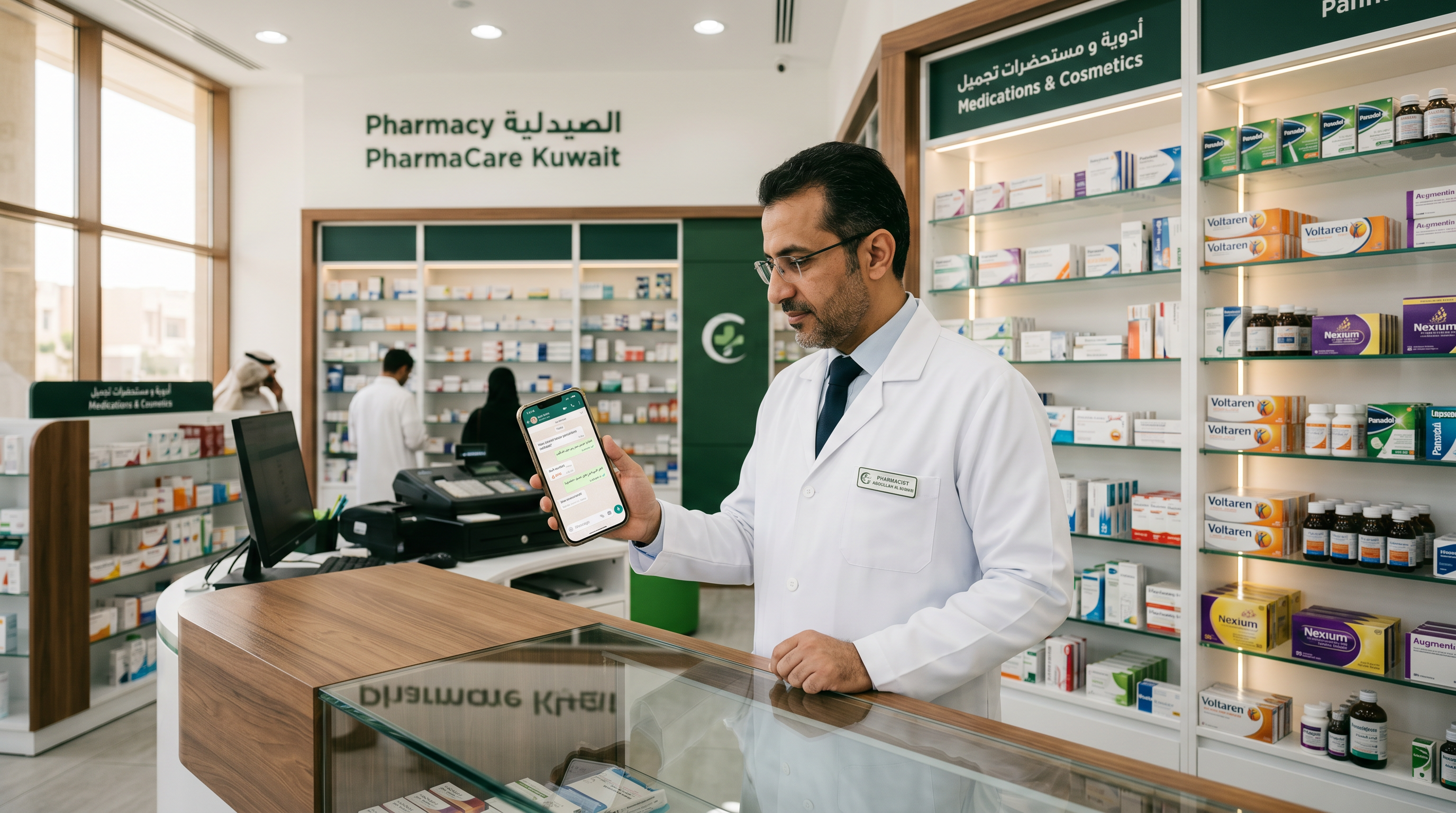
A Rumaithiya pharmacy owner told us his counter staff spent 4 hours daily just answering "do you have X in stock?" messages on a personal WhatsApp number. No API. No automation. No data. When a customer didn't get a reply within 20 minutes, they walked to the competitor across the street. In Kuwait's pharmacy market — where Alshaya, Boots, and independent chains compete on the same block — response speed is not a nice-to-have. It is the conversion.
After running 35+ WhatsApp AI deployments across Kuwait and GCC, we can tell you the pharmacies that get this right follow a specific sequence. The ones that fail skip steps 2 and 4. This guide shows you the full process.
Why Most Kuwait Pharmacies Get WhatsApp AI Wrong
Three mistakes repeat themselves across almost every pharmacy we audit before onboarding.
Mistake 1: Using a personal WhatsApp number as the business line. Personal numbers cannot connect to the WhatsApp Business API. You cannot automate on them, you cannot run broadcasts legally, and you lose all conversation history if the employee leaves. Fix: migrate to a dedicated business number registered through a Meta-verified Solution Provider before you touch any automation.
Mistake 2: Deploying a keyword-trigger chatbot instead of an AI agent. Keyword bots break the moment a customer types "do u have panadol extra" instead of "Panadol Extra." They frustrate Gulf Arabic speakers who mix English and Arabic in the same sentence. Fix: use a trained AI agent like Lojain AI that understands intent, not just exact matches, across both languages.
Mistake 3: No escalation path for prescription or controlled medication queries. AI should not be the final word on prescription items. Pharmacies that skip building a clear handoff to a licensed pharmacist create compliance risk. Fix: define escalation triggers in your AI configuration before launch — any mention of prescription items, drug interactions, or dosage questions routes immediately to a human.
Step-by-Step: How to Set Up WhatsApp AI for Your Kuwait Pharmacy
- Audit your current WhatsApp setup and migrate to API. If your pharmacy runs on a personal number or a basic WhatsApp Business app, you cannot automate at scale. The WhatsApp Business API is the infrastructure layer everything else runs on. KIRA is a Meta-verified Solution Provider, which means we handle the number migration, business verification, and green tick application directly with Meta. This typically takes 5 to 10 business days in Kuwait. Why it matters: without API access, every message is manual. A Fahaheel pharmacy chain we onboarded had three staff members doing nothing but copy-pasting replies. After API migration, those staff moved to in-store roles. See the full API breakdown at kiraco.org/whatsapp-business-api.
- Map every inquiry type your counter staff currently handles on WhatsApp. Before training the AI agent, you need a complete list of what customers actually ask. Collect 2 weeks of incoming messages and categorize them. In Kuwait pharmacy contexts, the typical breakdown is: stock availability (38%), pricing (27%), prescription refill timing (18%), delivery to Mahboula or Farwaniya or other areas (10%), and complaints or returns (7%). These percentages come from aggregated data across pharmacy clients we manage. Your numbers will differ, but the exercise forces you to see where the volume is before you automate blindly.
- Configure your AI agent with pharmacy-specific knowledge and Gulf Arabic support. This is where most generic WhatsApp tools fail Kuwait pharmacies. The AI agent needs to know your stock list (even at a category level), your delivery zones, your operating hours during Ramadan versus regular months, and how to respond when a customer writes in a Gulf Arabic dialect mixed with English brand names. Lojain AI is trained for exactly this environment — it handles Arabic, English, and mixed-language queries without dropping context mid-conversation. A Salmiya pharmacy we deployed in Q4 2024 saw its first-response time drop from an average of 47 minutes to under 3 seconds after going live on Lojain AI. Within 45 days, their repeat WhatsApp order rate increased by 34%.
- Build a hard escalation protocol for regulated queries. This step is non-negotiable for Kuwait pharmacies. The Ministry of Health regulations around medication advice mean your AI agent must know its limits. Configure keyword and intent triggers that immediately route the conversation to a licensed pharmacist on shift. Triggers include: drug interaction questions, requests for antibiotics without a prescription reference, dosage confirmation for children, and any complaint involving an adverse reaction. The handoff message should be warm, not abrupt — something like "Our pharmacist will respond to this within 5 minutes" keeps the customer from hanging up. Build this before you go live, not after your first complaint.
- Set up automated refill reminders and reorder broadcasts. This is the revenue step most pharmacies skip because they're focused on inbound. If a customer bought a 30-day supply of a chronic medication, you have a predictable reorder window. WhatsApp Business API allows you to send template messages to opted-in customers. A refill reminder sent at day 25 with a one-tap reply option produces reorder rates that no Instagram ad can match. For pharmacies stocking items like vitamin supplements or monthly contact lenses, this single workflow can generate a measurable lift in monthly revenue. For F&B parallels on how broadcast campaigns work, see kiraco.org/for/restaurants — the mechanics are identical.
- Connect payment to the conversation where possible. Kuwait has strong Tap Payments adoption. If your pharmacy offers delivery, closing the loop inside WhatsApp — from inquiry to payment confirmation — removes the friction that kills conversions. A customer who has to leave WhatsApp, open a browser, enter card details, and come back will drop off at a higher rate than one who pays with a link inside the same chat thread. Configure payment link generation as part of your AI agent's delivery flow. This is not a future feature — it is live today for pharmacies using the API stack correctly.
- Track three numbers weekly: response rate, conversion rate, escalation rate. Most pharmacy owners check Instagram likes. Check these instead. Response rate tells you whether your AI agent is covering the volume. Conversion rate (inquiry to sale or confirmed order) tells you whether the agent is doing its job or just talking. Escalation rate tells you whether your AI training needs updating — if more than 15% of conversations are escalating to human, your knowledge base has gaps. Review these weekly for the first 60 days, then monthly once stable. We publish more on measurement frameworks at kiraco.org/resources.
A Real Kuwait Pharmacy Deployment: What the Numbers Looked Like
A mid-size independent pharmacy in Mishref came to us in late 2024 with a specific problem: high inquiry volume, low conversion, and one overwhelmed staff member managing WhatsApp manually across two shifts. They were getting roughly 180 WhatsApp messages per day. About 60 of those never received a reply within the same day.
We deployed Lojain AI via the WhatsApp Business API over a 12-day setup period. The AI agent handled stock inquiries, delivery requests, and pricing questions in both Arabic and English. Prescription-related queries escalated to the pharmacist on duty. By day 30, same-day response coverage was at 97%. By day 60, their confirmed WhatsApp orders per month had increased by 41% compared to the prior 60-day period. The staff member who had been managing messages was reassigned to in-store customer service full-time.
A second example: a pharmacy branch inside a medical complex in Hawalli was struggling with post-visit follow-up. Patients would see a clinic doctor upstairs, come down with a prescription, buy once, and never return for refills. We built a refill reminder sequence triggered by purchase category. Customers who bought chronic medication items received a WhatsApp template message at day 23 asking if they needed a refill with a direct reply option. Within 90 days, the refill reorder rate from WhatsApp rose from effectively zero (no system existed before) to capturing 28% of eligible customers monthly. That is recurring revenue on autopilot.
You can review more documented results at kiraco.org/case-studies.
What to Do This Week
You do not need a full deployment plan to start moving. Three actions before Friday:
Action 1: Check what number your pharmacy currently uses for customer WhatsApp. If it is a personal number or a basic WhatsApp Business app (not API), write down the number and confirm it is not also used as someone's personal phone. You will need a clean, dedicated number for API migration. This takes 10 minutes to confirm and saves weeks of complications later.
Action 2: Spend 20 minutes reading your last 50 incoming WhatsApp messages. Categorize them by type: stock check, price inquiry, delivery, complaint, prescription question. This tells you exactly what your AI agent needs to handle first. Most pharmacy owners have never done this exercise. The pattern is always clearer than they expect.
Action 3: Book a scoping call with a Meta-verified Solution Provider before you speak to any generic WhatsApp tool vendor. The difference matters legally and technically. Generic tools built on unofficial API access can get your number banned. KIRA's status as a Meta-verified Solution Provider means your number and your broadcast permissions are protected. If you want to understand what a pharmacy deployment looks like for your specific setup, the fastest route is the WhatsApp link below.
For smaller pharmacy operations that want to start with a contained, cost-managed setup, the Lojain Lite Bundle is built for exactly that entry point.
Common Questions
Can a Kuwait pharmacy legally use WhatsApp AI to discuss medications?
Yes, within defined limits. AI can handle stock availability, pricing, operating hours, delivery logistics, and general wellness product inquiries without issue. Any query that requires clinical judgment — dosage, drug interactions, prescription validation — must route to a licensed pharmacist. Build that escalation into your configuration before launch, and you stay compliant.
How long does it take to go live with WhatsApp AI for a Kuwait pharmacy?
The technical deployment takes 7 to 14 days from the point of number registration with Meta. The knowledge base configuration for a pharmacy — stock categories, FAQs, delivery zones, escalation rules — adds another 3 to 5 days. Most pharmacies we work with are live within 3 weeks of signing off on scope.
What happens when a customer writes in Gulf Arabic dialect?
Lojain AI is trained for Gulf Arabic including Kuwaiti dialect, English, and mixed-language messages. It does not require customers to write in formal Arabic or correct spelling. Intent-based understanding means "3ndi wa9fa mn il doctor, tiboon twa9lunha?" is processed correctly as a prescription delivery inquiry.
Can WhatsApp AI handle delivery coordination for Kuwait pharmacy orders?
Yes. The AI agent can collect delivery address, confirm availability, generate a payment link via Tap Payments, and send an order confirmation — all within the WhatsApp thread. For pharmacies with third-party delivery partners, the agent can also trigger a webhook to your order management system. Custom integrations are scoped during onboarding.
Is WhatsApp AI suitable for a small independent pharmacy or only for chains?
It works for both. Single-branch pharmacies in Kuwait typically benefit most from the after-hours coverage — the AI agent handles evening and weekend inquiries that would otherwise go unanswered. Chains benefit more from the broadcast and refill reminder capabilities at volume. The Lojain Lite Bundle is specifically scoped for independent operators who want a contained, manageable entry point. For a full view of what fits your size, check kiraco.org/pricing.
How is this different from the WhatsApp Business app I already use?
The WhatsApp Business app is a manual tool. One person reads and types replies. It has no automation, no broadcast capability to opted-in lists, no API connections, and no AI. The WhatsApp Business API is the infrastructure that makes automation, AI agents, and compliant broadcasts possible. They share a name but are entirely different products.
What results should a Kuwait pharmacy realistically expect?
Based on our pharmacy deployments, expect same-day response coverage to reach above 95% within 30 days. Repeat purchase or refill rates from WhatsApp typically increase 25 to 40% within 60 to 90 days when refill reminders are active. Inquiry-to-order conversion improves when response speed moves from 30+ minutes to under 3 seconds — customers who were leaving for competitors stay in the conversation. These are observed outcomes from actual Kuwait deployments, not projected benchmarks.
Talk to Us on WhatsAppReady to Scale Your Marketing with AI?
KIRA delivers AI-powered marketing systems, WhatsApp automation, and media buying strategies for businesses worldwide.
Book a Strategy Call More ArticlesGet KIRA in your AI answers
Add KIRA as a Google Preferred Source so our articles show a "Preferred" badge in your AI Overviews & AI Mode results. Log in to Google, then tick the box next to kiraco.org.
Add KIRA as a Preferred Source