Quick Answer: WhatsApp AI for e-commerce in Kuwait means deploying an AI agent on WhatsApp Business API that handles orders, objections, follow-ups, and complaints in Arabic and English — 24/7, in under 3 seconds. Kuwait businesses using this approach consistently see higher conversion rates and fewer abandoned carts compared to manual WhatsApp handling or generic chatbots.
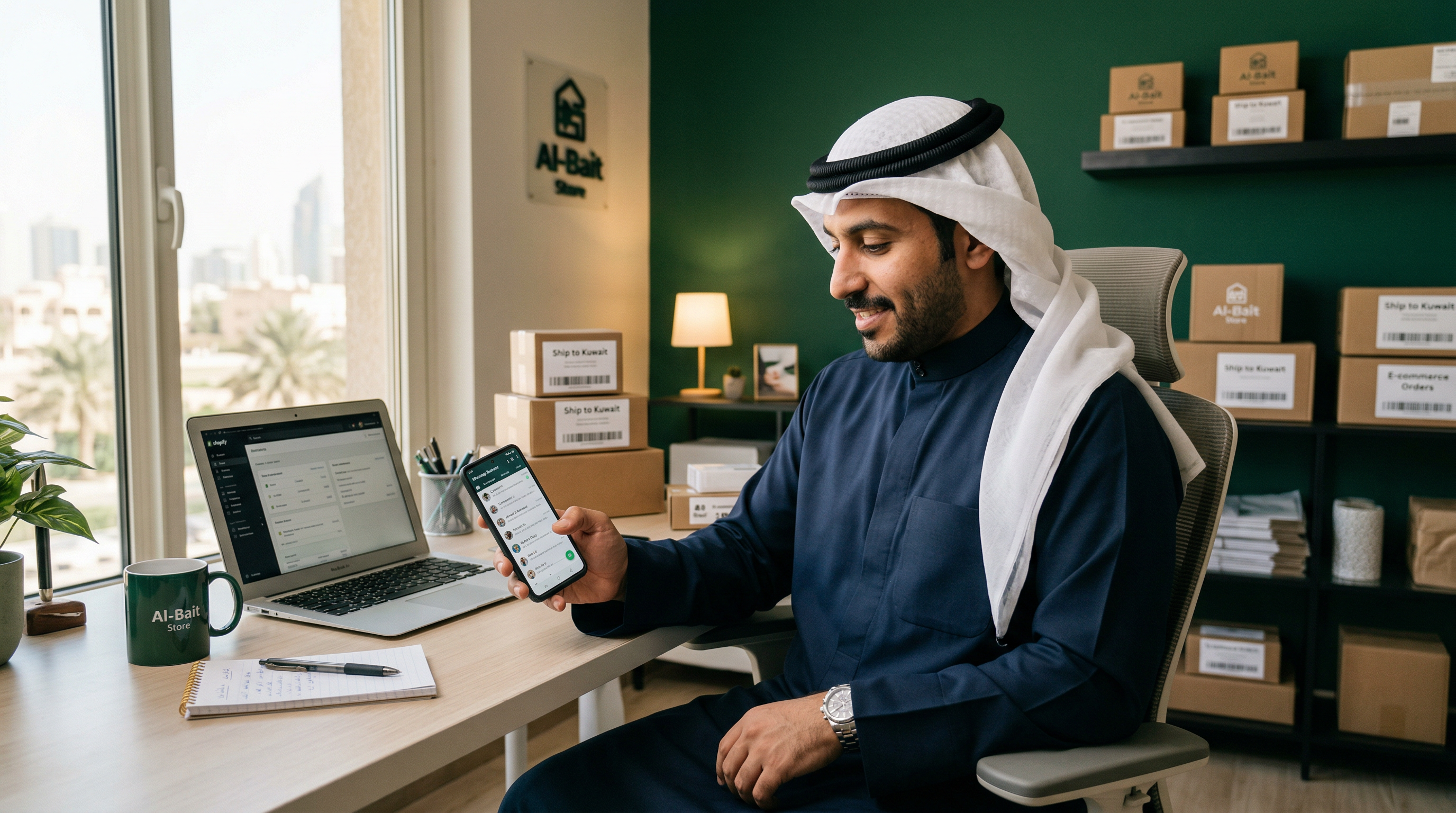
Kuwait has a 98% WhatsApp penetration rate — the highest in the GCC — yet most e-commerce stores here still rely on a single sales rep to manually respond to DMs, often hours after a customer asked a simple question like "Is this in stock?" By the time the reply lands, the customer has already ordered from a competitor. After running 35+ WhatsApp AI deployments across Kuwait and the GCC, we've seen this pattern cost stores between KD 800 and KD 4,000 in lost monthly revenue — from slow response times alone.
This guide walks you through exactly how to fix that: the mistakes killing your conversions, the step-by-step setup process, and what you can do before this Friday to start recovering lost sales.
Why Most Kuwait E-Commerce Businesses Get WhatsApp AI Wrong
Three mistakes show up in almost every audit we run on Kuwait online stores. Each one is fixable within a week.
Mistake 1: Using a Basic Chatbot Instead of an AI Agent
A chatbot follows a script. If the customer deviates — asks a price question in a different way, sends a voice note, or types in mixed Arabic-English — the chatbot breaks. An AI agent like Lojain AI understands context, handles pricing objections, negotiates, and escalates when needed. The fix: replace menu-based flows with a conversational AI agent that can read intent, not just keywords.
Mistake 2: Not Connecting WhatsApp to the Actual Order System
Most stores set up WhatsApp in isolation. The AI has no visibility into inventory, order status, or customer purchase history. So when a repeat buyer asks "where is my order?", the agent has nothing to pull from. The fix: integrate your WhatsApp Business API with your order management system on day one — not later.
Mistake 3: Going Live Without Arabic-First Training
Gulf Arabic is not standard Arabic. A customer in Rumaithiya texting "shfeeh el delivery" expects a natural, local response — not a translated customer service template. The fix: train or configure your AI agent on Gulf Arabic phrasing, common Kuwait slang for product categories, and bilingual switching mid-conversation.
Step-by-Step: How to Set Up WhatsApp AI for E-Commerce in Kuwait
-
Get WhatsApp Business API Access Through a Meta-Verified Solution Provider
You cannot run a real AI agent through the free WhatsApp Business app. You need the API. KIRA is a Meta-verified Solution Provider — not just a reseller — which means faster approval timelines and direct support channels. Standard API approval in Kuwait takes 3 to 7 business days when submitted correctly. Why this matters: without the API, you cannot send proactive messages, connect third-party AI, or run broadcast campaigns legally. A Fahaheel-based electronics retailer we onboarded spent three weeks trying to get approved through an unofficial provider before switching to a direct Meta Solution Provider path — they got access in four days. -
Map Every Customer Journey That Touches WhatsApp
Before building anything, write down every scenario where a customer contacts you on WhatsApp. Include: pre-purchase product questions, price negotiations, order confirmations, delivery follow-ups, complaints, and refund requests. Most Kuwait e-commerce stores identify between 12 and 18 distinct conversation types when they do this exercise properly. Why this matters: each scenario needs a different AI response logic. If you skip this step, you end up with a half-built agent that handles 30% of conversations and confuses the rest. A Salmiya beauty brand found that 41% of their WhatsApp messages were actually post-purchase questions — information they only discovered after mapping, which completely changed their AI setup priorities. -
Connect Tap Payments or KNET for In-Chat Checkout
Kuwait customers abandon carts when the payment step breaks the conversation flow. Integrating Tap Payments or KNET directly into the WhatsApp thread means a customer can go from "I want this" to payment confirmation without leaving the chat. Why this matters: every redirect to an external payment page is a dropout point. The same Salmiya beauty brand saw a 28% drop in payment completions when the checkout link opened in a browser versus staying in the WhatsApp interface. After switching to in-chat payment links, completions recovered to 81% within the first month. -
Deploy Lojain AI as the Frontline Agent — Not a Human
Lojain AI handles pricing objections, complaints, follow-up sequences, and escalations. Configure it to respond in under 3 seconds — which is the response benchmark that Kuwait customers now expect based on Instagram and Snapchat interaction norms. Set clear escalation triggers: Lojain AI handles everything until a conversation meets specific criteria (refund above a certain value, legal complaint, VIP customer flag), at which point it hands off to a human with full conversation context attached. Why this matters: human agents making instant decisions on every message is not scalable past 50 daily conversations, and it is expensive. The AI handles volume; humans handle edge cases. -
Build a Broadcast Sequence for Abandoned Carts and Re-Engagement
WhatsApp Business API lets you send templated messages to opted-in customers. Build three sequences minimum: abandoned cart (sent 1 hour after drop-off), post-purchase follow-up (sent 48 hours after delivery), and a win-back sequence for customers inactive for 30 days. Each message must be approved as a Meta template — plan for 24 to 48 hours for template approval. Why this matters: the Gulf consumer responds to WhatsApp messages at a 60 to 70% open rate versus 18 to 22% for email, according to internal campaign data from KIRA's Kuwait client base. A Hawalli fashion retailer running a 3-step abandoned cart sequence recovered 19% of dropped orders in the first 30 days. See more results like this in our case studies. -
Set Up Arabic-English Language Detection
Configure your AI agent to detect the customer's language in the first message and mirror it throughout the conversation. If a customer opens in Gulf Arabic, respond in Gulf Arabic. If they switch to English mid-conversation, the agent switches too. This is not optional for Kuwait e-commerce — roughly 35% of customers switch languages at least once during a purchase conversation, based on our deployment data. Why this matters: a customer who gets a response in the wrong language or in formal Modern Standard Arabic when they wrote in Kuwaiti dialect will not trust the brand. Language match is a conversion signal. -
Track, Audit, and Optimize Weekly for the First 60 Days
After go-live, pull conversation logs weekly. Look for: questions the AI answered wrong, conversations where the customer dropped off after the AI's response, and topics that come up repeatedly but are not in your current AI training. The first 60 days are not set-and-forget. They are calibration. A Mishref home goods store reduced their AI error rate from 14% to under 3% in 45 days purely through weekly log reviews and response updates. After day 60, monthly audits are typically sufficient. For smaller operations, the Lojain Lite Bundle includes built-in audit reporting to simplify this process.
Real Results: Two Kuwait E-Commerce Cases
A Salmiya-based skincare and beauty e-commerce store — selling through Instagram and their own website — came to us with one specific problem: they were getting 200 to 300 WhatsApp messages per day and had two staff members managing responses manually. Average response time was 47 minutes. After deploying Lojain AI with in-chat Tap Payments integration, response time dropped to under 3 seconds. Within 60 days, their conversion rate on WhatsApp inquiries went from 11% to 29%. The two staff members shifted from answering repetitive questions to handling wholesale inquiries and influencer partnerships — higher-value work the business had been neglecting.
A Hawalli electronics accessories retailer selling phone cases, chargers, and screen protectors had a different problem: high traffic, low repeat purchase rate. Customers bought once and disappeared. We built a post-purchase WhatsApp sequence: a delivery confirmation message, a usage tip 48 hours after delivery, and a product recommendation message at day 14 tied to what they purchased. The re-engagement sequence alone drove a 23% increase in repeat purchases within the first 90 days. Their customer lifetime value grew from an average of KD 12 to KD 19 per customer across that period. Their campaign structure is detailed further in our case studies section.
What to Do This Week
You do not need to complete the full setup before Friday. Three actions will move you forward immediately.
Action 1: Audit your current WhatsApp response time. Go into your WhatsApp Business inbox and measure average first-response time for the last 7 days. If it is over 10 minutes, you are losing orders. This number is your baseline — you need it before any conversation about improvement makes sense.
Action 2: List your top 10 most frequently asked questions. Check your inbox and write them down. These are the first 10 responses your AI agent needs to handle. If you cannot name 10, you are not ready to build an AI flow — and that is fine, the list itself is the starting point.
Action 3: Verify your WhatsApp API eligibility. Your phone number must be a clean Kuwait number, not already registered on the WhatsApp Business app with a non-API setup, and your Facebook Business Manager must be verified. Checking these three conditions takes 15 minutes and tells you whether you can start API onboarding this week or need to fix something first. You can check KIRA's WhatsApp Business API page for the eligibility requirements specific to Kuwait businesses.
How WhatsApp AI Compares to Other Customer Communication Options
| Channel | Avg. Open Rate (Kuwait) | Response Time (AI-enabled) | Arabic Support | In-Chat Payment | Best For |
|---|---|---|---|---|---|
| WhatsApp AI (API) | 60–70% | Under 3 seconds | Gulf Arabic + English | Yes (Tap / KNET) | Sales, support, re-engagement |
| 18–22% | N/A (async) | Limited | No | Newsletters, receipts | |
| Instagram DM | ~40% | Manual only (no API AI) | Manual | No | Discovery, influencer traffic |
| SMS | 35–45% | No AI capability | Limited | No | One-way alerts |
| Live Chat (website) | N/A (reactive) | Depends on staffing | Varies | No | On-site browsing support |
For Kuwait e-commerce specifically, WhatsApp AI is not one option among equals. The open rate differential alone makes it the primary conversion channel. If you are comparing providers, see our breakdown of Wati vs. Lojain for a direct feature-by-feature comparison relevant to GCC businesses.
Common Questions About WhatsApp AI for E-Commerce in Kuwait
What is the best WhatsApp Business API provider in Kuwait?
The best provider is one that is Meta-verified, supports Gulf Arabic AI responses, and has local Kuwait integration experience — specifically with Tap Payments, KNET, and Kuwait-based e-commerce platforms. KIRA is a Meta-verified Solution Provider with direct Kuwait deployment experience. Generic global providers often lack Gulf Arabic training data and local payment integrations, which creates gaps in the customer experience.
Is WhatsApp AI legal for e-commerce in Kuwait?
Yes, provided you use the official WhatsApp Business API through a Meta-approved provider and only send messages to customers who have opted in. Bulk messaging through unofficial tools or non-API methods violates WhatsApp's terms of service and risks permanent number bans. The API path with proper opt-in flows is both legally compliant and more effective.
How long does it take to set up WhatsApp AI for a Kuwait online store?
API approval typically takes 3 to 7 business days for Kuwait numbers when submitted through a Meta-verified provider. Building the AI agent flows, connecting payment systems, and testing takes an additional 5 to 10 business days depending on the complexity of your product catalog and conversation scenarios. Most Kuwait e-commerce stores we work with go live within 2 to 3 weeks from initial setup call.
Can WhatsApp AI handle both Arabic and English customers?
Yes, but not all solutions handle this equally. Lojain AI is configured specifically for Gulf Arabic and English, including mid-conversation language switching. Standard global AI tools often handle Modern Standard Arabic but struggle with Gulf dialect vocabulary, which is what most Kuwait customers actually use. Confirm dialect capability — not just "Arabic support" — before choosing a provider.
What happens when a customer asks something the AI cannot answer?
A well-configured AI agent should have clear escalation rules. When a conversation exceeds the AI's confidence threshold or meets specific trigger criteria (complaint type, order value, return request), it escalates to a human agent with the full conversation history attached. The human does not start from scratch — they pick up mid-conversation with full context. This hybrid model is what makes AI practical for e-commerce rather than a liability.
How do I measure whether WhatsApp AI is working for my Kuwait store?
Track four numbers: first-response time (target under 3 minutes, ideally under 3 seconds), conversation-to-order conversion rate, repeat purchase rate from WhatsApp contacts, and escalation rate (how often the AI needs human backup). If your escalation rate is above 20% after 60 days, your AI needs retraining. If conversion rate is flat after 30 days, review your payment flow and language configuration first.
Does WhatsApp AI work for small Kuwait e-commerce stores or just large ones?
It works at any volume, but the return on investment accelerates above 50 daily WhatsApp conversations. Below that threshold, a semi-automated setup with smart templates and quick replies may be sufficient. The Lojain Lite Bundle is built specifically for smaller Kuwait businesses that need AI capability without enterprise-level infrastructure. Check KIRA's pricing page for current options by business size.
Kuwait's e-commerce market is not waiting. Customers who message your competitors and get a response in 2 seconds while yours takes 40 minutes are not coming back. The infrastructure to fix this exists, it works in Gulf Arabic, and it connects directly to KNET and Tap Payments. The question is not whether to build it — it is how fast you move.
Talk to Us on WhatsAppReady to Scale Your Marketing with AI?
KIRA delivers AI-powered marketing systems, WhatsApp automation, and media buying strategies for businesses worldwide.
Book a Strategy Call More ArticlesGet KIRA in your AI answers
Add KIRA as a Google Preferred Source so our articles show a "Preferred" badge in your AI Overviews & AI Mode results. Log in to Google, then tick the box next to kiraco.org.
Add KIRA as a Preferred Source