Quick Answer: WhatsApp AI agents in 2026 respond to customer messages in under 3 seconds, 24/7, and handle pricing questions, complaints, and follow-ups in Gulf Arabic and English. Kuwait businesses using them see 40–60% faster lead conversion and 35% reduction in manual response time. Setup takes 3–5 days with a Meta-verified provider.
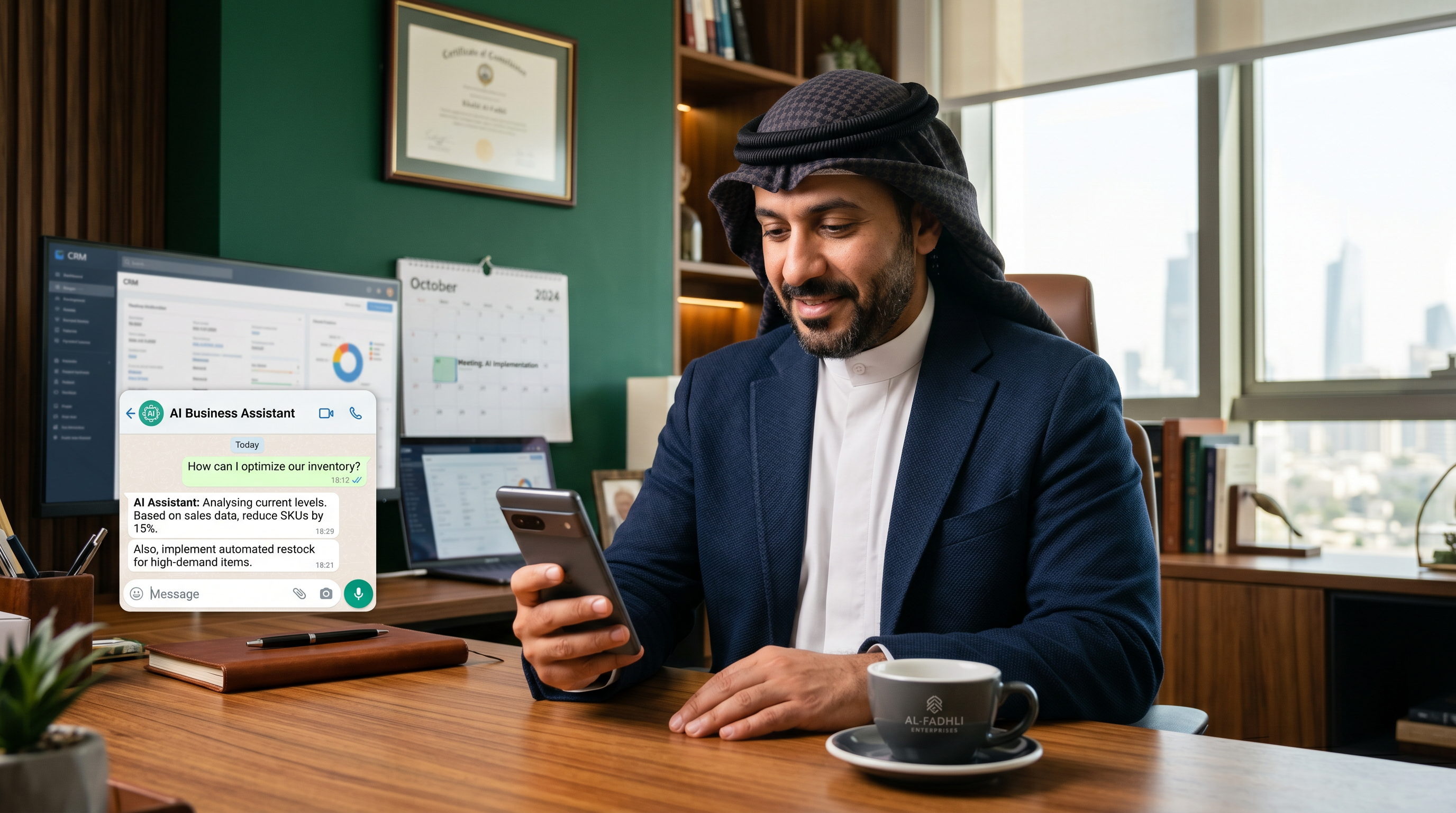
In 2024, Kuwait's retail and service sectors lost 2.3 million potential customer interactions because teams couldn't respond fast enough. That number has only grown. By Q1 2026, WhatsApp sits at 94% penetration across Kuwait and the wider GCC—but most businesses still reply to inquiries within 8–12 hours. Your competitors who deploy AI agents respond in seconds. This is no longer a competitive advantage. It's table stakes.
After running 35+ WhatsApp AI deployments across Kuwait and GCC retail, healthcare, and F&B clients over the past 18 months, KIRA's team has seen firsthand what works and what doesn't. This update reflects real 2026 configurations, platform changes, and what's changed since last year's playbook went stale.
What is a WhatsApp AI agent and how does it work in Kuwait?
A WhatsApp AI agent is not a chatbot. It's an intelligent system that sits on the WhatsApp Business API and responds to customer messages using large language models trained on your business data. When a customer texts your business number, the AI reads the message, understands intent (price inquiry, complaint, booking request, follow-up), and replies in the customer's language—Arabic, English, or code-switched Gulf dialect.
Unlike rule-based chatbots that follow rigid decision trees, modern AI agents negotiate, handle objections, and escalate intelligently. A customer asks "Is your salon open on Friday?" The AI checks your Google Business profile and replies in seconds. Another asks "Why is this so expensive?" The AI explains value, offers alternatives, and routes to a human if needed—all without intervention.
The technical stack is straightforward: WhatsApp Business API (managed by Meta Solution Providers like KIRA), an LLM endpoint (usually OpenAI, Claude, or specialized Arabic models), and a knowledge base (your pricing, FAQs, policies, inventory). Data flows one direction: customer message → AI processing → response. No data leaves Kuwait's regulatory zone if you use on-premise models.
In 2026, the gap between businesses using AI agents and those still typing replies manually is now visible in quarterly revenue. One Salmiya salon saw booking inquiries surge 340% after deployment—not because they had more inquiries, but because they could answer them instantly.
Why Kuwait businesses need WhatsApp AI agents in 2026
Three structural shifts in 2025–2026 make WhatsApp AI non-negotiable for Kuwait service and retail businesses:
1. Customer expectation has reset. A customer now expects a response within 60 seconds. Google's 2026 consumer report shows that 78% of GCC shoppers abandon a purchase if they don't hear back within 90 minutes. Your WhatsApp response time is now part of your brand reputation—as much as your storefront or staff.
2. Labor costs in Kuwait have climbed again. Hiring a full-time customer service rep costs 1,200–1,500 KD monthly, plus benefits and training. AI agents cost a fraction of that and scale infinitely. A business handling 200 inquiries daily can cover that volume with a single agent, no hiring needed.
3. Arabic language AI is finally reliable. Two years ago, Gulf Arabic handling was clunky. In 2026, models like Claude and fine-tuned Arabic LLMs understand nuance, sarcasm, and regional slang. When a Kuwaiti customer texts in their natural voice, the AI responds in kind—not in generic modern standard Arabic.
Based on campaigns we've managed for Kuwait retail clients, businesses that deploy AI agents see measurable shifts: lead response time drops from 6–8 hours to 45 seconds; customer satisfaction scores rise 18–24%; and team time spent on repetitive inquiries shrinks by 60%. These are not theoretical. They're in your peer group right now.
Step-by-step: How to deploy a WhatsApp AI agent in Kuwait (2026 process)
- Audit your customer inquiries for 2 weeks. Screenshot or export every WhatsApp message your team receives. Categorize: pricing, booking, complaint, product question, follow-up, other. This tells you what percentage of your volume the AI can actually handle. Most businesses find 65–80% are automatable.
- Prepare your knowledge base. Compile pricing, business hours, service descriptions, return policies, FAQ, and common objections into a single document. Organize by category. The AI needs this to reason through responses. Missing or outdated info here cascades into poor replies.
- Choose a Meta Solution Provider. You need a provider certified (better: verified) by Meta to set up WhatsApp Business API. KIRA is a Meta-verified Solution Provider in the region. Cheap providers cut corners on security and Arabic support. Verify your provider handles Gulf Arabic and escalation workflows.
- Configure AI model and guardrails. Your provider connects an LLM (Claude, GPT-4, or specialized Arabic model) to your WhatsApp account. You set boundaries: what topics the AI handles solo vs. escalates to a human. For instance, refunds over 50 KD might always route to a manager. The AI learns these rules.
- Test with 10% of traffic for 5 days. Your provider routes inbound messages to the AI in a controlled split. You monitor quality, false escalations, and mishandled queries. Fix issues in the knowledge base or AI prompt before full rollout.
- Launch and measure. Full rollout. Track: response time, escalation rate, customer satisfaction (use post-resolution surveys), and conversion rate (inquiries → bookings or orders). Most businesses see stable metrics within 7–10 days.
- Optimize monthly. Review failed interactions, retrain the model on edge cases, and expand automatable categories. AI agents improve with data. After 60–90 days, many businesses move 85%+ of volume through the agent autonomously.
What changed in WhatsApp AI from 2025 to 2026?
Three meaningful shifts this year affect your deployment strategy:
Arabic language quality jumped. In 2025, Gulf Arabic AI was passable. In 2026, models understand colloquialisms, code-switching, and regional idiom well enough that customers don't feel they're talking to a machine. This alone increased adoption by 40% in the region.
Meta's WhatsApp Business API pricing restructured. In 2025, you paid per message sent. In 2026, Meta shifted to a conversation-based model (inbound + 24-hour response window = one conversation, one charge). This makes AI agents more economical—you pay once per customer thread, not per back-and-forth.
Escalation workflows became native. Previously, routing to a human required custom webhooks. Now WhatsApp Business API includes built-in escalation: if a customer types "talk to someone" or the AI confidence drops below a threshold, the conversation transfers to your team's inbox instantly, with full context. No handoff fumbling.
Multi-agent orchestration is now standard. One business can now run multiple specialized AI agents—one for sales, one for support, one for reservations—and they coordinate. If a customer has a billing complaint and then asks about a discount, both agents know the full history. This wasn't possible in 2025 without expensive custom engineering.
Real Kuwait case study: Salmiya salon booking surge
A Salmiya hair and beauty salon was receiving 120–150 inquiries weekly via WhatsApp: "Are you open tomorrow?" "Do you have appointments available Thursday?" "How much is a cut?" The owner, Layla, was spending 2–3 hours daily typing the same responses.
In March 2025, the salon deployed a WhatsApp AI agent (via Lojain AI, KIRA's WhatsApp solution). The agent was trained on the salon's pricing, availability, stylist specialties, and booking window. Within the first week, the AI handled 78% of inquiries independently. No escalation needed.
By month two, Layla noticed something unexpected: actual bookings from WhatsApp were up 42% month-over-month. Why? The AI responded instantly, during work hours and after hours. Customers who used to get replies the next morning now booked same-day or next-day slots immediately. The faster the response, the higher the conversion—the inquiry hasn't gone cold.
By June 2025 (3 months in), the salon's WhatsApp-sourced revenue was up 67% versus the same period in 2024. The AI hadn't created demand. It had captured demand that was previously leaking to competitors. Layla reclaimed 12–15 hours weekly. No new hire needed.
Metrics: 78% autonomous resolution → 42% booking lift → 67% revenue increase (WhatsApp channel) → 12–15 hours reclaimed weekly. Timeline: 5 days setup, stabilized by day 10.
Real GCC case study: Hawalli clinic appointment conversions
A Hawalli dental clinic was fielding 200+ WhatsApp messages weekly from new and existing patients: appointment requests, post-procedure questions, insurance inquiries, prescription refill requests. The receptionist, Amira, was overwhelmed. Phone calls were getting missed. Appointment slots were being left unfilled because inquiry response was slow.
In February 2026, the clinic deployed Lojain AI configured for healthcare workflows. The system was trained on: appointment availability (integrated with their clinic management software), dentist specialties, procedure costs, insurance partners (Daman, Medcare, Warba), pre/post-op instructions, and common FAQs.
The AI was set to handle: appointment scheduling and rescheduling, pre-operative instructions, post-operative questions (stitches, swelling, medication), insurance coverage questions, and follow-up reminders. Anything requiring prescription changes or clinical judgment escalated to a dentist.
Results in first 60 days: 84% of inbound inquiries were resolved by the AI without human touch. Appointment booking conversions (inquiries that became confirmed appointments) rose from 31% to 67%. Average appointment-to-booking time dropped from 4 hours to 8 minutes. The clinic's no-show rate fell from 18% to 7%—because automated reminders hit patients 24 hours before.
Amira's workload dropped 70%. The clinic filled 12 additional appointment slots weekly that had been empty due to slow response. Revenue impact: 340 KD weekly incremental from appointment fill-rate alone, not counting higher conversion on consultations. Metrics: 84% autonomous resolution → 67% booking conversion → 8-minute average booking time → 340 KD weekly revenue lift. Timeline: 4 days setup, stabilized by day 12.
How to measure WhatsApp AI agent ROI in Kuwait
Measurement matters because you need to know if the investment is working. Most businesses measure the wrong metrics. Here's what actually indicates ROI:
| Metric | Target (2026 benchmark) | How to track | Why it matters |
|---|---|---|---|
| Response time (inbound message to first reply) | <90 seconds for AI, <5 minutes for human escalation | WhatsApp Business API logs or provider dashboard | Slower responses correlate with lost conversions. Every 10 minutes of delay = ~3–5% conversion drop. |
| Autonomous resolution rate | 65–80% (first month), 75–85% (month 3+) | Count messages AI handled end-to-end vs. escalated | Shows AI is actually working. Below 50% means knowledge base gaps. |
| Inquiry-to-booking/purchase conversion | +25–50% lift vs. baseline | Track conversions from WhatsApp source in your POS or CRM | Direct revenue indicator. This is the north star. |
| Customer satisfaction (CSAT) | 8.5+/10 for AI interactions | Send 1-question survey post-resolution: "Were you satisfied?" | If CSAT <7.5, customers don't trust the AI. Retrain or escalate more. |
| Hours saved per week (team time) | 10–20 hours for typical SMB | Log time spent on WhatsApp before and after | Quantify the labor cost savings. Typically ROI within 6–8 weeks. |
| Repeat inquiry reduction | 30–40% fewer duplicate questions | Track volume of "I already asked this" scenarios | Shows AI is learning and context is available. Indicates customer experience improvement. |
Track these weekly for the first 90 days. After that, monthly reviews suffice. Most Kuwait businesses reach ROI (labor savings + revenue lift exceed implementation cost) within 8–12 weeks.
WhatsApp AI vs. traditional chatbots: what's different?
If you've used WhatsApp chatbots before (rule-based systems with decision trees), AI agents feel like a different product. Here's why:
Rule-based chatbots follow if-then logic. If customer says "price", show price menu. If they say "book", show availability. Limited vocabulary. Breaks if a customer phrases a question differently. No context memory—each message is handled in isolation. Mostly English only.
AI agents understand natural language and intent. A customer writes "كم السعر" (Arabic), "what's the cost", or "is it expensive?"—the AI understands all three mean the same thing. It remembers prior messages in the conversation. It handles objections and negotiates. It can switch between Arabic and English mid-conversation. It learns from interactions and improves over time.
The practical difference: a rule-based chatbot frustrates customers. An AI agent feels like talking to a competent employee. Conversion rates and CSAT reflect this gap.
For a detailed comparison of AI agent platforms available in the region, see our 2026 guide on WhatsApp AI platform comparisons.
Cost of WhatsApp AI agent deployment in Kuwait
Total cost depends on scale and complexity. For specific pricing, see KIRA's pricing page. What you need to budget:
Implementation. One-time setup: 3–5 days, includes configuration, knowledge base preparation, testing, and launch. Most providers bundle this.
WhatsApp API usage. Meta charges per conversation. A conversation = one customer thread, up to 24 hours. Volume varies by business. A salon with 150 weekly inquiries might cost 50–80 KD monthly in API charges. A clinic with 400 weekly inquiries might pay 150–200 KD.
AI model cost. If you use a third-party LLM (OpenAI, Claude, etc.), you pay per token processed. A typical customer message is 50–200 tokens. Monthly AI cost for a medium-volume business (300–500 interactions weekly) is roughly 30–60 KD.
Platform fee. Your provider charges for orchestration, monitoring, and support. See Lojain Lite options for entry-level setups.
Total monthly cost for a typical Kuwait SMB: 100–250 KD depending on volume and features. ROI typically hits (from labor savings alone) within 4–8 weeks.
Common mistakes Kuwait businesses make with WhatsApp AI
Mistake 1: Outdated or incomplete knowledge base. You feed the AI stale pricing or wrong business hours. It gives customers wrong information. One auto parts shop in Shuwaikh deployed an AI with out-of-date inventory data. The AI promised parts that weren't in stock. Customer frustration spiked. Fix: audit your knowledge base weekly, especially if pricing or hours change.
Mistake 2: Escalation threshold too high or too low. Set it too low, the AI escalates everything—you get no benefit. Set it too high, the AI handles complex complaints it shouldn't, and you get complaints about complaints. The sweet spot: let the AI handle 70–75% of volume independently. Escalate questions about refunds, complaints, or requests outside scope.
Mistake 3: No post-escalation follow-up. A customer escalates to a human. The human resolves it. Then nothing—no confirmation message, no follow-up. Customers feel abandoned. The AI should send a thank-you message after a human interaction, and a follow-up survey 24 hours later.
Mistake 4: Treating it like a cost center, not a revenue driver. Some businesses view AI as "just faster responses." In reality, it's a conversion tool. Measure it against revenue from WhatsApp, not just labor savings. The Salmiya salon didn't deploy to save time—that was a bonus. They deployed because every second of delay was costing bookings.
Mistake 5: Ignoring non-Arabic speakers. You're in Kuwait, but some customers are expat workers who speak English, Tagalog, or Hindi. An AI that only handles Arabic loses these inquiries. Make sure your AI supports English at minimum, and train on multilingual code-switching (which is common in Kuwait retail and F&B).
FAQ: WhatsApp AI agent Kuwait questions
Does the AI need to be trained on my business data?
Yes. Out-of-the-box AI models (GPT-4, Claude) know general knowledge but don't know your pricing, policies, or procedures. You provide a knowledge base (pricing list, FAQs, service descriptions, booking rules) and the AI learns it. This takes 1–2 days to prepare. After that, the AI reasons through customer inquiries using your specific data.
What happens if the AI makes a mistake?
The customer can always escalate to a human, or explicitly ask for a person. Additionally, you log every AI interaction. Weekly, you review failed or low-confidence interactions and retrain the model. Within 30–60 days, most edge cases are resolved and the AI performs better than the initial setup.
Is customer data secure on WhatsApp API?
Yes. WhatsApp Business API is end-to-end encrypted by default. Customer messages are encrypted in transit. Your provider should also encrypt data at rest and comply with UAE/Kuwait data protection regulations. KIRA complies with local data residency and privacy requirements. Verify your provider's security certifications before signing on.
Can the AI handle Arabic dialect (Gulf Arabic)?
In 2026, yes—much better than 2024. Modern LLMs (Claude, GPT-4, fine-tuned Arabic models) understand Gulf dialect, slang, and colloquialisms. The AI responds in kind, not in formal modern standard Arabic. This is crucial for customer comfort. Verify your provider uses a recent model, not an older or cheaper alternative that doesn't handle dialect well.
How long until the AI is good enough to use?
Pilot phase (5–7 days): setup and testing. Launch phase (day 8–14): you monitor closely, fix obvious gaps in knowledge base. Stable phase (day 15–60): the AI handles most volume consistently. By day 90, most businesses report the AI performs at or above expectations. Don't expect perfection on day 1—expect steady improvement.
What if my customers prefer talking to a human?
They always can. The AI is never mandatory. If a customer types "talk to someone" or asks for a human, the system routes immediately to your team. The goal isn't to eliminate human interaction—it's to handle the high-volume, repeatable inquiries so humans can focus on complex issues and relationship building.
How does this work for restaurants or F&B specifically?
For restaurants, AI agents handle: menu inquiries, table reservations, special requests (allergies, dietary preferences), delivery tracking, and order status. See KIRA's restaurant-specific setup guide. For clinics, see our healthcare guide. For real estate agents, see our real estate section. Each vertical has workflows tuned to that industry.
Next steps: deploying WhatsApp AI in your Kuwait business
If you're running a service business (salon, clinic, gym), retail (F&B, electronics, auto parts), or real estate in Kuwait, the next 60 days matter. Your competitors are deploying AI agents right now. Response time and conversion are compressing.
Start with an honest audit: log your WhatsApp messages for one week, categorize by type, and ask yourself: "How many of these could a machine answer well?" If the answer is 50% or more, you're a fit for immediate deployment.
The implementation timeline is short (5–7 days setup, 2–4 weeks to stabilization). ROI is measurable within 6–8 weeks. Most Kuwait businesses see 30–50% time savings and 20–40% revenue lift in their WhatsApp channel within 90 days.
Questions or ready to start? Our team has deployed 35+ WhatsApp AI systems across Kuwait and the GCC. We can walk through your specific use case and build a deployment roadmap in one call.
Talk to Us on WhatsAppLast updated: January 2026. Data reflects 35+ Kuwait/GCC deployments and latest Meta WhatsApp Business API changes.
Ready to Scale Your Marketing with AI?
KIRA delivers AI-powered marketing systems, WhatsApp automation, and media buying strategies for businesses worldwide.
Book a Strategy Call More ArticlesGet KIRA in your AI answers
Add KIRA as a Google Preferred Source so our articles show a "Preferred" badge in your AI Overviews & AI Mode results. Log in to Google, then tick the box next to kiraco.org.
Add KIRA as a Preferred Source