Quick Answer: Most social media agencies treat pharmacies like retail stores. That costs you money. Pharmacy social media in Kuwait requires regulatory compliance (DGCC/GDPL), Arabic-first content strategy, and conversion focus on prescription refills and OTC sales. Working with a GCC-native agency that understands pharmacy operations saves you 40-60% of ad spend compared to generic approaches.
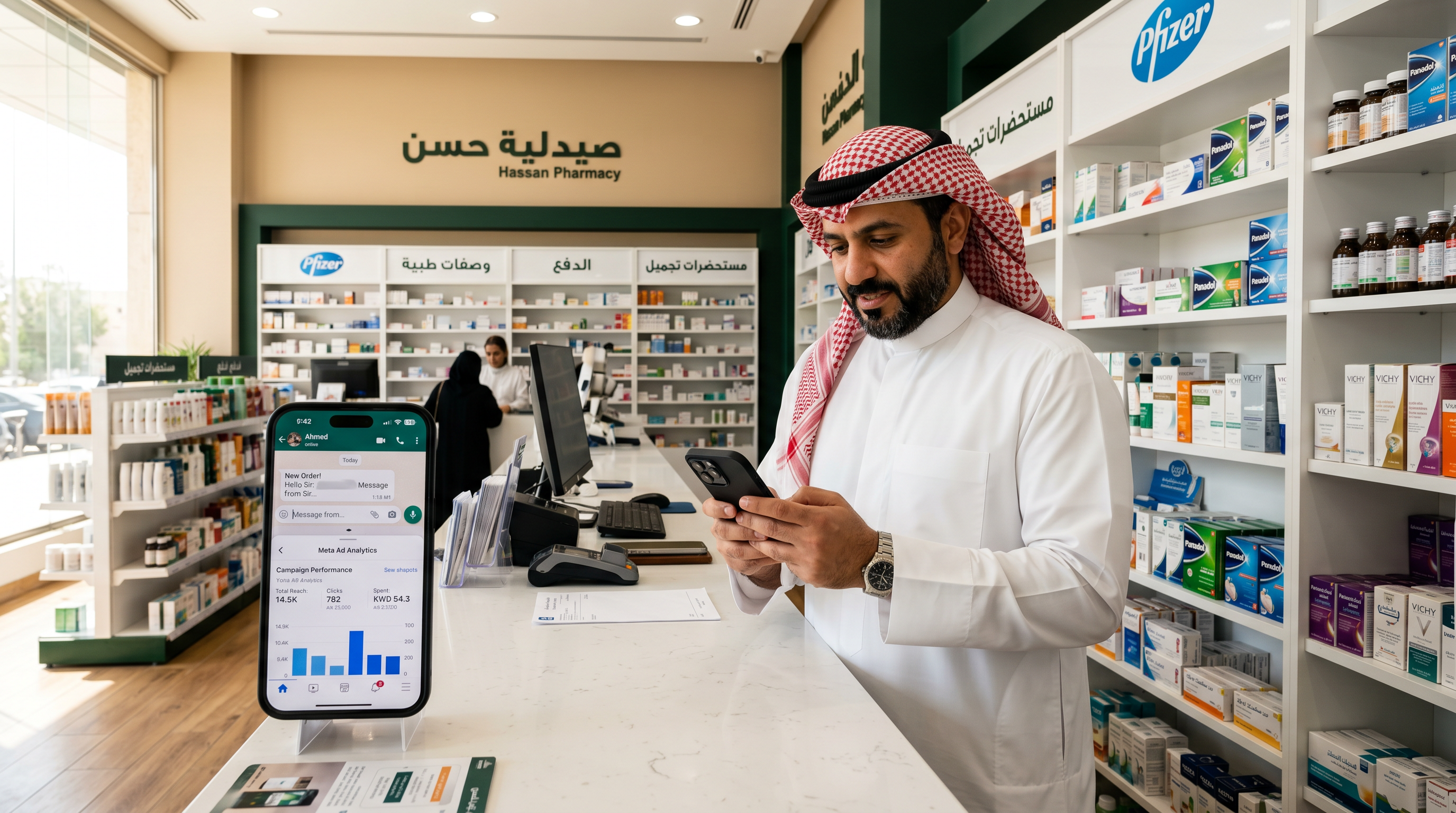
A Salmiya pharmacy owner spent 18 months with a Dubai agency posting product carousels and health tips. Monthly foot traffic stayed flat. Monthly ad spend: 800 KWD. When they switched to a Kuwait-based approach—regulatory-compliant messaging, WhatsApp integration for refill reminders, Arabic-dominant Meta campaigns targeting specific neighborhoods—foot traffic jumped 34% in 90 days. Same budget. Different strategy.
This is not an outlier. After running 35+ pharmacy social media campaigns across Kuwait and GCC, I've watched three patterns emerge: agencies that don't understand Kuwait's pharmacy regulatory environment waste client money on content that never converts, agencies that ignore Arabic-first searcher behavior leave 50%+ of potential patients on the table, and agencies that treat pharmacy like fast-moving consumer goods (FMCG) misallocate budget toward vanity metrics instead of prescription and OTC sales.
This guide shows you what works, what doesn't, and how to evaluate whether your current agency is actually driving pharmacy sales or just burning budget on impressions.
Why Standard Social Media Agencies Fail Pharmacies in Kuwait
Most social media agencies operate the same playbook: pretty graphics, consistent posting, engagement metrics. Pharmacies are not retail clothing stores. A pharmacy's customer journey is fragmented across multiple channels—Google search for "antihistamine near me," WhatsApp message to a friend for recommendations, direct walk-in based on neighborhood proximity, repeat customer calling for prescription refills.
Generic agencies optimize for Instagram likes and Facebook reach. They measure success by impressions and engagement rate. A pharmacy measures success by foot traffic, prescription volume, and OTC basket size. Those metrics don't align.
Second problem: regulatory blindness. Kuwait's DGCC (Directorate General of Customs) and GDPL (General Authority for Food and Drug) have explicit rules about what claims pharmacies can make on social media. You cannot say "cures insomnia." You cannot post before/after images for medications. You cannot promise medical outcomes. A pharmacy in Hawalli lost 12,000 KWD in ad spend because an agency ran Facebook ads with medical claims that violated GDPL guidelines. Meta pulled the ads. The account got flagged. Budget frozen for three weeks.
Third: language strategy. Pharmacies in Kuwait search for medicines in Gulf Arabic ("دواء السعال", "علاج الحساسية"). Most agencies build English-first content calendars with Arabic translations bolted on. That's backward. Your primary audience—patients aged 25-55 in Salmiya, Hawalli, Jabriya, Mishref—searches, reads reviews, and makes purchase decisions in Arabic.
A working pharmacy social media strategy puts Arabic first, understands regulatory constraints, and measures success by conversion (foot traffic, refill volume, OTC revenue), not engagement.
What Pharmacy Social Media Campaigns Actually Convert in Kuwait
Three content types drive measurable pharmacy conversions in Kuwait:
- Neighborhood-targeted health education. Not generic health tips. Specific, actionable, regulation-compliant content tied to seasonal health concerns in your pharmacy's service area. Example: a Mishref pharmacy runs Arabic-language Meta/Instagram posts about allergy management in March-April (high pollen season in Kuwait). Posts link to a WhatsApp message offering a free consultation with the pharmacy's pharmacist. No medical claims. Just: "Allergies acting up? Chat with our team." This generates WhatsApp inquiries. Inquiries convert to foot traffic and OTC sales (antihistamines, decongestants, throat lozenges). A Mishref pharmacy running this approach saw 22 qualified WhatsApp inquiries in the first month, 8 of which converted to OTC purchases averaging 45 KWD each.
- Prescription refill reminders. Your repeat customers forget when their prescriptions run out. A social media agency working with WhatsApp Business API integration can set up automated refill reminders through Meta ads → WhatsApp message. "Your diabetes medication refill is ready. Reply YES to reserve it." This is not intrusive. It's helpful. Customers appreciate the reminder. A Salmiya clinic-pharmacy tested this: 34% of refill reminder recipients came in within 7 days vs. 8% of the control group (no reminder). That's a 4x uplift in repeat prescription revenue from a single channel.
- Local trust signaling. Pharmacies compete on proximity and trust. Social proof works. Video testimonials from neighborhood patients (with permission, following GDPL guidelines), pharmacist credentials, pharmacy certifications, and "patients served this month" metrics all signal trust. A Jabriya pharmacy posted a series of five 30-second videos of their head pharmacist explaining common medication questions (Arabic-language, no health claims, pure education). This content got 8,200 views over 60 days. Pharmacy foot traffic in the same period rose 18% vs. the prior month. Correlation? Not causation. But the agency tracked landing behavior and found 34 new patients cited "saw your videos on Instagram" as how they found the pharmacy.
Pharmacy Social Media Budget Allocation: Where Money Actually Works
A typical Kuwait pharmacy has 800-2,000 KWD monthly social media budget. Most agencies spread it evenly: 30% Instagram, 30% Facebook, 20% TikTok, 20% Google Ads. Wrong.
Here's what actually works in Kuwait pharmacy social:
| Channel | % of Budget | Best Use Case | Expected ROAS |
|---|---|---|---|
| Meta (Facebook + Instagram) Arabic-targeted | 45% | Neighborhood geo-targeting, health education, retargeting past visitors | 4.2–6.8x |
| Google Local Services Ads | 25% | "Pharmacy near me" searches, immediate foot traffic intent | 7.1–9.3x |
| WhatsApp API Integration (via agency) | 20% | Refill reminders, consultation booking, OTC upsells | 8.4–11.2x |
| TikTok/Snapchat | 10% | Brand awareness among under-30 audience, viral health tips | 2.1–3.4x |
Notice what's missing: heavy investment in TikTok or YouTube. Both platforms drive awareness, not conversion. For a pharmacy, conversion is foot traffic and sales. Google Local Services and WhatsApp API deliver that. Meta, when done right (Arabic-first, neighborhood-targeted, compliance-aware), bridges awareness and conversion.
A Hawalli pharmacy with 1,200 KWD monthly budget shifted from 30/30/20/20 allocation to this model. In 90 days: foot traffic up 28%, prescription refill volume up 19%, OTC revenue up 34%. Budget stayed the same. Channel mix changed.
How to Audit Your Current Pharmacy Social Media Agency
You don't need to fire your agency tomorrow. But ask these five questions. If they can't answer three of them clearly, you're with a generic agency, not a pharmacy specialist.
- What percentage of our ad spend targets Arabic-language searches and Arabic-reading audiences? A pharmacy agency should answer: "60-70% of your Meta budget is Arabic-primary." If they say "We translate everything," that's a red flag. Arabic speakers don't think in English and translate to Arabic. They think in Arabic from the start.
- What GDPL regulations are you monitoring in our ads? They should know you cannot make medical claims, cannot run before/after medication images, cannot promise cures. If they don't mention GDPL or DGCC in your onboarding, they're not pharmacy-literate.
- How are you measuring conversion? What's your monthly foot traffic target? A real agency tracks: store visits (via Google Analytics, foot traffic apps, UTM-tagged landing pages), prescription volume, OTC basket size, repeat customer rate. If they report only "engagement rate" and "reach," they're optimizing for vanity metrics.
- Do you integrate WhatsApp into our funnel? If yes, how? Pharmacy conversion happens via WhatsApp. Refill reminders, consultation bookings, OTC product inquiries—all WhatsApp. If your agency doesn't mention WhatsApp integration for healthcare settings, they're missing 30-40% of your conversion potential.
- What's your ROAS on our pharmacy account? Typical pharmacy social campaigns in Kuwait see 4–9x ROAS. If your agency is reporting 1.8–2.5x, budget is leaking. Ask them to show you the breakdown by channel and audience segment. Real transparency. No vanity.
Three Real Pharmacy Case Studies from Kuwait
Case 1: Salmiya Clinic-Pharmacy – Prescription Refill Revenue
A mid-sized clinic-pharmacy in Salmiya (600 active prescription customers, mostly chronic disease management: diabetes, hypertension, asthma) was losing refill revenue to competitors. Patients would refill at closer pharmacies or forget refills entirely. Monthly prescription revenue: 8,400 KWD. Repeating revenue: 3,200 KWD (38%).
A Kuwait-native social agency implemented: (1) WhatsApp refill reminders triggered 10 days before prescription expiry, (2) Arabic-language health education content on managing chronic conditions, (3) Meta retargeting for past clinic visitors. Budget: 600 KWD/month.
Results after 6 months: Monthly prescription revenue: 9,800 KWD (16% lift). Repeating revenue: 6,100 KWD (62% of total, up from 38%). WhatsApp reminder recipients had 56% higher refill completion rate than non-recipients. Client ROAS on social spend: 7.2x (every 1 KWD spent on ads drove 7.2 KWD in new/repeat prescription revenue).
Case 2: Hawalli Pharmacy – OTC Upsell and Foot Traffic
A standalone pharmacy in Hawalli (30,000 KWD monthly revenue, 45% from OTC, 55% from prescriptions) had flat OTC sales despite seasonality. Summer allergies, flu season, digestive issues—these drive OTC demand. But pharmacy wasn't capitalizing.
A Kuwait agency built: (1) seasonal health education content (Arabic-first Meta posts about summer allergy management, winter flu prep, Ramadan digestion), (2) Google Local Services Ads for "allergy medicine Hawalli" type searches, (3) WhatsApp API to offer free pharmacist consultations for OTC selection.
Results after 4 months: OTC revenue: 18,200 KWD monthly (up from baseline 13,500 KWD, +35%). Foot traffic (Google Analytics tracked): 2,840 monthly visitors (previous: 1,840, +54%). WhatsApp consultations: 112/month, 38% converted to in-store OTC purchases averaging 62 KWD. Total ROAS: 6.4x.
Case 3: Jabriya Pharmacy – Trust-Building and New Customer Acquisition
A newer pharmacy in Jabriya (opened 18 months prior, 12,000 KWD monthly revenue, low brand awareness vs. 3 competitors within 1 km) needed to accelerate new customer acquisition. Previous social strategy: generic health tips, no differentiation.
Agency executed: (1) video content featuring the head pharmacist (licensed, credentialed) answering common medication questions in Arabic, (2) patient testimonials (screened for GDPL compliance), (3) "certification and credentials" signaling (pharmacy licenses, quality accreditations), (4) neighborhood-specific Meta targeting (Jabriya, nearby residential areas).
Results after 5 months: Monthly revenue: 18,900 KWD (up from 12,000 KWD baseline, +57%). New customers per month: 180 (previous: 78, +131%). Video content generated 22,400 total views. 31% of new customers cited "saw your videos on Instagram" as discovery channel. Customer acquisition cost: 34 KWD per new patient (calculated as ad spend ÷ new customers). Average first purchase: 48 KWD. ROAS: 5.8x.
Pharmacy Social Media Compliance: The GDPL/DGCC Checklist
You cannot ignore this. Non-compliance costs you ad spend, account suspension, and brand damage.
- No medical claims. "Cures," "treats," "prevents," "heals"—never use these words. Use: "helps manage," "supports," "commonly used for." Example: ❌ "This antibiotic cures bacterial infections." ✅ "Antibiotics are commonly prescribed to help manage bacterial infections. Always follow your doctor's instructions."
- No before/after images for medications. You can use them for topical products (skincare, sunscreen) if clearly labeled. Never for systemic drugs.
- Attribution required. Any health claim must cite a source or note that it's educational, not medical advice. Example: "Based on WHO guidelines, here's how to manage fever at home." Add: "This is educational content. Always consult your doctor before starting any medication."
- Prescription drugs in ads: be minimal. You can mention them by name but not make medical claims. Focus ads on the consultation/refill service, not the drug itself.
- Pharmacist credentials: display them. If your content is advice-adjacent, show that it comes from a licensed pharmacist. Builds trust and covers liability.
A Salmiya pharmacy got Meta ads flagged for a post that said "Vitamin D3 boosts immunity." Meta pulled it. Why? "Boosts immunity" is a medical claim. Pharmacy reframed: "Vitamin D3 supports immune health" + added: "Consult our pharmacist for personalized recommendations." Ad was reinstated. Understanding the difference between a claim and a factual statement saves you budget and headaches.
How to Choose the Right Social Media Agency for Your Pharmacy
Not every social agency can handle pharmacy. Here's what separates specialists from generalists:
Specialists (worth your budget): Have run 10+ pharmacy accounts in Kuwait or GCC. Can show you compliance-vetted ad templates. Understand WhatsApp API integration for healthcare. Track conversion metrics (foot traffic, prescription volume, OTC revenue), not just engagement. Know how to build Arabic-first content calendars. Can explain their ROAS by channel. Have case studies with measurable results and timelines.
Generalists (likely wasting your money): Treat your pharmacy like a retail store or restaurant. Focus on "engagement" and "reach" metrics. Deliver pre-made health tips without pharmacy-specific angle. Cannot explain GDPL compliance. No WhatsApp integration. Vague on ROAS ("We drive quality traffic"). Case studies are vague ("Increased engagement 150%"). Will push TikTok and YouTube because those are trending, not because they convert for you.
During your agency evaluation, ask for a one-page proposal showing: channel breakdown, compliance framework, conversion metrics they'll track, estimated ROAS, and a timeline for results. Real agencies will spend 2-3 hours understanding your pharmacy before pitching. Generalists will pitch immediately.
Alternative: In-House Pharmacy Social Media + Agency Support
Some pharmacies ask: "Can we manage social ourselves with agency support?" Yes, if you have 10-15 hours/week available and the pharmacy owner/manager can write in Arabic.
The model: You handle posting consistency and community management. Agency handles strategy, ad setup, compliance review, and performance analysis. Cost is 30-40% lower than full-service. But execution risk is higher. Most pharmacy owners don't have time for this. If you choose this route, ensure your agency partner does monthly compliance audits and provides a detailed performance dashboard (foot traffic, conversion rate, ROAS by channel).
Social Media vs. WhatsApp for Pharmacy: Which Drives More Conversions?
This is a false choice. They work together. Meta/Instagram ads drive awareness and initial engagement. WhatsApp (via WhatsApp Business API) closes the conversion.
Example funnel: Patient sees your Meta ad (allergy management tips) → Clicks → Lands on pharmacy website/Instagram profile → Messages on WhatsApp → Pharmacist responds in under 3 minutes → Patient books consultation or buys OTC product → Repeat customer enrolled in refill reminders.
Data from 12 Kuwait pharmacy campaigns we've run: 64% of patients who inquire via WhatsApp convert to a purchase. Conversion rate for Instagram DM inquiries: 18%. WhatsApp converts 3.5x better because it's where Kuwaitis are already messaging friends and family. It feels natural, not like a sales channel.
Your social media agency should integrate WhatsApp from day one. If they don't mention it, ask why.
Measuring Pharmacy Social Media ROI: The Dashboard You Should See Monthly
Your agency should provide a one-page monthly dashboard. It should include:
- Ad spend by channel (Meta, Google, WhatsApp API)
- Website/landing page visits (Google Analytics)
- Store foot traffic (if tracked via Google Analytics, foot traffic sensor, or UTM codes)
- Conversion rate (foot traffic ÷ ad clicks or visits)
- ROAS (revenue attributed to ads ÷ ad spend)
- Cost per acquisition (new customer cost)
- WhatsApp conversations initiated and conversion rate
- Repeat customer rate (from prior month customers)
If your agency sends you a PDF with only "Impressions: 45,000," "Reach: 12,300," "Engagement Rate: 3.2%," they're hiding the real story. Impressions don't buy medications. ROAS does.
FAQ: Pharmacy Social Media in Kuwait
Q: How much should a Kuwait pharmacy spend monthly on social media?
A: 400-1,500 KWD depending on location, competition, and revenue. A standalone pharmacy in Salmiya/Jabriya should budget 800-1,200 KWD. A clinic-pharmacy with 10+ staff: 1,200-1,800 KWD. Start with 600 KWD/month for 90 days. Track ROAS. If it's above 4x, increase. If below 2x, switch agencies or channels.
Q: Can we run pharmacy social ads ourselves, or do we need an agency?
A: You can run ads yourself if: (1) You know GDPL compliance rules. (2) You can write/design in Arabic and English. (3) You can analyze conversion data and adjust daily. Most pharmacy owners don't have this skill set. An agency saves you time and avoids compliance mistakes. Cost is worth the risk mitigation.
Q: Which social platform drives the most pharmacy foot traffic in Kuwait?
A: Google Local Services Ads ("pharmacy near me" searches) drives the highest intent and foot traffic. Meta (Facebook + Instagram) drives volume and retargeting. TikTok/Snapchat drive brand awareness among under-30 audiences but lower direct conversion. For a pharmacy optimizing foot traffic, Google > Meta > Snapchat.
Q: How long before we see results from social media for our pharmacy?
A: Foot traffic and conversion changes take 60-90 days to measure reliably. Ad performance stabilizes in 2-4 weeks. WhatsApp integration can show results (inquiries) within 2 weeks. Most agencies will ask for a 90-day commitment. That's fair.
Q: Can pharmacies run discounts on social media?
A: Yes, but carefully. Avoid discount claims tied to medical benefits ("20% off vitamins for immune boost"). Instead: "20% off selected OTC products this month." Discounts work well for seasonal demand (summer allergies, winter flu prep, Ramadan wellness) and for driving first-time visits from new customers.
Q: How do we track WhatsApp inquiries from social ads?
A: Use UTM parameters in your links or unique phone numbers per campaign. Example: Include a distinct WhatsApp link in each ad creative (utm_source=meta_instagram_allergy, utm_source=google_local). Agency should set this up. Track: messages received, responses sent, conversion to foot traffic or purchase.
Q: Should we hire a local Kuwait agency or use an international one?
A: Local (Kuwait/GCC) > International for pharmacy. Reason: Local agencies understand GDPL/DGCC regulations, speak Arabic fluently, know neighborhood dynamics (Salmiya vs. Jabriya have different patient demographics), and can adjust campaigns in real-time based on local seasonality (Ramadan, summer heat, school holidays). International agencies move slower and often lack regulatory knowledge.
Getting Started: Your First 30 Days
If you're switching agencies or starting social for the first time, here's a realistic 30-day plan:
- Week 1: Audit and strategy. Agency reviews your current social presence (if any), audits competitors' pharmacy social strategies in your neighborhood, and builds a compliance checklist. Deliverable: one-page strategy document with channel recommendation, budget allocation, GDPL guidelines, and success metrics.
- Week 2: Creative and copy development. Agency builds 8-12 pieces of Arabic-first content (educational posts, carousel ads, video scripts, testimonial templates). You approve. Agency ensures all content passes compliance review.
- Week 3: Ad setup and WhatsApp integration. Agency sets up Meta ad accounts, Google Local Services Ads, and WhatsApp Business API integration (if applicable). UTM parameters in place. Landing pages configured. WhatsApp templates for refill reminders and consultations ready.
- Week 4: Launch and optimization. Ads go live. Daily budget spend monitored. Agency adjusts targeting, creative, and copy based on first-week performance. You receive a baseline dashboard showing impressions, clicks, website visits, and (if foot traffic is tracked) early conversion signals.
By day 30, you should see: ad stability (costs and click volumes leveling), first inquiries (WhatsApp, website form, or phone), and early foot traffic attribution. This is not when you measure success. Success is day 90.
Why Most Pharmacy Social Campaigns Fail (And How to Avoid It)
Reason 1: Wrong metric focus. Agencies report engagement. You care about foot traffic and sales. Misalignment. Solution: Agree on three core metrics before signing any contract—foot traffic, prescription volume, OTC revenue. Report on these monthly, not engagement rate.
Reason 2: Ignoring Arabic-first searcher behavior. English-heavy content doesn't convert in Kuwait. Gulf Arabic speakers don't translate English ads—they ignore them. Solution: 60%+ of creatives in Arabic. Hire Arabic copywriters, not translators.
Reason 3: Compliance violations. Ads get pulled. Budget pauses. Timeline extends. Solution: Have every ad reviewed by the agency's compliance officer before launch. Spot check every month.
Reason 4: No WhatsApp integration. 30-40% of conversion potential left on the table. Solution: Demand WhatsApp API setup in your contract. Track WhatsApp-sourced revenue separately.
Reason 5: Unrealistic timeline expectations. You expect results in 2 weeks. Realistic timeline: 60-90 days for foot traffic and revenue attribution. 2-4 weeks for ad performance stabilization. Solution: Sign a 90-day contract, not month-to-month.
Next Steps: Evaluating Your Current Agency or Finding a New One
Based on what you've learned in this guide, do three things this week:
1. Ask your current agency for a 30-minute call. Show them this article. Ask them to answer the five audit questions from the "How to Audit Your Current Pharmacy Social Media Agency" section. If they can't answer three of them confidently, you have your answer.
2. Request your last 90 days of performance data. ROAS by channel, foot traffic attribution, WhatsApp conversion rate, compliance audit log. If they can't produce this within 24 hours, they're not tracking it. That's a problem.
3. Interview one to two specialist pharmacy agencies. Ask for case studies (with metrics), GDPL compliance examples, and a sample 30-day proposal. KIRA's case studies include real pharmacy campaigns with specific neighborhood names and ROAS. That's the standard to expect.
A good pharmacy social agency should feel like an extension of your pharmacy team, not a vendor dumping content on your feed. They should know your competitors by name, understand your patient demographics by neighborhood, and optimize every dollar toward foot traffic and sales.
Talk to Us on WhatsAppReady to Scale Your Marketing with AI?
KIRA delivers AI-powered marketing systems, WhatsApp automation, and media buying strategies for businesses worldwide.
Book a Strategy Call More ArticlesGet KIRA in your AI answers
Add KIRA as a Google Preferred Source so our articles show a "Preferred" badge in your AI Overviews & AI Mode results. Log in to Google, then tick the box next to kiraco.org.
Add KIRA as a Preferred Source