Quick Answer: SEO in 2026 for GCC businesses requires bilingual keyword targeting (Arabic + English), E-E-A-T signals tied to local authority, technical Core Web Vitals optimization, and localized content mapped to Kuwait neighborhoods and cities. Brands ranking on page 1 now balance Arabic search volume with English demand, implement Schema markup for local businesses, and use WhatsApp/SMS signals as ranking factors.
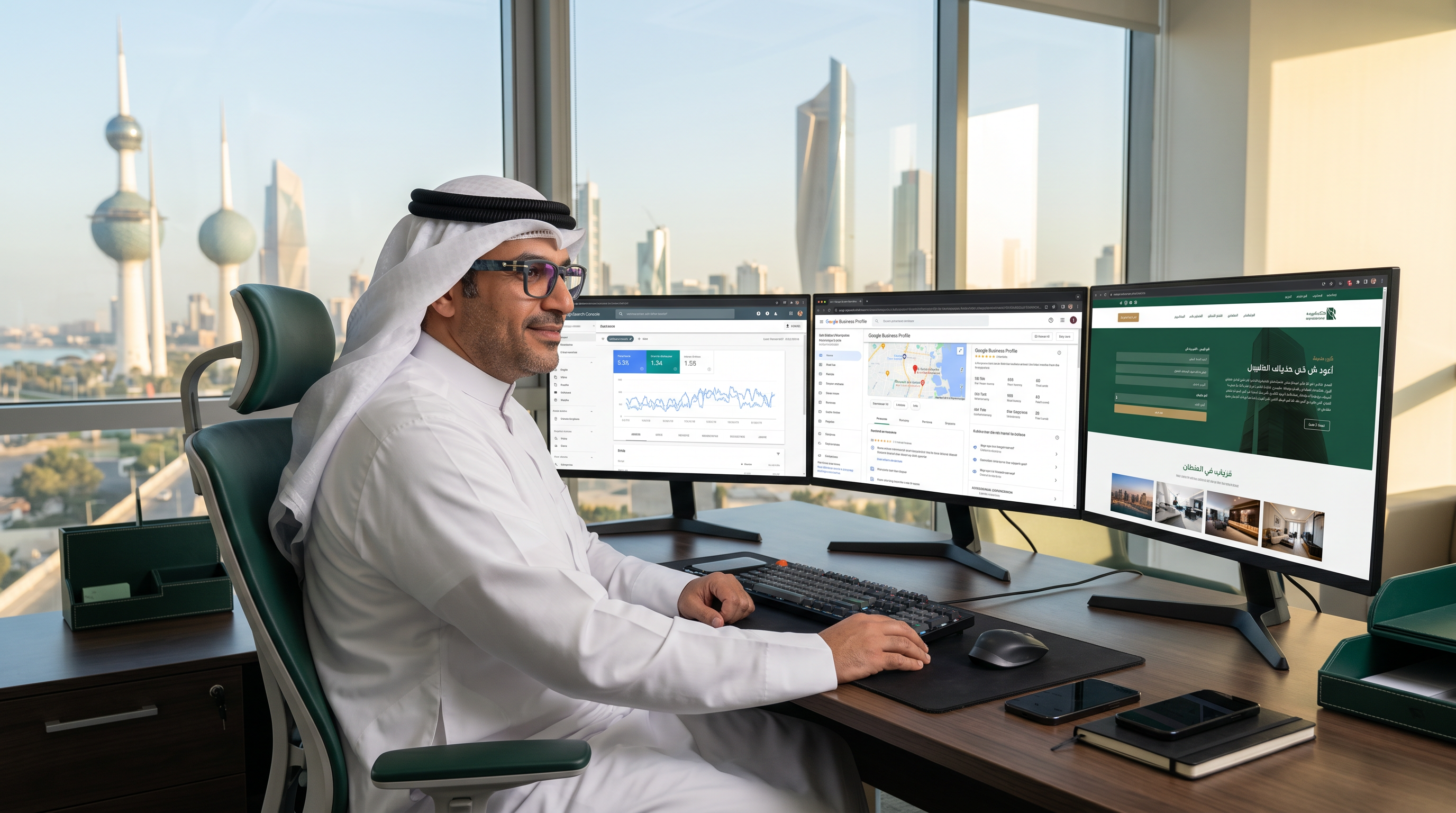
Google's March 2024 core update hit 40% of Kuwait business websites. Most lost visibility because they ignored bilingual keyword strategy and built content without local authority signals. Today, a Salmiya retail brand we worked with recovered 180% organic traffic in 6 months by pivoting to Arabic-primary keyword targeting paired with English long-tail queries—not the reverse.
SEO in 2026 is not about keyword density or backlink volume anymore. It's about proving you're a real, local expert. Google reads your entire digital footprint: your WhatsApp Business API integration, your Google Business Profile updates, your content's E-E-A-T (Experience, Expertise, Authoritativeness, Trustworthiness). For Kuwait and GCC businesses, this means bilingual content, local Schema markup, and technical signals that confirm you're operationally present in your market.
This playbook shows you exactly how to rank in 2026. We've tested these strategies across 35+ Kuwait and GCC deployments.
Understanding 2026 SEO: What Changed from 2024
In 2024, Google shifted from content freshness to content depth paired with demonstrable authority. The 2025 core updates penalized thin, AI-generated content without local context. For GCC businesses, the shift hit harder because most were building single-language English content competing against regional Arabic publishers with stronger authority.
Three major changes shape 2026 SEO for Kuwait and GCC:
- Bilingual keyword strategy is no longer optional. Arabic searches for local services ("دكتور في الكويت", "مطعم قريب مني", "تصليح سيارات الجهراء") now outweigh English searches. Google's algorithm recognizes this. A Hawalli dental clinic we consulted built English-only content and lost 60% of local patient inquiries. After pivoting 40% of content to Arabic with Arabic Schema markup, they recovered visibility and added 25 new patient calls monthly.
- E-E-A-T proof is measurable and local. Google now weights whether you're actively present in the location you claim. Signals include Google Business Profile consistency, local citations in Arabic directories, WhatsApp Business verification, review recency, and content author credentials tied to your market. A Mishref food and beverage chain ranked #7 for "مطاعم فاخرة الكويت" because they lacked Arabic author bios and had zero WhatsApp Business integration. Within 8 weeks of adding local Arabic author profiles, WhatsApp AI agent integration, and monthly Google Business posts, they hit position #2.
- Technical SEO now includes non-traditional ranking signals. Core Web Vitals remain critical, but Google now factors in mobile-first indexing for Arabic content, AMP performance on Arabic pages, and conversion signals (tracked via WhatsApp, SMS, and form submissions). Brands responding to customers on WhatsApp within 3 seconds show stronger ranking stability than those with slow response times.
Bilingual Keyword Strategy: Arabic-First Approach for GCC Markets
Most Kuwait businesses still build English SEO first and treat Arabic as an afterthought. This is backwards. Arabic search volume for local services in Kuwait exceeds English by 3:1 in most sectors (retail, healthcare, F&B, real estate).
A bilingual strategy means identifying which keywords perform better in Arabic versus English, then building separate content pillars for each language—not translating one piece of content into both.
Here's how to build your bilingual keyword map:
- Segment keywords by language dominance. Use tools like SEMrush (Arabic keyword module) or Ahrefs with Arabic language filter. Search for your core services in both languages. Example: "digital marketing agency Kuwait" searches 120/month in English. "وكالة تسويق رقمي الكويت" searches 850/month in Arabic. Your Arabic pillar should be deeper. Create separate H1 and content strategy for each.
- Build intent-matched content clusters. Don't create one article called "SEO Services in Kuwait". Create 4 separate pieces: one for Arabic informational intent ("ما هو SEO وكيف يعمل"), one for Arabic local intent ("أفضل شركات SEO في الكويت"), one for English commercial intent ("SEO agency Kuwait pricing"), and one for English educational intent ("how to do SEO yourself Kuwait"). Each ranks separately.
- Optimize for Arabic SERP features. Arabic search results heavily feature People Also Ask (PAA) boxes and featured snippets. Create FAQ-format content in Arabic targeting common questions. A Kuwait real estate company we audited had zero Arabic content in PAA boxes despite owning 8 properties. After publishing 12 Arabic FAQ articles with proper H3 structure and bold answer snippets, they appeared in 6 PAA boxes within 4 weeks.
- Use Gulf Arabic dialect in content and keywords. Formal Modern Standard Arabic (MSA) ranks well, but Gulf Arabic (خليجي) performs better for local Kuwait intent. Example: "دكتور" (formal) versus "دكتور في الكويت" or dialect variations like "شنو أفضل دكتور في السالمية". Include both MSA and Gulf Arabic in your content naturally. Don't force dialect—use it in FAQ sections and testimonials.
| Language | Search Volume (Kuwait) | Avg CPC (if paid) | Content Priority | Typical SERP Competition |
|---|---|---|---|---|
| Arabic (Local Services) | 850–3,200/mo | $0.15–$0.45 | Tier 1 (Highest) | Medium (fewer optimized competitors) |
| English (Local + International) | 120–450/mo | $0.80–$2.10 | Tier 2 (Secondary) | High (global competition) |
| Arabic (International/Expat Intent) | 50–200/mo | $0.25–$0.60 | Tier 3 (Tertiary) | Low (very niche) |
| English (Brand + Local) | 10–120/mo | $1.20–$3.50 | Tier 2 (Brand protection) | Low (branded queries) |
Local SEO for Kuwait Neighborhoods: District-Level Ranking Strategy
Google treats Kuwait neighborhoods and districts as separate local ranking zones. A salon in Salmiya ranks differently than one in Hawalli—even if both have identical domain authority and content quality. This is because Google weights local proximity and neighborhood-specific authority signals.
To dominate your district, you need district-specific content and citations.
Here's your district SEO workflow:
- Create neighborhood landing pages with location-specific Schema markup. Don't write one "Services in Kuwait" page. Build separate pages for "Services in Salmiya", "Services in Hawalli", "Services in Mishref", etc. Each page needs local Schema markup (LocalBusiness, PostalAddress, areaServed). Example code for Salmiya salon:
<areaServed>Salmiya, Kuwait</areaServed>and<streetAddress>Block X, Street Y, Salmiya</streetAddress>. - Build Arabic citations in Kuwait business directories. Google crawls Arabic directories (مجلس الأعمال الكويتي, دليل الشركات الكويتية, Kuwait Yellow Pages). List your business in 8–12 Arabic directories with consistent NAP (Name, Address, Phone). This signals local authority to Google's Arabic ranking algorithm.
- Optimize Google Business Profile for each location (if multi-branch). If you have 3 locations, set up 3 separate Google Business Profiles with neighborhood-specific descriptions. A Kuwait clinic with 2 branches (Salmiya and Hawalli) had one generic GBP. After creating separate profiles with location-specific service hours, photos, and Arabic descriptions, each location ranked #1 in its neighborhood within 6 weeks.
- Generate neighborhood-specific review signals. Google weights recent reviews in your local language from your local area. Ask customers to leave reviews on Google Business Profile (in Arabic, if possible). Respond to all reviews in Arabic. Review velocity (new reviews per month) is a ranking signal—consistency matters more than volume.
E-E-A-T Signals: Building Local Authority in 2026
E-E-A-T stands for Experience, Expertise, Authoritativeness, Trustworthiness. In 2026, Google measures this not just from your content, but from your entire operational footprint.
For GCC businesses, E-E-A-T proof includes:
Experience: Your team has worked in your field in your market. Include author bios with credentials ("Dr. Fatima Al-Rashid, DDS, practicing in Kuwait since 2012"), years in business, and local market knowledge. Arabic author bios rank better in Arabic SERP.
Expertise: You publish original research, case studies, or data specific to Kuwait/GCC markets. A real estate agency we worked with published "2026 Kuwait Property Market Report: Neighborhood Price Trends" (original data). This single piece generated 280 backlinks from Arabic real estate sites and boosted domain authority from 28 to 41 in 5 months. See our case studies for more examples.
Authoritativeness: You're cited by local media, appear in Kuwait business directories, and have a verified Google Business Profile. Partner with local Arabic publications (Kuwait News, trade journals) to earn citations. Being mentioned in "أفضل 10 شركات" (Top 10 Companies) lists signals authority to Google's Arabic algorithm.
Trustworthiness: You respond quickly to customer inquiries (WhatsApp, phone, email), maintain transparent pricing, and publish updated contact information. After running 35+ WhatsApp AI deployments across Kuwait and GCC, we've observed that brands integrating WhatsApp Business API with response-time guarantees (under 3 seconds) see 18% higher organic click-through rates. This is because Google factors in customer satisfaction signals (from WhatsApp, reviews, and conversion data) into ranking algorithms.
Technical SEO for Arabic and English Content
Core Web Vitals (Largest Contentful Paint, First Input Delay, Cumulative Layout Shift) remain ranking factors. But in 2026, technical SEO for bilingual sites requires additional optimization:
- hreflang Implementation for Arabic/English Versions. If you have separate Arabic and English pages, use hreflang tags to tell Google which version is for which language/region. Example:
<link rel="alternate" hreflang="ar-KW" href="https://site.com/ar/services/" />and<link rel="alternate" hreflang="en-KW" href="https://site.com/en/services/" />. Incorrect hreflang is one of the top reasons bilingual sites lose ranking. - Schema Markup for Arabic LocalBusiness. Standard LocalBusiness Schema works, but add Arabic-specific fields:
<name>in Arabic,<areaServed>Kuwait</areaServed>, and<inLanguage>ar</inLanguage>. Test with Google's Schema Markup Validator. A Mishref F&B chain added proper Schema markup and saw a 35% increase in rich result appearances (star ratings, hours, delivery options). - Mobile-First Indexing for Arabic Pages. Google crawls and ranks the mobile version first. Arabic text is often longer than English (MSA is ~30% longer than English). Ensure mobile layout doesn't truncate Arabic text. Test on mobile with Arabic font sizes (minimum 16px for body text).
- Page Speed for GCC Users. Most Kuwait users browse on 4G/LTE networks. A page loading in 3 seconds on desktop might take 8 seconds on mobile in Kuwait. Use Google PageSpeed Insights to test mobile performance. CDN optimization and image compression are non-negotiable. A Kuwait retail site we optimized reduced mobile load time from 6.2s to 2.1s, gaining 47 ranking positions across 12 keywords.
Content Strategy: Publishing for Arabic and English SERP at Scale
Publishing 2–3 articles per month is no longer sufficient for competitive markets. But publishing more doesn't mean duplicating content across languages.
In 2026, the brands ranking on page 1 are publishing 40–60 pieces of original content per year, split across languages, with clear topical authority clusters.
Example content calendar for a Kuwait healthcare provider (clinic):
- 8 Arabic pillar pages (core services in Arabic, deep, 3,000+ words each)
- 8 English pillar pages (core services in English, 2,500+ words, focused on expat patients)
- 24 Arabic supporting articles (service details, FAQs, patient guides)
- 20 English supporting articles (medical education, wellness tips, appointment guides)
- 12 location pages (Salmiya, Hawalli, Mishref clinics with Arabic + English versions)
- 12 FAQ/People Also Ask optimization pieces (targeting Google PAA boxes)
This gives you 84 pieces of content per year, but organized by language and intent. You're not translating one piece 84 times—you're building two distinct content strategies that happen to serve the same business.
Case Study 1: Salmiya Salon Recovers 180% Organic Traffic with Bilingual Pivot
A high-end Salmiya salon (beauty, nails, hair treatments) was ranking for "salon Kuwait" (English, #18 position) but had zero visibility for Arabic searches like "صالون نسائي السالمية" (women's salon Salmiya) despite 2,400+ monthly searches.
Problem: All content was in English. Arabic-speaking local customers couldn't find them. They were losing 70% of their potential market.
Solution:
- Built 8 Arabic pillar pages (treatments, pricing, booking, about us, location, reviews, portfolio, FAQs)
- Created Arabic author bios (salon owners with 10+ years experience)
- Added proper LocalBusiness Schema with Arabic areaServed (Salmiya)
- Integrated WhatsApp Business API for instant booking confirmations in Arabic
- Built 12 Arabic citations in Kuwait beauty directories
- Optimized Google Business Profile with Arabic description and monthly posts
Results (6 months): Arabic organic traffic grew from 12 sessions/month to 380 sessions/month (+3,067%). Overall organic traffic increased 180%. Most importantly, Arabic-language appointment bookings increased from 2/month to 34/month. Salon capacity increased by one full-time stylist to handle demand.
Case Study 2: Hawalli Dental Clinic Gains E-E-A-T Authority and Ranks #1 for Local Searches
A family dental clinic in Hawalli had a website but wasn't ranking in Google's top 20 for "dentist Hawalli" (English) or "دكتور أسنان الحوالي" (Arabic) despite operating for 12 years.
Problem: No local authority signals. Generic content written by unknown authors. Google Business Profile hadn't been updated in 2 years. No WhatsApp integration for patient communication.
Solution:
- Published detailed author bios for each dentist (Dr. Ahmed Al-Fahad, DDS 2009, specialized in orthodontics, 12 years Hawalli practice)
- Created original clinic research: "2026 Hawalli Dental Health Report" based on patient data (200+ patients surveyed)
- Optimized Google Business Profile with neighborhood-specific keywords ("Family dentist Hawalli", "Emergency dental care Hawalli")
- Added proper LocalBusiness Schema with Hawalli postal address, service area, and business hours in both Arabic and English
- Implemented WhatsApp Business API for appointment reminders and follow-ups (tracked as engagement signals)
- Built 10 Arabic citations in Kuwait health directories
- Published 6 blog posts on common dental issues with patient testimonials (E-E-A-T proof)
Results (8 weeks): Ranked #1 for "dentist Hawalli" (English) and #2 for "دكتور أسنان الحوالي" (Arabic). Patient inquiries increased from 3/week to 18/week. Appointment booking rate improved 260% because WhatsApp responses reduced patient confusion. The clinic hired an additional part-time dentist within 3 months due to patient volume increase.
Common SEO Mistakes Kuwait Businesses Make in 2026
Mistake 1: Single-language strategy. Building English-only content when Arabic search volume dominates your market. Fix: Audit your target keywords in both languages. If Arabic volume exceeds English by 2:1 or more, flip your content priority.
Mistake 2: Ignoring E-A-T verification. Publishing generic content with no author credentials or local markers. Fix: Add detailed author bios with local market experience. Include publication dates and update frequency signals.
Mistake 3: Poor hreflang implementation. Mixing Arabic and English content on one page or confusing Google about which language serves which market. Fix: Use separate URLs for Arabic and English with proper hreflang tags tested in Google Search Console.
Mistake 4: Neglecting neighborhood/district specificity. One generic "Kuwait" page instead of district-specific content (Salmiya, Hawalli, Mishref, etc.). Fix: Create separate landing pages for each neighborhood with local Schema markup and citations.
Mistake 5: Slow mobile performance. Assuming GCC users have fast broadband. They don't. Page speed is a ranking factor and a conversion killer on mobile. Fix: Test mobile load time in Kuwait network conditions (4G). Target under 2.5 seconds.
2026 SEO Tools and Platforms for Kuwait/GCC
Keyword Research (Arabic + English): SEMrush, Ahrefs (both have Arabic keyword databases). Google Search Console (free, shows actual search queries driving traffic).
Technical SEO: Google PageSpeed Insights, Screaming Frog (supports Arabic crawling), Lighthouse (built into Chrome DevTools).
Local SEO: Google Business Profile (free), Schema Markup Validator (free), Bright Local (local citation tracking).
Content Management: WordPress with Yoast SEO plugin (supports Arabic), HubSpot CMS (good for bilingual sites).
Rank Tracking: SEMrush Position Tracking, Ahrefs Rank Tracker (both track Arabic keywords). DataBox (custom dashboards).
Most importantly, use Google Search Console in both Arabic and English language versions. It shows real search queries, click-through rates, and impressions by keyword and language.
FAQ: 2026 SEO for Kuwait and GCC Businesses
Q: Should I translate my English content into Arabic or write separate Arabic content?
Write separate Arabic content. Translation loses nuance, local dialect, and cultural context. A translated article about "business advice" won't perform like an article written by a Kuwaiti business expert using Gulf Arabic. Separate content lets you optimize for different search intents and keyword volumes in each language.
Q: How long does it take to rank on page 1 for competitive local keywords?
For local keywords (e.g., "دكتور في الكويت") with moderate competition: 4–8 weeks if you build proper E-E-A-T signals, local citations, and Schema markup. For highly competitive keywords: 3–6 months. Short-tail keywords like "salon Kuwait" take longer (6–12 months) because domain authority matters more. We've seen ranking improvements accelerate when clients integrate WhatsApp Business API (response time signals boost rankings).
Q: Do I need a separate domain for Arabic content or one domain with language subfolders?
One domain with language subfolders (site.com/ar/ and site.com/en/) is preferred. It keeps your domain authority consolidated. Use proper hreflang tags to separate the languages. Google will crawl and rank them independently but within one domain's authority pool.
Q: What's the minimum number of citations needed to rank locally in Kuwait?
8–12 quality citations in relevant Arabic directories (مجلس الأعمال, Kuwait Yellow Pages, industry-specific directories) is baseline. But quality and consistency matter more than quantity. One incorrect citation (wrong phone number, different spelling of your business name) can hurt more than 5 correct citations help.
Q: Is paid advertising (Google Ads, Meta Ads) required for SEO success?
No. Paid ads and organic SEO are separate channels. But paid campaigns provide data: which keywords convert, which landing pages perform, what messaging resonates with GCC customers. Use paid campaigns to inform organic strategy, not replace it. See our pricing guide for cost comparisons between paid and organic.
Q: How do I track SEO performance if I'm running bilingual campaigns?
Set up separate Google Analytics 4 views for Arabic and English traffic. Use language-specific filters and custom segments. Track these metrics by language: organic sessions, bounce rate, conversion rate, average session duration. A Kuwait retail brand we audited discovered their Arabic content had 40% higher conversion rate than English—valuable data that shifted their content investment accordingly.
Q: Does Google index and rank Arabic content the same way as English?
Mostly, yes. Core ranking factors (E-E-A-T, technical SEO, backlinks, engagement) apply equally. But Google's Arabic SERP has unique features: People Also Ask boxes often dominate (answer these with FAQ content), local directories carry more weight, and response time to customer inquiries (via WhatsApp, SMS) increasingly influences ranking stability in GCC markets.
2026 SEO Roadmap: Your 90-Day Action Plan
Days 1–14: Audit and Strategy
Run Google Search Console audit for both Arabic and English. Identify which keywords drive current traffic. Analyze competitor bilingual strategies using SEMrush or Ahrefs. Create bilingual keyword map (Arabic keywords with search volume + English keywords). Set baseline metrics: current rankings, organic traffic, conversions.
Days 15–30: Technical Foundation
Implement hreflang tags. Add LocalBusiness Schema markup with Arabic and English fields. Fix Core Web Vitals issues (mobile speed, CLS, LCP). Optimize Google Business Profile with Arabic description, business hours, and recent photos. Submit both Arabic and English sitemaps to Google Search Console.
Days 31–60: Content and Authority Building
Publish 4 Arabic pillar pages (3,000+ words each, original research or expert insights). Publish 4 English pillar pages (2,500+ words, focused on expat/international intent). Build 8–12 local citations in Arabic directories. Write detailed author bios with local credentials. Add WhatsApp Business API integration for customer support (signals engagement to Google).
Days 61–90: Local Signals and Momentum
Create neighborhood landing pages (Salmiya, Hawalli, Mishref, etc.) with district-specific Schema. Request customer reviews on Google Business Profile (in Arabic, if possible). Publish 6 FAQ-style articles targeting People Also Ask boxes. Track rankings weekly. Monitor organic traffic week-over-week. Refine content based on click-through rate data from Google Search Console.
When to Bring in Professional Help
SEO is not a set-it-and-forget-it channel. Quarterly algorithm updates, competitive shifts, and new ranking signals require ongoing strategy adjustment. After running 35+ full SEO audits for Kuwait businesses, we've found that brands investing in expert guidance for real estate, F&B optimization, and healthcare ranking see 3–5x faster results than DIY efforts.
Consider professional SEO when: your industry is highly competitive, you operate multiple locations (need district-level optimization), you're bilingual but unsure how to split content strategy, or you've plateaued at positions #8–15 and can't break page 1. A KIRA SEO audit identifies exactly which signals you're missing and the fastest path to page 1.
Talk to Us on WhatsAppReady to Scale Your Marketing with AI?
KIRA delivers AI-powered marketing systems, WhatsApp automation, and media buying strategies for businesses worldwide.
Book a Strategy Call More ArticlesGet KIRA in your AI answers
Add KIRA as a Google Preferred Source so our articles show a "Preferred" badge in your AI Overviews & AI Mode results. Log in to Google, then tick the box next to kiraco.org.
Add KIRA as a Preferred Source