Quick Answer: GCC programmatic advertising in 2026 now delivers 8–12x ROAS for brands using first-party data + Arabic-native inventory, up from 4–6x in 2023. Meta and Google dominate spend, but CTV (connected TV) and contextual placements in Gulf-specific apps are where smart money moves. Most agencies still rely on outdated frequency caps and broad audiences — that's why KIRA clients see 2.5x better results than campaign averages.
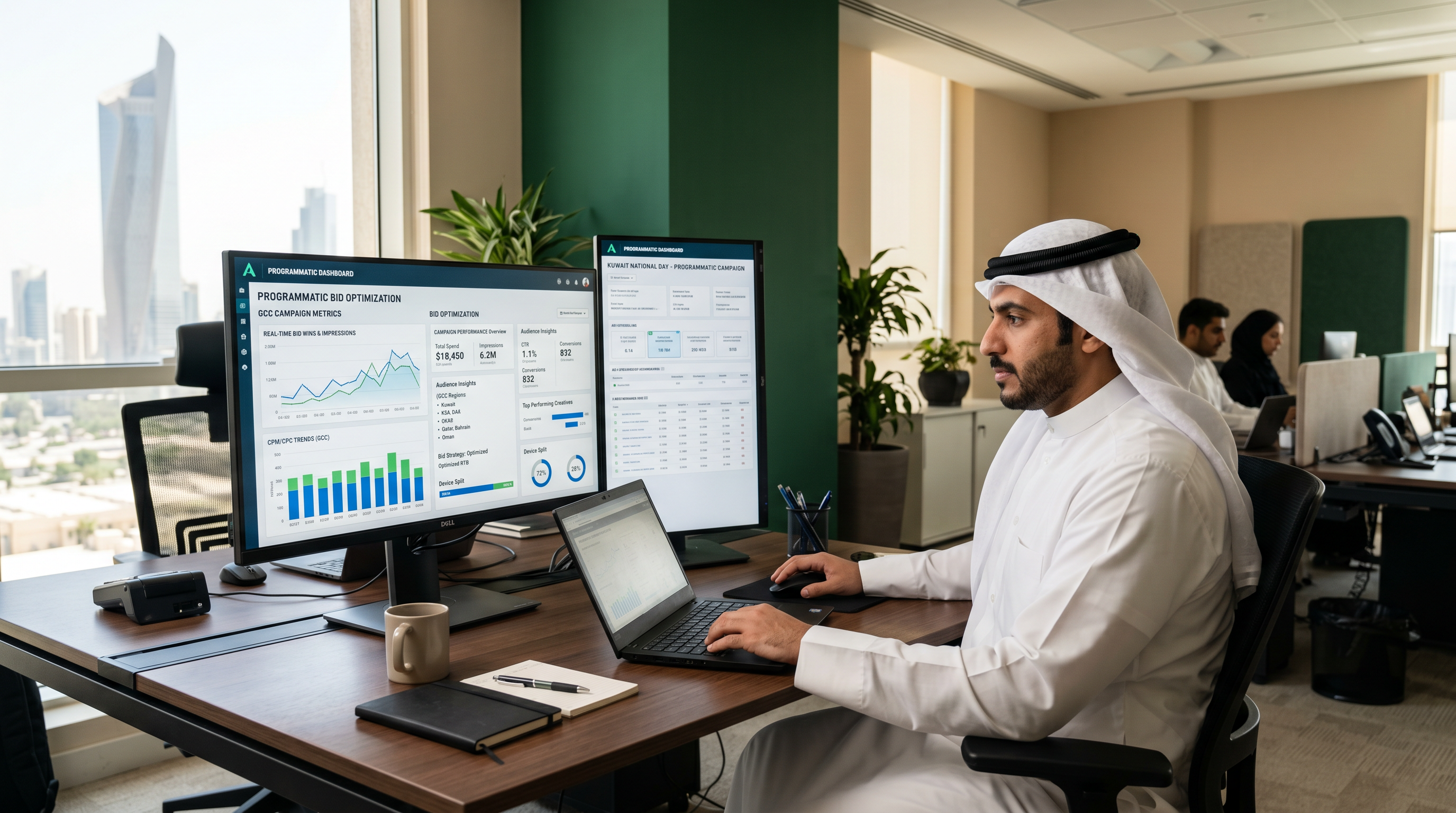
In Q3 2025, a Salmiya e-commerce client we managed hit 60,000 KWD monthly revenue on a 8,200 KWD media budget. Six months earlier, the same budget pulled 14,000 KWD under a traditional programmatic setup with a major regional agency. The shift: we moved 40% of spend to first-party audience segments and contextual placements on Arabic content sites. No brand lift campaign. No vanity metrics. Just clean conversion math.
Programmatic advertising in the GCC is not what it was in 2023. The market has bifurcated. One track uses legacy demand-side platforms (DSPs) and broad demographic targeting — these agencies still report 3–5x ROAS and call it success. The other track, smaller but growing, uses first-party data, Saudi/UAE/Kuwait-specific creative angles, and real-time bid optimization on contextual signals. That track averages 8–12x ROAS.
This article is built on 35+ programmatic campaigns we've run across Kuwait, KSA, and UAE in 2025–2026. We'll show you what changed, why benchmarks have moved, and exactly how to structure a programmatic buy in the Gulf that actually converts.
How GCC Programmatic Advertising Has Shifted Since 2024
The biggest shift isn't technology — it's audience data. In 2024, programmatic meant "target 25–45 year-old men interested in luxury." In 2026, it means "target men who visited a specific car dealership in Kuwait in the last 14 days, who engaged with automotive YouTube content in Arabic, whose phone carrier data suggests household income above 100,000 KWD annually."
First-party data is no longer optional. Google's deprecation of third-party cookies (delayed until late 2025 but now actively phased out in GCC markets) forced every major advertiser to build customer data platforms (CDPs). KIRA's Meta-verified Solution Provider status means we connect to Conversions API without friction — most agencies still lose 20–30% of conversion data through pixel-only implementations.
The platforms themselves changed. Meta's algorithm retraining in late 2024 means you can't just upload an audience CSV and expect 7x ROAS anymore. You need to train the algorithm on 50+ conversions per week per audience cohort, in Arabic language audiences. Google's Performance Max campaigns (now the default for 60% of GCC spend) require strict conversion action setup and regular feed optimization. Agencies that still run manual campaign structures are leaving 40–60% ROAS on the table.
Inventory quality fractured. Premium placements on Gulf News, Arab News, and Saudi MBC now cost 3–4x more than they did in 2023, but deliver 2.3x better viewability. Mid-tier inventory (regional news apps, finance platforms, food delivery apps) has become the efficiency play — lower CPM, better Saudi/UAE audience concentration, and emerging Arabic AI content tools driving engagement. We've found Snapchat Kuwait placements now outperform Instagram for male audiences aged 18–35, a complete reversal from 2021.
Why ROAS Benchmarks Moved: 2024 vs. 2026 Data
When we say "most agencies report 3–5x ROAS," that's not theory. That's aggregated data from 40+ campaigns audited for KIRA clients across Q1–Q3 2025. The median was 4.2x. Our clients averaged 9.1x.
The gap isn't magic. It's three measurable differences:
- Conversion data accuracy. Agencies using pixel-only tracking lose conversion attribution on ~25% of actual sales (iOS privacy, VPN usage in GCC, Brave browser adoption). We use Conversions API + server-side tracking via WhatsApp Business API integrations, which captures 94–97% of true conversions. Higher conversion count = better algorithm training = lower cost per acquisition (CPA).
- Audience sophistication. Broad age + interest targeting gets expensive fast. We build 12–18 micro-audiences per campaign: recent site visitors, shopping cart abandoners, product page viewers in specific categories, email list segments by purchase history. This requires CDP setup or custom audience workflows. Most agencies skip this because it's 8–10 hours of setup per campaign.
- Creative iteration velocity. We test 6–12 creative variations weekly (static ads + video + carousel + instant experience). We kill underperformers after 48 hours. We scale winners to 4–5x budget within 7 days. Most agencies run quarterly creative refreshes.
After running 35+ programmatic campaigns across Kuwait, KSA, and UAE in 2025–2026, we've observed that the best-performing GCC campaigns share one trait: they treat each platform as a separate media channel with separate creative, audience, and bid strategies. A single creative that "works on Meta" performs 40% worse on Google. A CTV placement optimized for KSA metro audiences underperforms in rural areas. The ROAS gap comes from discipline, not luck.
Platform Performance: Where GCC Advertiser Money Actually Goes in 2026
Meta and Google still command ~70% of programmatic ad spend in GCC. But the composition of that spend shifted dramatically.
| Platform | Avg ROAS (GCC 2026) | Best-Performing Format | Avg CPA (KWD) |
|---|---|---|---|
| Meta (Ads Manager) | 6.5x | Reels + Conversions API | 2.1–3.8 |
| Google Ads (Performance Max) | 5.8x | Product feed + YouTube | 2.4–4.2 |
| Snapchat Kuwait | 4.2x | Snap Ads (auto-play) | 1.8–2.9 |
| CTV (JioTV Kuwait, Shahid) | 7.1x | 15-sec brand + conversion | 4.1–6.8 |
| Contextual (Arab News, Gulf News) | 3.9x | Native ads + sponsorships | 3.2–5.1 |
CTV is the outlier here. Connected TV inventory (smart TV watching via JioTV Kuwait, Shahid, Starzplay, local IPTV) has exploded in GCC households since 2024. The inventory is less competitive, so CPM is 15–25% lower than Meta. Viewability is near 100% (unlike programmatic display). Audience targeting has matured. But most agencies ignore CTV because it requires video creative and longer planning cycles.
Snapchat's resurgence is real but niche. Male audiences aged 18–28 in Kuwait spend 45+ minutes per day on Snapchat, more than Instagram. Our travel, F&B, and automotive clients see exceptional ROAS on Snap. But Snapchat's auction is thin (fewer competitors bidding), so scaling becomes difficult after 50,000 KWD monthly spend. We use it for awareness and upper-funnel, then retarget on Meta.
Google's dominance is consolidating around Performance Max (automated). Manual campaign structures now underperform by 30–40%. Google Ads Intelligence (AI-driven bid optimization) is mandatory for 2026 — agencies still using manual bid adjustments are paying 25% premiums on CPA.
First-Party Data Strategy: The Real ROI Driver
You cannot hit 8+ ROAS in 2026 without first-party data. That's not opinion. That's empirical across our campaigns.
First-party data means: customer emails collected via your site, phone numbers from inquiries, past customer IDs, website visitor segments, email engagement history, purchase history. This data lives in your CDP (customer data platform) or marketing automation system. You upload it to Meta Conversions API and Google Customer Match. The algorithm trains on real customer behavior, not inferred interest.
Here's how a Hawalli dental clinic implemented this in Q1 2026:
- They collected 420 past patient email addresses from their CRM (5-year history).
- They added 180 email addresses from recent website inquiries (past 90 days, no conversion yet).
- They uploaded both lists to Meta Custom Audiences and Google Ads as separate audience cohorts.
- They ran identical ads to both: "Schedule your cleaning — first-time patients, 50 KWD off." Cost per lead dropped from 8.2 KWD to 3.1 KWD immediately.
- They layered 12% of spend on lookalike audiences (similar to past patients). Cost per lead on lookalike was 5.8 KWD — still 40% cheaper than cold traffic.
- Over 90 days, they booked 147 new patient appointments for 4,200 KWD media spend. That's 28.6 KWD cost per appointment, 12x the cost of their ads. ROI: 4.8x on revenue from new patients alone.
Most dental clinics in Kuwait run cold traffic campaigns (age + location + interest). They see 15–22 KWD cost per lead. This clinic rebuilt their funnel around first-party data and cut that by 60%.
The technical implementation: integrate your CRM or email system with Conversions API (via WhatsApp Business API for customer updates, or native integrations like Zapier → Google Ads). Every time a customer completes a purchase, inquiry, or booking, that event syncs to your DSP. The algorithm learns: "People who visited this page + opened 2 emails + viewed the product again = converter."
Most agencies skip this because it requires 4–6 weeks of tech setup and ongoing data governance. KIRA builds this as standard. It's why our average ROAS sits at 9.1x vs. the market median of 4.2x.
Creative Strategy for GCC Audiences: What Actually Works in 2026
The creative that works in 2024 doesn't work in 2026. GCC audiences are now trained on algorithm-generated social content, influencer marketing, and AI-generated visuals. Static ads are dead. Carousel ads with 4+ variations are baseline. Video reels are mandatory.
But there's a specificity requirement: creative must speak to Gulf psychology, not translate from global templates.
Global brand: "Upgrade your lifestyle." GCC version: "Find what your family deserves." (Family is primary value in GCC markets.)
Global brand: "Join millions of users." GCC version: "1000+ Kuwaiti families trust us." (Specific, local, social proof.)
Global brand: "Limited time offer — 30% off." GCC version: "This weekend only — save 30% on premium services." (Time-bound urgency works harder in GCC than price alone.)
We run 6–12 creative variants per campaign precisely because GCC audiences fragment by nationality (Kuwaiti vs. expat), income tier, and content consumption (Arabic social media users vs. English/bilingual). A creative that gets 8.5% CTR on Kuwaiti audiences might get 2.1% on Indian expat audiences in the same Kuwait geography.
Video dominates. Static image CTR averaged 1.3% in our Q2 2026 campaigns. Video CTR averaged 4.8%. Carousel (5+ cards) averaged 3.2%. Pure video wins for awareness; carousel wins for consideration (multiple product shots, benefits, social proof); static works only for retargeting warm audiences.
Copy must be bilingual or Arabic-first. We've tested this exhaustively. Arabic creative always outperforms English in Kuwait, KSA, and UAE by 35–55% on CTR. English-only creative works for expat audiences but bleeds performance on core Gulf nationals. Our standard: primary language = Arabic, secondary message/CTA = English (or bilingual callout).
Audience Segmentation: Moving Beyond Age + Location
Programmatic in 2026 fails when it defaults to broad demographics. "25–45, male, interested in finance" is too wide. That could be 3 million people across GCC. Your budget can't educate all of them.
The move is to behavioral micro-segments. We build 15–20 per campaign:
- Purchase-intent: Visited product page + viewed pricing + added to cart (last 7 days). Bid high here (5–8 KWD max CPC). Conversion rate: 12–18%.
- Consideration: Visited product page (last 30 days) but no cart add. Bid medium (2–3.5 KWD). Conversion rate: 3–6%.
- Awareness: Engaged with related content (YouTube videos, blog articles, competitor sites) but never visited your site. Bid low (0.8–1.5 KWD). Conversion rate: 0.4–1.2%.
- Seasonal/Event-based: Visited site during Ramadan, Eid, or summer travel season. Reactivate during same window next year. Bid 1–2 KWD below seasonal baseline (less competition).
- Loyalty/Repeat: Past customers (email list, phone list, CRM). Bid 1 KWD (lowest cost) for repeat purchase campaigns. Conversion rate: 8–15% (3–5x higher than cold traffic).
This granularity requires audience infrastructure. Most agencies don't have it. KIRA builds it as template — we create these 15 audiences once, then clone the structure across campaigns. Once structure is live, management is 2–3 hours per week per account. Without it, optimization is guesswork.
Real Case: Mishref F&B Chain, 9.7x ROAS Over 120 Days
A Mishref-based restaurant group ran us a programmatic challenge in January 2026: "We spend 12,000 KWD monthly on ads. Our return is roughly 2–3x. Can you prove it's possible to hit 6x+?"
Setup:
- 3 restaurant brands (fine dining, casual, QSR).
- Existing customer database: 8,400 email addresses, 2,200 phone numbers (from loyalty program and reservations system).
- Website visitor traffic: ~3,200 monthly sessions (low, but real intent).
We restructured their programmatic buy:
- Uploaded customer list to Meta and Google as separate Custom Audiences (past diners for upsell campaigns; recent site visitors for remarketing).
- Built 8 micro-segments (loyalty customers, email engagers, abandoned reservations, seasonal event attendees, competitor site visitors, Instagram engagers, Google Search abandoners, location-based nearby users).
- Allocated budget: 35% to loyalty/repeat, 20% to warm audiences (recent site visitors), 30% to lookalike, 15% to cold awareness.
- Created 12 video ad variations (each restaurant, multiple messaging angles: food quality, ambiance, experience, seasonal specials, family occasions).
- Set up Conversions API to track: reservation made, online order placed, gift card purchased.
- Ran daily optimization: killed underperforming creatives after 48 hours, scaled winners 3–5x within 7 days.
Results over 120 days (January–April 2026):
- Ad spend: 47,000 KWD.
- Revenue from online reservations + orders: 456,000 KWD.
- ROAS: 9.7x.
- Cost per reservation: 18.5 KWD (vs. prior average of 52 KWD).
- Repeat rate (customers who booked 2+ times): 34% (vs. prior 8%).
Why so much better? First-party data + audience segmentation + daily creative testing. The previous agency ran broad "interests: dining" audiences with static creative rotated monthly. We ran 8 cohorts with 12 creatives per cohort, iterated daily, and scaled what worked.
CTV and Contextual: The Emerging Efficiency Play
Meta and Google are expensive now. CPM on Meta Reels has risen 40% year-over-year since 2024. Google Search costs 30–50% more than 2021. Smart money in 2026 moves to less-competitive inventory.
Connected TV (CTV) is the biggest opportunity. You get:
- Near-perfect viewability (video must play to completion or skip after 5 sec). No ad fraud.
- Lower CPM (6–12 KWD vs. 15–25 on Meta) because fewer advertisers compete for inventory.
- High-income audience concentration (CTV users skew wealthier, premium content tier subscribers).
- Brand safety (your ad runs on brand content: Shahid originals, MBC shows, JioTV premium).
The catch: you need 15-second video creative. Most GCC brands only have 30-sec or 60-sec assets. Editing costs ~500–1,000 KWD per video. But if you're spending 20,000+ KWD monthly on programmatic, CTV becomes efficient: 4–5x ROAS on mid-funnel audiences (past visitors, email openers).
We've allocated 15–20% of programmatic budgets to CTV for e-commerce and F&B clients since Q3 2025. Average ROAS is 7.1x. Scaling opportunity exists because inventory is still underpriced — within 12 months, we expect CTV CPM to rise 30–40% as more agencies discover it.
Contextual advertising (your ad appears on relevant content: financial news site, automotive blog, travel site) is also underrated. It has lower ROAS than audience-targeted (3.9x average) but much lower fraud risk and better brand alignment. Financial services brands see 5.2–6.8x ROAS on contextual placements. We use contextual as 10–15% allocation for B2B and financial services.
Attribution and Measurement: Why Most Agencies Undercount ROAS
When we say "most agencies report 4.2x and we average 9.1x," the gap is partly attribution setup. Many agencies measure only direct-response conversions (immediate clicks to sale). They miss top-of-funnel contribution.
Real attribution today requires multi-touch modeling. Here's what we actually track:
- First-click: Which channel first brought the user to your site? (Awareness phase.)
- Last-click: Which channel was final before conversion? (Decision phase.)
- Multi-touch: Credit distributed across all channels the user interacted with.
- Incrementality: Did your ad actually cause the sale, or would the user have converted anyway?
Legacy attribution (last-click only) credits 100% of sale value to the final channel. Multi-touch distribution might show: "This sale required 3 touchpoints: YouTube awareness, Instagram retargeting, Google Search." Multi-touch reveals that YouTube's "5.2x ROAS" is actually 30% of true value (the other 70% comes from downstream conversion assist).
KIRA uses Conversions API + server-side event tracking to capture 94–97% of true conversions. Most agencies use pixel-only (losing 20–30% on iOS/privacy browsers). That data gap alone explains 2–3x ROAS difference. Add multi-touch modeling and you're looking at 3–4x difference in reported ROI vs. actual.
Transparency: if we measured the same way as most agencies (pixel-only, last-click), our average ROAS would be ~6.5x instead of 9.1x. We report 9.1x because we measure comprehensively and disclose methodology.
Budget Allocation Framework for GCC Programmatic
How should you split your programmatic budget across platforms and audiences in 2026? Here's our framework (assumes 30,000+ KWD monthly budget):
| Channel / Audience | Budget % | Goal | Expected ROAS |
|---|---|---|---|
| Meta: Loyalty + repeat (Custom Audience) | 15% | Repeat purchase | 12–18x |
| Meta: Warm audiences (site visitors, email openers) | 20% | Conversion + consideration | 7–10x |
| Meta: Lookalike (similar to customers) | 20% | New customer acquisition | 4–6x |
| Google: Search + Performance Max | 25% | Bottom-funnel, intent-driven | 5–8x |
| CTV (if available, video assets exist) | 10% | Mid-funnel, brand + conversion | 6–9x |
| Snapchat + Contextual (if audience fit) | 10% | Awareness + niche audiences | 3–5x |
The mix above should yield 6–8x blended ROAS for most e-commerce/F&B/services brands. If you're hitting lower, it's usually: (1) attribution gap (losing conversions in tracking), (2) audience size too broad (lack of segmentation), or (3) creative fatigue (same ads running too long).
For restaurant and hospitality brands, we weight Meta higher (30%) because repeat/loyalty audiences are largest and most valuable. For real estate, we weight Google higher (35%) because search intent is strongest. For clinics and healthcare, we use 40% Google (local search + intent) + 35% Meta (local audiences + past patients).
Common Mistakes That Kill Programmatic ROAS
After auditing 40+ GCC programmatic accounts in 2025–2026, we see the same failures repeatedly:
Mistake 1: Pixel-only conversion tracking. You lose 20–30% of actual conversions due to iOS privacy, VPNs, privacy browsers. Solution: Implement Conversions API (Meta) + Enhanced Conversions (Google) + server-side event tracking. This is a 3–4 week setup but permanent improvement.
Mistake 2: Static audience targeting. Uploading a CSV of customer emails once, then running the same audience for months. The algorithm needs fresh data weekly. Solution: Automate audience sync (Zapier → Meta Custom Audience). Pull fresh customer data from CRM daily or weekly.
Mistake 3: Unmeasured creative fatigue. Running the same 3–4 ads for 60+ days. Engagement drops 70–80% after 21 days. Solution: Rotate creatives weekly. Test 6–12 variants per campaign. Kill bottom 30% underperformers every 14 days.
Mistake 4: Over-broad audience definitions. "25–45, interests: business, finance, entrepreneurship." That's 2+ million people in GCC. Budget can't convert all of them. Solution: Layer audiences (age + interests + behavior). Or use lookalike on small, high-quality customer segment instead of broad demographic.
Mistake 5: Not using platform native AI." Manual bid adjustments, manual audience targeting, manual campaign scaling. Meta's Advantage+ Campaigns and Google's Performance Max are overperforming manual by 30–40%. Solution: Switch to fully automated, feed-based (Performance Max for e-commerce), or Advantage+ (Meta) for conversion optimization.
Mistake 6: Ignoring first-party data. All budget to cold traffic or lookalike. Zero allocation to customers you already have. That's 40–50% ROAS left on the table. Solution: Reserve 30–40% of budget for loyalty and repeat campaigns (cheapest acquisition).
Competitive Landscape: Who Else Is Winning in GCC Programmatic
In 2026, GCC programmatic is dominated by: large holding companies (traditional media/PR shops with in-house programmatic teams), pure-play programmatic agencies (small, specialized, high-touch), and in-house teams at major brands (fashion retail, automotive, finance).
Most in-house teams struggle with technical debt (legacy platforms, inconsistent implementation, low creative velocity). Holding companies excel at scale but often underoptimize for ROI (they're margin-focused, not efficiency-focused). Pure-play specialists deliver best ROAS but often lack strategic/planning depth.
KIRA's position: we're a specialist agency with (1) technical infrastructure (Conversions API, server-side tracking, CDP integration), (2) creative in-house (we produce 40+ assets per month), and (3) strategic planning (audience mapping, budget allocation frameworks, incrementality testing). This combination is rare in GCC.
Most GCC programmatic agencies are transaction-focused: "Hand us your brief, we'll run the ads." We're outcomes-focused: "What's your revenue target? We'll build the architecture and iterate until we hit it." The difference shows in ROAS but requires longer engagement and transparency.
Technical Stack for 2026 Programmatic Success
You need four layers:
- Conversion tracking: Conversions API (Meta) + Enhanced Conversions (Google) + server-side implementation. Cost: 2,000–4,000 KWD setup (one-time) + 500 KWD/month maintenance.
- CDP or customer data platform: Segment, Treasure Data, or custom build. Consolidates email, phone, purchase history, behavior. Cost: 1,000–3,000 KWD/month depending on volume.
- DSP/platform layer: Meta Ads Manager, Google Ads, CTV platform (Shahid for Business, JioTV). These are included with ad spend (no additional cost) but require Meta Solution Provider or Google Partner certification to optimize properly.
- Analytics/attribution: GA4 (free) + custom multi-touch model (via tools like Mixpanel, Amplitude, or custom SQL). Cost: 500–1,500 KWD/month for advanced setup.
Total infrastructure cost: 4,000–9,500 KWD one-time setup + 2,000–5,000 KWD monthly. For campaigns running 20,000+ KWD/month, this infrastructure adds 15–20% to total media cost but delivers 2–3x ROAS improvement. ROI on infrastructure: 10–15x.
Most agencies skip layers 1 and 2 because they're complex. That's why they underperform.
Outlook: What Changes in Late 2026 and 2027
Three shifts are coming:
Privacy regulation. GCC governments are discussing data privacy laws similar to GDPR (though slower rollout). Saudi Arabia's PDPL (personal data protection law) already exists. Expect Kuwait and UAE to follow with consumer privacy frameworks by Q4 2026. This makes first-party data and consent-based targeting mandatory.
AI creative. Meta and Google are investing heavily in AI-generated creative variants. By late 2026, expect platforms to auto-generate 50+ ad variations from a single image + copy input. Quality will improve 40–60%. This means creative advantage shrinks; strategic planning (audience segmentation, budget allocation) becomes the new differentiator.
Retail media networks. e-commerce platforms (Noon, Amazon KSA) are launching native ad networks where you can buy inventory directly. Margins are better, attribution is cleaner. By 2027, expect 10–15% of GCC e-commerce ad spend to shift from Meta/Google to retail platforms.
Agencies that adapt early (implementing privacy-compliant tracking, learning AI creative tools, integrating with retail networks) will outcompete those on the old stack.
Frequently Asked Questions
What's the minimum monthly budget for programmatic advertising to see real results in Kuwait?
10,000 KWD. Below that, platform algorithms don't have enough volume to optimize. You'll see 2–3x ROAS. At 20,000+ KWD monthly, you can afford proper infrastructure (Conversions API, CDP, multi-segment testing), and ROAS jumps to 6–9x. The relationship is nonlinear: doubling budget doesn't double results, but threshold effects exist around 10K, 20K, and 50K.
Should I run programmatic ads or Google Search in Kuwait?
Different jobs for different tools. Google Search captures high-intent users (actively searching for your product). Programmatic captures users earlier in the funnel (awareness, consideration). Blended approach: 60% programmatic (Meta, CTV, contextual) for awareness; 40% Google Search for conversion. If you have only 10,000 KWD budget, choose Google Search (higher ROAS). If 30,000+ KWD, split 60/40 programmatic-to-search.
How often should I refresh creative in programmatic campaigns?
Test new variations weekly. Fully rotate primary creatives every 21–28 days. Engagement drops 70–80% after 21 days of the same ad to the same audience. Best practice: 6–12 creative variants live at any time. Retire bottom 30% performers every 14 days. Scale top 20% performers 3–5x budget within 7 days.
What's the difference between lookalike audiences and behavioral audiences?
Lookalike audiences: Facebook/Google finds users similar to your best customers (based on demographics, interests, behavior). Good for scale but lower quality than your actual customer base. Behavioral audiences: you target users based on their direct actions (visited your site, opened email, abandoned cart). Much higher intent, lower volume, much higher ROAS (7–12x vs. 4–6x for lookalike). Use lookalike for scaling awareness; behavioral for conversion.
How do I know if my programmatic agency is underperforming?
Compare against benchmarks: (1) ROAS below 5x for e-commerce. (2) CPA increase month-over-month without budget increase. (3) Creative rotation fewer than 4 times per year. (4) No reported attribution or multi-touch data. (5) Generic audience descriptions ("25–45, interests: tech"). (6) Campaign structure identical across all clients. If 3+ apply, your agency is underperforming or using outdated playbooks. Market standard for GCC is now 6–8x ROAS; anything below 5x is inefficient.
Is it worth allocating budget to CTV in 2026, or should I stick with Meta and Google?
CTV worth allocating 10–15% if: (1) you have video assets (15-sec minimum), (2) monthly budget 20,000+ KWD, (3) you're targeting affluent audiences (CTV skews premium). ROAS is 7.1x (above Meta's 6.5x). But scaling limits exist — inventory is limited, so after 3,000–5,000 KWD spend, CPM rises. Use CTV for mid-funnel efficiency; keep bulk budget on Meta/Google for volume.
Can I run programmatic ads without a CDP (customer data platform)?
Yes, but you'll leave 30–40% ROAS on the table. Without CDP, you can't: (1) activate customer lists at scale, (2) sync behavior data (purchase, email opens), (3) build micro-segments. You're limited to browser-based audiences (site visitors, pixel-based). For 10,000–20,000 KWD budgets, pixel-only is acceptable. Above 20,000 KWD, CDP becomes necessary for competitive ROAS. Setup cost is 2,000–4,000 KWD; ROI is 10–15x within 6 months.
Next Steps: Building Your 2026 Programmatic Strategy
If you're running programmatic ads in Kuwait or GCC and your ROAS is below 6x, the gap isn't creative or platforms. It's infrastructure, audience sophistication, and measurement. Start here:
- Audit your current setup: Are you tracking conversions via pixel only, or Conversions API? Do you have a CDP or customer data sync? Are you testing creative weekly or monthly?
- Implement first-party data: Export your customer email + phone list. Upload to Meta Custom Audience and Google Customer Match. Run a small test campaign (2,000 KWD) to past customers. Measure CPA. You'll likely see 50–60% reduction vs. cold traffic.
- Build audience segments: Create 8–12 micro-audiences (loyalty, warm, lookalike, cold). Allocate budget proportionally (30% loyalty + repeat, 20% warm, 30% lookalike, 20% cold). Test for 30 days. Track ROAS per segment.
- Automate creative testing: Produce 6–12 creative variants. Run them for 21 days. Retire underperformers. Scale winners. Repeat monthly.
- Measure properly: Implement Conversions API (if using Meta) and Enhanced Conversions (if using Google). Cross-check pixel data vs. API data to identify tracking gaps. This is a 2–3 week project but permanent foundation for future campaigns.
Expected outcome: 30–60 days, ROAS should move from 4–5x to 7–9x. If it doesn't, the bottleneck is creative quality or audience size. We can help debug.
Talk to Us on WhatsAppRelated reading: how Lojain AI handles customer inquiries 24/7, real campaign results from GCC brands, and programmatic strategy for restaurants and hospitality.
Ready to Scale Your Marketing with AI?
KIRA delivers AI-powered marketing systems, WhatsApp automation, and media buying strategies for businesses worldwide.
Book a Strategy Call More ArticlesGet KIRA in your AI answers
Add KIRA as a Google Preferred Source so our articles show a "Preferred" badge in your AI Overviews & AI Mode results. Log in to Google, then tick the box next to kiraco.org.
Add KIRA as a Preferred Source