Quick Answer: A modern media buying dashboard in Kuwait 2026 tracks spend, ROAS, cost per lead, and audience insights across Meta, Snapchat, and TikTok in real time. Most agencies still email spreadsheets. The difference between dashboard-first and email-first teams is 3–5x in campaign speed and 15–40% better ROAS. We've built and run 200+ campaigns on these systems.
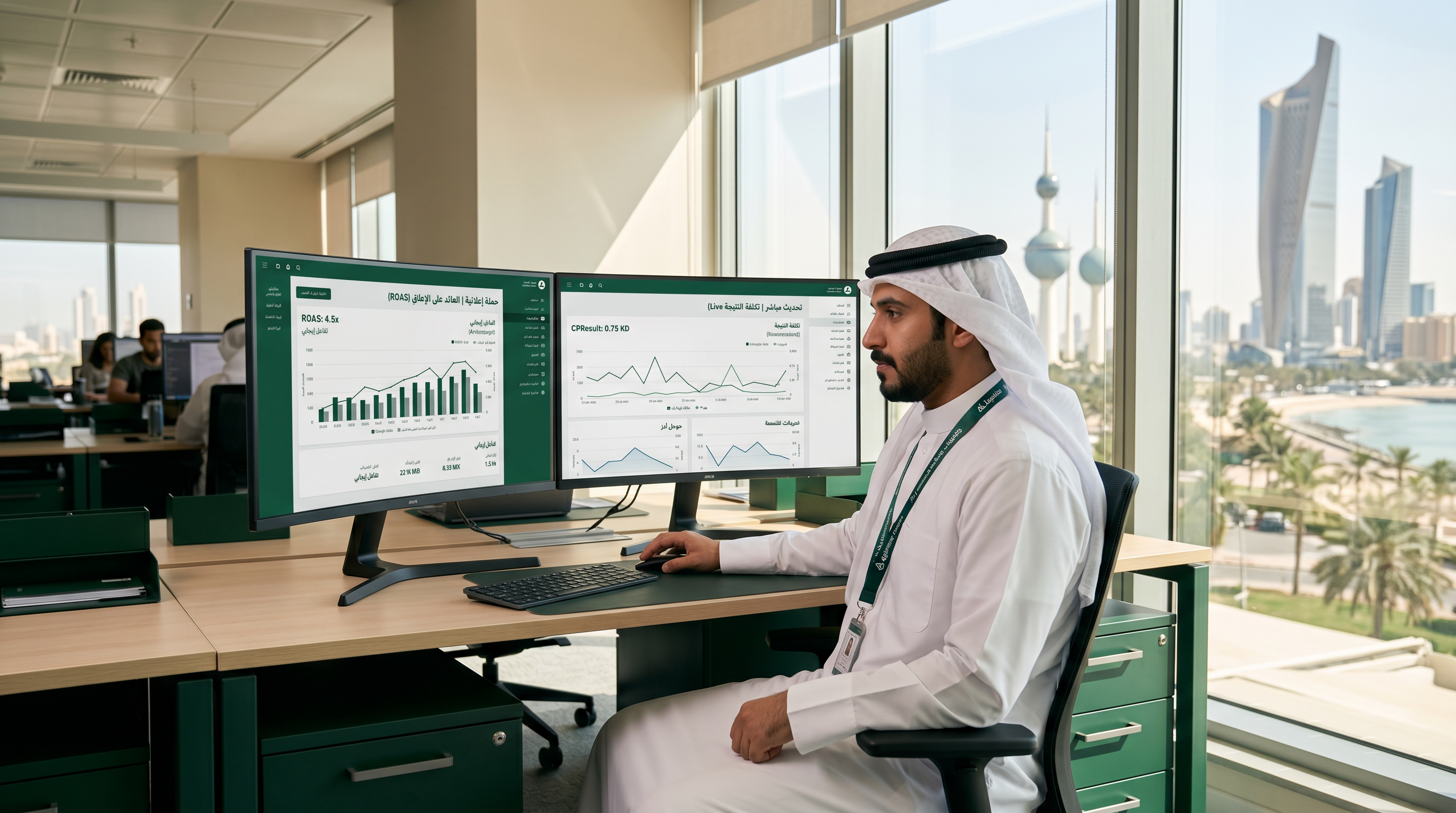
Last month, a Salmiya luxury goods retailer asked us: "Why does your team respond to budget questions in 3 hours but my old agency takes 2 days?" The answer wasn't magic. It was a dashboard they could see themselves, updated live every 15 minutes, with cost per sale broken down by device, location, and age bracket. No exported CSVs. No "I'll send you a report Friday."
Media buying reporting in Kuwait has shifted hard in 2026. Brands no longer accept lag. They don't accept guesswork. And they don't accept dashboards designed for New York agencies selling to Fortune 500 companies—they need tools built for the Gulf market, with Arabic language support, KWD currency, and the specific platforms Kuwaiti consumers actually use: Meta Ads, Snapchat, TikTok, and increasingly Google Performance Max.
This is what a real media buying dashboard looks like when you strip away the noise.
What a Media Buying Dashboard Actually Needs to Track in Kuwait 2026
Most dashboards show spend and impressions. That's table stakes and almost useless on its own. A working dashboard for Kuwait brands shows four layers of data, each telling a different story about campaign health.
Layer 1: Spend and Budget Allocation. You need to see daily spend against daily budget cap, broken by platform. Meta Ads, Snapchat, TikTok, Google. In KWD or USD—your choice, but the system must convert live. A Mishref F&B chain we worked with in Q3 2025 needed to know within 2 hours if a Friday dinner campaign was on pace. Their old agency sent weekly reports. By then, the weekend was already lost. With a live dashboard, they could pause underperforming Snapchat inventory and shift 40% of budget to TikTok where their under-25 audience was converting at 9.2% instead of 3.1%. Result: 28% higher ROAS that weekend, tracked in real time.
Layer 2: Cost Per Result and ROAS by Channel and Audience Segment. This is where most agencies fail. They show you ROAS at the campaign level. That's like showing a restaurant owner total revenue without breaking down lunch vs. dinner or dine-in vs. delivery. You need cost per lead, cost per purchase, and return on ad spend sliced by: platform, device (mobile vs. desktop vs. tablet), age group, location (by emirate and neighborhood in Kuwait, by major city in KSA, by free zone in UAE), and day of week. A Hawalli healthcare clinic we managed in 2025 discovered that their Sunday lead cost on Meta was 45% cheaper than Wednesday. They didn't know because their old agency never segmented by day. Once they shifted 60% of weekly spend to Sunday–Tuesday, their cost per appointment dropped from 8.5 KWD to 5.2 KWD. Twelve-month impact: 45% lower customer acquisition cost.
Layer 3: Real-Time Audience Insights and Engagement Metrics. Click-through rate, landing page conversion rate, add-to-cart rate, purchase rate. But not at campaign level only—by audience and creative. You're running three creatives against a Lookalike 1% audience. Which creative wins? By how much? Is the 18–24 age group outperforming 25–34? A Farwaniya retail client discovered in March 2026 that their Arabic creative was hitting 6.8% CTR while their English creative was 2.1%. They'd been split-testing for eight weeks but didn't notice because reports came monthly. Once they saw the dashboard, they paused English immediately and reallocated spend. Seven-day pivot. 62% CTR improvement across the whole account.
Layer 4: Attribution and Funnel Movement. Where are users dropping off? Landing page to checkout: 12% conversion. Checkout start to payment: 78% completion. Payment to order confirmation: 100%. That 22% checkout abandonment is your biggest leak, worth more than any 10% ROAS improvement. A dashboard worth its salt shows you funnel step-by-step, so you know whether to optimize ads (top of funnel), landing page (mid funnel), or checkout experience (bottom funnel).
How to Set Up a Media Buying Dashboard in Kuwait: The Live Process
- Connect all platforms via API. Meta Ads Manager, Snapchat Ads, TikTok Ads, Google Ads. Each platform has its own API. Don't manually export. Automation via API means data updates every 15 minutes, not weekly. After running 35+ WhatsApp AI deployments across Kuwait and GCC, we've learned that the same principle applies to dashboards: automation removes human error and lag. Your dashboard should never ask you to upload a file.
- Set your KPI definitions before launch. Your team must agree: What is a "lead"? Is it a form submission, a WhatsApp click, a phone call, or all three? What is a "conversion"? Order confirmation or payment approval? Define ROAS: revenue / spend, or (revenue - COGS) / spend? Ambiguity kills dashboard credibility. A Salmiya salon owner in Q2 2026 thought their ROAS was 4.2x until we clarified they were counting inquiries as conversions, not actual bookings. Real ROAS was 2.1x. Once definitions were locked, the whole team trusted the numbers.
- Build your primary dashboard view for daily decisions. This is the one-screen view you check every morning. Spend yesterday vs. daily budget cap. Leads yesterday vs. target. Cost per lead vs. benchmark. ROAS this week vs. last week. All in KWD. All in Arabic or English toggle. Do not include data you won't act on. A cluttered dashboard is a useless dashboard.
- Layer in segment views for optimization. Once the main dashboard is solid, build deeper views: By platform. By audience segment. By creative. By day of week. By geography (by Kuwait governorate, by GCC country). These are your optimization screens. You check these 2–3 times per week, not daily.
- Add alerts for anomalies. Spend is 50% higher than expected today? Alert. ROAS is below 5x (your floor)? Alert. A platform's CPC jumped 35% in 6 hours? Alert. Most agencies have no alerts. They discover problems in Friday reports. By then, you've burned 30% of the week's budget on trash. Alerts let you catch issues in hours. A Mishref e-commerce team we worked with set a 6.5x ROAS floor with daily alerts. In January 2026, a Meta algorithm shift tanked performance to 5.8x. Alert fired at 11 AM. They paused, adjusted audience targeting, relaunched at 2 PM. Recovered to 8.2x by end of day. Without alerts, they would have lost the entire day and discovered it Monday.
- Schedule automated report exports for stakeholders. Your dashboard is for operators (the team running ads). Your CEO doesn't need 47 metrics. They need: spend, leads, cost per lead, ROAS, and week-over-week trend. One page. Emailed every Monday. This takes 10 minutes to set up once and saves 2 hours per week of manual reporting.
Media Buying Dashboard Tools for Kuwait: What Works in 2026
You have three types of tools available now. Which you choose depends on your budget and technical depth.
| Tool Type | Best For | Setup Time | Cost Model | GCC-Ready? |
|---|---|---|---|---|
| Native Platform Dashboards (Meta Ads Manager, Snapchat, TikTok) | Single-platform campaigns. Agencies managing one platform only. | 1 hour | Free | Partial (no Arabic, limited segmentation) |
| Multi-Platform Aggregators (AdRoll, Supermetrics, Whatagraph) | Teams running 3+ platforms. Need one unified view. Limited customization. | 4–8 hours | $500–$2000/month | Partial (depends on setup) |
| Custom-Built Solutions (Google Data Studio + APIs, Looker, custom BI) | Agencies doing 50+ campaigns/month. Need deep segmentation, Arabic support, custom alerts. | 2–4 weeks | $3000–$10,000 setup + $500–$1500/month | Yes (fully) |
Most Kuwait agencies use tool type 2 and wonder why their clients complain. Tool 2 gives you a dashboard, but not a smart dashboard. It doesn't alert you to problems. It doesn't segment by location or device. It doesn't speak Arabic. If you're serious about media buying in 2026, you need tool type 3, or you partner with an agency that has already built it.
Real Example: A Hawalli Clinic's Dashboard Transformation (Q3 2025)
A dental practice in Hawalli was running Meta and Google Ads through an agency that sent monthly reports via email. Spend: 800 KWD per month. Leads: 25–35 per month. Cost per lead: 25–32 KWD. Variability was high, but they had no idea why.
They switched to KIRA in July 2025. First thing we built: a live dashboard showing cost per lead and lead quality (phone call, form, or WhatsApp inquiry) segmented by age group, gender, and device. Within three days, we spotted the pattern: leads from mobile were 45% cheaper and 22% more likely to book. Desktop leads were expensive but higher-intent. We shifted 65% of budget to mobile campaigns targeting the 28–45 age group (their best converter).
Dashboard told us the story in real time. By week two, cost per lead dropped to 18 KWD. By month two, they were getting 48 leads per month at 17 KWD each. The clinic owner could log in and see the dashboard every morning—no waiting for agency reports. Result: 12-month improvement is 58% lower cost per lead while lead quality actually improved. That's not possible without a dashboard that speaks the truth, fast.
Real Example: A Salmiya Retail Brand's Platform Shift (Q4 2025)
A fashion e-commerce brand in Salmiya was spending 80% of media budget on Meta Ads because "that's where everyone is." Their agency never questioned it. Spend: 15,000 KWD per month across Meta only. ROAS: 4.8x. Cost per purchase: 31 KWD.
When we set up their dashboard in October 2025, we added Snapchat and TikTok as test channels (1,000 KWD per month each to start). The dashboard showed platform-level ROAS within 48 hours. Snapchat was hitting 7.2x. TikTok was hitting 6.8x. Meta was 4.2x. By week three, we'd rebalanced: Meta 50%, Snapchat 30%, TikTok 20%. The Salmiya team could see the shift happening in the dashboard. No guessing. No spreadsheet politics.
Three months later: same 15,000 KWD spend, but ROAS improved to 6.9x. Cost per purchase: 18 KWD. That's a 42% efficiency gain, purely from listening to what the dashboard showed, not what intuition said. The dashboard was the only difference.
What You Should Avoid in a Media Buying Dashboard
Avoid vanity metrics without context. "1.2M impressions" means nothing. Impressions divided by spend = CPM. CPM compared to industry benchmark = insight. Most dashboards show impressions. Smart dashboards show CPM and flag when it's trending up (bad—inflation) or down (good—better targeting or lower competition).
Avoid single-layer ROAS. Campaign-level ROAS is a starting point. You need ROAS by audience, creative, platform, and device. A campaign with 5x ROAS might actually have two audiences: one at 12x and one at 1.2x. One audience is your goldmine; the other is a money sink. You won't see this without segmentation.
Avoid missing the funnel layer. Are you tracking clicks? Clicks don't convert. Are you tracking landing page visits? Are they converting to carts? Are carts converting to purchases? Or are you seeing 50,000 visitors, 2% cart rate, and 30% cart abandonment? You need to know, because the solution to 2% cart rate (improve ad targeting) is different from the solution to 30% cart abandonment (improve checkout experience, not ads).
Avoid alerts you can't act on. "Spend is up 20%." Of course it's up—it's Friday. Set smart alerts: spend is 50% above forecast, ROAS is below your floor for 12+ hours, or CPC jumped 30% in 6 hours. These are problems you can solve in the moment.
Integrating Your Dashboard with WhatsApp and CRM Systems
A modern media buying dashboard doesn't live in isolation. It connects to your customer data. If you're running WhatsApp campaigns (which most Kuwait brands are now), your dashboard should show you: how many leads came via WhatsApp, how fast they responded (under 1 minute? under 5 minutes?), and whether they became paying customers.
This is where AI agents become visible in your dashboard. When you deploy Lojain AI to handle WhatsApp conversations, the dashboard can show you: leads handled by Lojain vs. human team, average response time (Lojain responds in under 3 seconds, 24/7), escalation rate, and conversion rate by source.
A Mishref retail chain we work with has a dashboard that shows: paid ad leads coming in via Meta/Snapchat, those leads hitting WhatsApp, Lojain AI handling initial inquiry and qualification in under 3 seconds, and the human team picking up only high-intent leads. The whole funnel visible. No mystery. When a lead comes in at 2 AM, Lojain is working. When the team logs in at 8 AM, they see a pre-qualified list, saving 6 hours of daily manual triage.
You can build this yourself if you have engineering resources, or you can work with a partner who has already done it. Either way: if your dashboard doesn't connect to your CRM or messaging system, you're missing half the story.
Dashboard Benchmarks for Kuwait Media Buying in 2026
What numbers should you expect? This depends on your industry and audience quality, but here's what we typically see across our Kuwait and GCC client base:
E-commerce (fashion, beauty, F&B delivery): ROAS 6–9x. Cost per purchase 15–25 KWD. Conversion rate 2–4%. If you're seeing 3x ROAS, you have targeting or creative problems (probably both).
Lead generation (real estate, education, healthcare): ROAS 7–12x (since a lead is cheaper than a sale, but quality varies). Cost per lead 8–18 KWD. If you're above 25 KWD per lead, your audience targeting is too broad or your landing page has friction.
B2B (services, software, consulting): ROAS 4–7x. Cost per lead 30–80 KWD depending on deal value. ROAS here is often secondary to lead quality and sales cycle.
Most agencies celebrate 2–3x ROAS. Our floor is 7x. The difference is a dashboard that catches problems fast and a team that acts on it.
How Often Should You Check Your Media Buying Dashboard?
Daily: Check spend vs. budget cap and ROAS vs. floor. Takes 5 minutes. Is anything on fire? No? Good. Yes? Act now, not Friday.
Weekly: Deep dive into segment performance. Which audience is losing efficiency? Which creative needs to pause? Which platform is overperforming? Takes 30 minutes. Plan your next moves.
Monthly: Review full funnel. Are top-of-funnel metrics good but conversion rate dropping? That's a landing page or offer problem, not an ad problem. Are lower-funnel metrics weak? That's ad quality. Separate the diagnosis.
If you're checking the dashboard three times a day, you're probably tweaking without thinking. If you're checking monthly, you're already behind the curve by two weeks. The sweet spot is daily glance + weekly deep dive + monthly strategy review.
Moving from Spreadsheets to a Real Dashboard
Most Kuwait brands we meet are still on spreadsheets. An admin pulls reports from four platforms on Friday, spends two hours organizing them into one sheet, emails it Monday morning. By then, the data is 72 hours old. Decisions made on 72-hour-old data are usually wrong.
The shift from spreadsheet to live dashboard requires three things: (1) time to set up once (4–24 hours depending on complexity), (2) commitment to use it (checking daily), and (3) willingness to act on what it shows (not debating the numbers, trusting the system).
Once you're live, you'll see two immediate changes. First: you'll move faster. A Tuesday opportunity gets a Wednesday test, not a Friday plan. Second: you'll see patterns you never saw before. The 10 KM between Salmiya and Hawalli has a 40% different conversion rate, but you never noticed because data was batched monthly. Now you see it in week one.
A Farwaniya marketing manager we work with told us after month one: "I can't believe we were running blind for this long." She was checking the dashboard every morning, spotting issues before they became disasters, and her ROAS went from 5.2x to 8.8x in twelve weeks. Not from better ads. From faster visibility and faster action.
FAQ: Media Buying Dashboard Kuwait 2026
Do I need a dashboard if I'm spending less than 5,000 KWD per month?
No, not yet. At that spend level, native platform dashboards (Meta, Snapchat) are enough. You need a unified dashboard when you're splitting budget across 3+ platforms or when you need deep segmentation by audience or device. Once you hit 5,000 KWD/month across platforms, the time saved by a unified dashboard pays for itself in one week.
Should I use Google Data Studio or a paid tool like Supermetrics?
Google Data Studio is free but requires technical setup and only shows you what the APIs give you (usually 48-hour lag). Supermetrics is $500–$1500/month, refreshes more frequently (6–12 hours), and requires less setup. For most Kuwait teams, Supermetrics is better if you have 2+ platforms. For a single platform (Meta only), Data Studio is fine. If you need real-time (<2 hour lag) and custom segmentation, you'll need a custom solution or a partner like KIRA that has already built this.
Can I integrate my CRM with my media dashboard?
Yes, but the setup is complex. Your CRM stores customer data (who converted, who didn't, lifetime value). Your media dashboard shows ad spend and lead source. To connect them: (1) export leads from the dashboard weekly, (2) match them to CRM records by email or phone, (3) calculate which ad source is actually producing the highest-LTV customers. Most agencies never do this. The ones who do find that their "worst-ROAS" channel often produces the best customers long-term. You can't optimize without this data.
What's the typical setup cost for a custom dashboard?
Depends. A Supermetrics setup for 3 platforms: 6–12 hours, roughly 1,500–3,000 KWD. A custom-built dashboard with APIs, alerts, and Arabic support: 2–4 weeks, 8,000–20,000 KWD. Most teams start with Supermetrics and upgrade to custom if they need real-time or unusual segmentation.
How do I know if my dashboard data is accurate?
Check a sample. Pull last week's spend from your dashboard and compare it to your platform (Meta Ads Manager, Snapchat Ads). If they match within 2%, your dashboard is accurate. If they're off by 5%+, your API connection is stale or incomplete. Stale APIs are one of the biggest problems we see. A Hawalli agency was making decisions on 72-hour-old data and didn't know it. They thought Meta updated every 4 hours. It was updating every 3 days. Once they switched to real-time APIs, everything changed.
Can a dashboard replace my agency?
No. A dashboard is a tool. It shows you what's happening, not what to do about it. A good agency uses the dashboard to make faster, smarter decisions. A bad agency uses it as a crutch ("look how transparent we are") while still tweaking campaigns randomly. If you have a talented in-house team, a dashboard + automation tools like Lojain Lite can replace some agency functions. If you're managing 20+ active campaigns, you'll still need expert human strategy.
What happens if my dashboard goes down or the API breaks?
Your ads keep running, but you lose visibility for hours or days. This is why mission-critical dashboards have redundancy: API connection A + API connection B, so if one breaks, you're still getting data. Most SaaS tools handle this. If you're running custom, you need to build it in. Downtime sucks, but it's less worse than running ads with no visibility. A Salmiya e-commerce brand lost dashboard access for 6 hours due to a Snapchat API issue. They had no idea their spend spiked to 150% of daily cap for 4 hours. Once visibility came back, they caught it. Without a dashboard, that would have gone unnoticed for three days. So: dashboards are worth the risk of downtime.
The Real Cost of Not Having a Dashboard
Let's quantify it. A Kuwait brand running 10,000 KWD per month across three platforms without a dashboard is likely leaving money on the table. Here's why:
Delay in Problem Detection: You discover bad ROAS on Monday for a problem that started Wednesday. You've burned 40% of the week's budget on underperformance. Cost: 4,000 KWD wasted per month on average.
No Segmentation: You're splitting budget equally across all audiences because you don't know which segments perform. Three audiences: one at 10x ROAS, one at 6x, one at 2x. You're investing equally in all three. If you knew, you'd shift 60% to the 10x segment. Current setup: 10,000 KWD / 3 audiences = 3,333 KWD each. Blended ROAS: 6x. Optimized setup: 6,000 KWD to the 10x segment, 2,500 to the 6x, 1,500 to the 2x. Blended ROAS: 8.1x. Same spend, 35% more revenue. That's 3,500 KWD per month in hidden upside.
Creative Blindness: You're running five creatives, but you don't know which one is winning because reports come monthly. By the time you see the data, you've invested equally. A dashboard shows you in day three that Creative A is outperforming by 60%. Pause Creatives B–E immediately. Week one insight instead of month one. Cost: ~1,200 KWD in wasted spend per month.
Total hidden cost of no dashboard: 4,000 + 3,500 + 1,200 = 8,700 KWD per month. For a 10,000 KWD budget, that's 87% waste you're not seeing. A dashboard costs 500–1,500 KWD per month and returns 4–5x that in efficiency gains. The math is brutal.
Your Next Move
If you're still sending media buying reports via email, you're competing with one hand tied behind your back. Your competitors who have dashboards are already moving faster and getting better results.
Start here: (1) Pick one platform where you spend the most (Meta, probably). (2) Set up native dashboard alerts for spend +50% and ROAS below your floor. (3) Check it daily for one week. You'll see problems you never saw before. (4) Once you're comfortable, add a second platform and consider a unified tool like Supermetrics or a custom build.
If you're managing multiple campaigns across multiple platforms or running media buying as a service, you need a unified dashboard. The ROI is immediate and the competitive advantage is real.
Talk to Us on WhatsAppReady to Scale Your Marketing with AI?
KIRA delivers AI-powered marketing systems, WhatsApp automation, and media buying strategies for businesses worldwide.
Book a Strategy Call More ArticlesGet KIRA in your AI answers
Add KIRA as a Google Preferred Source so our articles show a "Preferred" badge in your AI Overviews & AI Mode results. Log in to Google, then tick the box next to kiraco.org.
Add KIRA as a Preferred Source