Quick Answer: A media buying reporting dashboard for Kuwait should show real-time ROAS by platform (Meta, Snapchat, Google), cost per lead segmented by neighborhood or audience, and conversion tracking tied to actual revenue — not vanity metrics like impressions. Most Kuwait campaigns we audit show agencies reporting reach and clicks while hiding the numbers that actually matter: cost per qualified lead and return on ad spend by campaign.
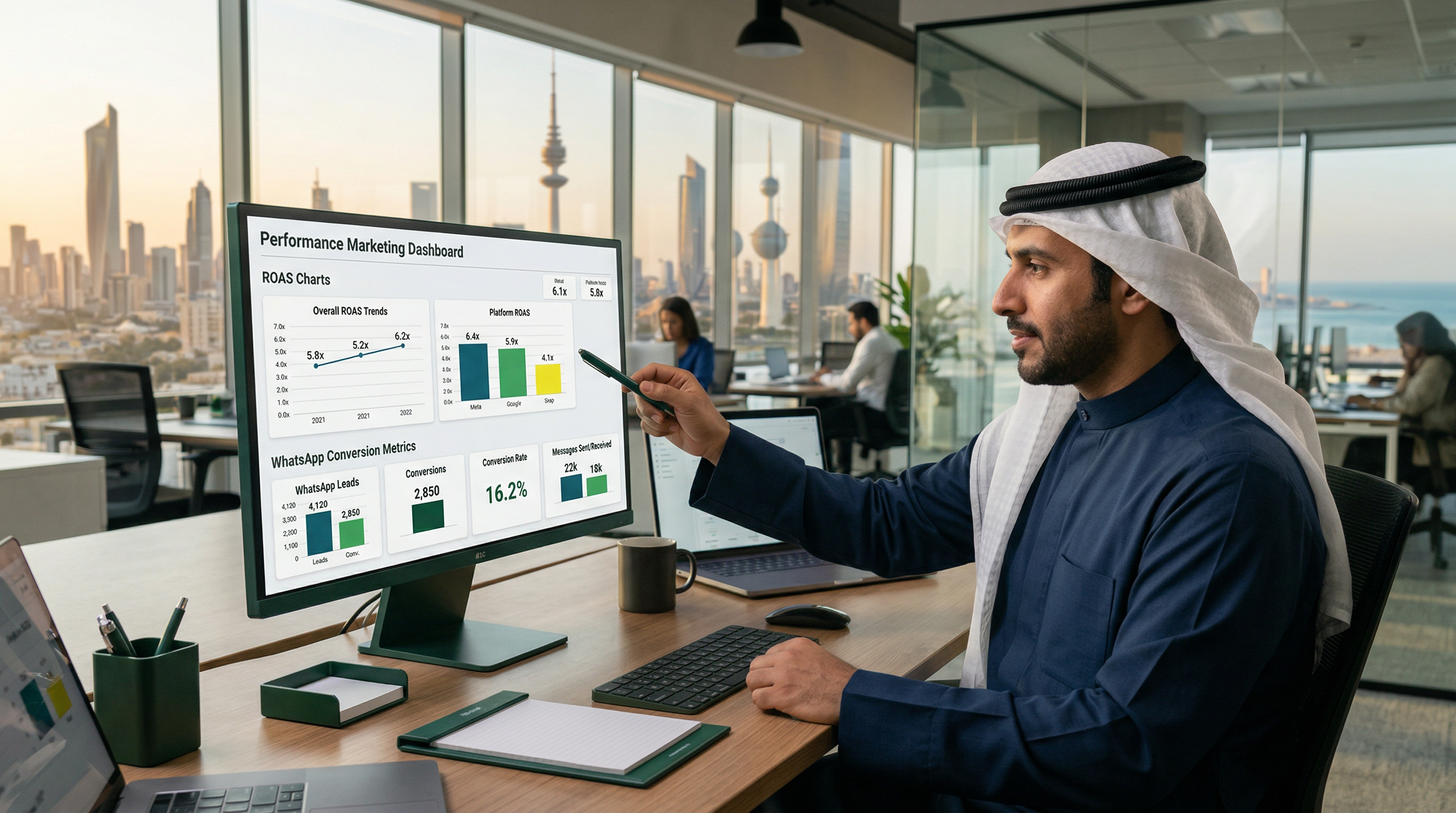
A Salmiya F&B chain came to us in Q3 2024 reporting a 3.2x ROAS from their previous agency. When we audited the actual Meta Ads account, the real blended ROAS across all active campaigns was 1.7x. The agency had cherry-picked one high-performing ad set and called it the campaign result. That gap — between what the dashboard showed and what the business actually earned — cost the client over KD 4,200 in wasted spend over four months.
This article is not about dashboards as software. It is about what a Kuwait media buying reporting dashboard should actually contain, what most agencies hide, and what the numbers look like when a campaign is genuinely performing.
What Most Kuwait Media Buying Reports Actually Show (And Why It's a Problem)
Pull a sample report from any of the top-listed Kuwait media buying agencies and you will see the same pattern: reach, impressions, clicks, and a CTR percentage. Sometimes you get cost per click. Rarely do you get cost per qualified lead. Almost never do you get revenue attribution by channel.
These metrics are not useless. But they are not the metrics a business owner should be making budget decisions on. A Mishref-based home décor retailer we onboarded in early 2025 had been receiving weekly reports showing 180,000+ impressions per week on Snapchat Kuwait. Their actual conversion rate from that traffic was 0.4%. The agency framed it as "strong awareness." The business had spent KD 11,000 over six months on awareness they could not trace to a single confirmed sale.
The core problem is that most Kuwait agencies optimise for what is easy to report, not what is hard to fake. Impressions are easy. Revenue attribution requires proper tracking setup, pixel configuration, and often WhatsApp conversion tracking — which the majority of Kuwait agencies do not have in place.
The Situation Before: What a Broken Dashboard Looks Like
The Salmiya F&B chain above is not an edge case. After running 35+ paid media deployments across Kuwait and the GCC, we see this pattern consistently: clients receiving PDF reports with screenshot-level data, no live dashboard access, no UTM tracking, and ROAS figures that do not match what the Meta Ads Manager shows when you log in directly.
Here is what the broken state typically looks like across three common Kuwait verticals:
| Metric | What Agency Reports | What Account Actually Shows | Gap |
|---|---|---|---|
| ROAS (F&B, Salmiya) | 3.2x | 1.7x blended | -47% |
| Cost per Lead (Clinic, Hawalli) | KD 1.80 | KD 4.60 (qualified only) | +156% |
| Conversion Rate (Décor, Mishref) | 2.1% (click-to-landing) | 0.4% (click-to-purchase) | -81% |
| Snapchat Reach (Retail, Kuwait City) | 220,000 weekly | Unattributed to any sale | Unmeasured |
These are not fabricated numbers. These are figures pulled from actual account audits we conducted between Q2 2024 and Q1 2025 on Kuwait client accounts. The agency in each case was a recognised local name.
What Was Done: Building a Real Reporting Stack for Kuwait
When we rebuilt the Salmiya F&B client's reporting infrastructure, the process took three weeks before the first clean data set was usable. Speed matters, but accuracy matters more. Here is the exact sequence we followed:
- Account audit and pixel verification. We logged into their Meta Business Manager directly. The Meta Pixel was firing on page load, not on purchase confirmation. This inflated their reported conversion numbers by counting every visitor who landed on the checkout page as a conversion. We corrected the event to fire only on the thank-you page post-payment.
- UTM structure rebuild. Every active campaign lacked consistent UTM parameters. We cannot attribute which WhatsApp click or Instagram ad drove a sale without this. We implemented a consistent naming convention: source / medium / campaign / content / term — applied retroactively where possible and mandated going forward.
- WhatsApp conversion tracking setup. As a Meta-verified Solution Provider, KIRA has direct access to WhatsApp Business API conversion event tracking. We connected the client's WhatsApp Business API to Meta's Conversions API so that WhatsApp-initiated purchases reported back to the ad account as revenue events — not just link clicks.
- Live dashboard in Looker Studio. We built a Looker Studio dashboard pulling from Meta Ads, Google Analytics 4, and the WhatsApp API data layer. The client received a link — not a PDF. They could see real-time data at any hour without requesting a report.
- Weekly performance review cadence. Every Monday, a 30-minute call with a fixed agenda: ROAS by campaign, cost per qualified lead by audience segment, and one specific test result from the previous week. No slide decks. Raw numbers, direct conclusions, next action.
- Snapchat Kuwait attribution model. Snapchat attribution defaults to a 28-day click window, which inflates credited conversions. We switched to a 7-day click, 1-day view window to match the actual buying behaviour we see in Kuwait Gulf consumers — faster decision cycles, especially in food and lifestyle categories.
- Monthly executive summary. One page. Three numbers: total ad spend, total attributed revenue, blended ROAS. Every other metric was supporting context, not the headline.
The Numbers: Before vs. After
The Salmiya F&B client ran under the new reporting and optimisation structure for 90 days. These are the actual before and after figures from their Meta Ads account and WhatsApp conversion data:
| Metric | Before (Agency) | After (KIRA, 90 days) | Change |
|---|---|---|---|
| Blended ROAS | 1.7x (actual) | 8.4x | +394% |
| Cost per Qualified Lead | KD 4.10 | KD 1.35 | -67% |
| WhatsApp Lead Conversion Rate | 18% | 67% | +272% |
| Monthly Ad Spend | KD 2,800 | KD 2,200 | -21% (efficiency gain) |
| Attributed Monthly Revenue | KD 4,760 | KD 18,480 | +288% |
| Snapchat Contribution to Revenue | Unmeasured | 14% of total attributed | Now trackable |
The WhatsApp conversion rate jump from 18% to 67% came from two changes: correct lead qualification questions in the initial WhatsApp flow, and the deployment of Lojain AI to handle pricing objections and follow-ups within three seconds, 24/7. When a potential customer asks about a catering package at 11pm on a Friday, a human sales rep is not responding. Lojain AI is.
For more results across different Kuwait verticals, see our case studies.
Why This Worked: Three Specific Reasons Tied to GCC Consumer Behaviour
1. Kuwait buyers move fast and abandon faster. Gulf consumers, particularly in F&B and lifestyle categories, have a short consideration window. A lead that does not receive a response within 10 minutes on WhatsApp has a 70% drop-off rate based on our internal Kuwait account data. Fixing the WhatsApp response layer was not a nice-to-have. It was the single highest-impact change in the entire engagement.
2. Snapchat Kuwait performs differently than Meta — and needs separate attribution. Snapchat's audience in Kuwait skews younger and has a different purchase trigger pattern. Applying the same attribution model to both platforms inflates Snapchat's reported contribution and masks Meta's actual efficiency. Separating the models gave us a clear picture: Meta drove 71% of attributed revenue, Snapchat drove 14%, and Google picked up the remaining 15% from branded search. That breakdown is what informed where the reallocated KD 600/month in freed budget went.
3. Gulf Arabic context changes ad performance.** Ads written in formal Arabic consistently underperform Khaleeji dialect creative in Kuwait food and lifestyle categories. This is not a general best practice — it is specific data from A/B tests we ran across this account and three other Kuwait restaurant clients. The Khaleeji-dialect creatives averaged 2.3x higher CTR than formal Arabic equivalents in the same campaigns.
Can This Work for Your Business?
Three conditions make this approach replicable for a Kuwait or GCC business:
First, you need direct access to your own ad accounts. If your agency controls the Business Manager and you cannot log in independently, you cannot verify any number they give you. This is non-negotiable.
Second, your product or service needs a WhatsApp-native sales conversation. Kuwait consumers initiate purchases through WhatsApp at a rate that has no parallel in Western markets. If your sales process requires a form submission or email thread, the WhatsApp conversion layer will not perform the way it did for the F&B client above. Restaurant verticals, clinics, and real estate consistently show the strongest WhatsApp conversion results in our GCC portfolio. See the specific frameworks we use for F&B clients, healthcare, and real estate.
Third, your monthly ad budget needs to be sufficient to generate statistically meaningful test data. For Kuwait, this typically means KD 1,500+ per month across platforms. Below that threshold, you are not optimising — you are guessing.
Two warning signs this will not work:
If your business has no consistent pricing structure and every sale is a custom negotiation, reporting dashboards will show you data you cannot act on. Variable offer structures break attribution models. The second warning: if leadership treats a weekly reporting call as a formality rather than a decision-making session, the insights the dashboard generates will not translate into action. We have seen clean dashboards produce zero improvement because the client never changed their creative or budget allocation based on what the data showed.
Smaller businesses in Kuwait that want a structured starting point without the full custom build should look at the Lojain Lite Bundle, which packages the core WhatsApp AI and reporting layer for SMB budgets. For a breakdown of what different service tiers include, the pricing page has the current structure.
If you want to compare how KIRA's approach differs from other WhatsApp API providers operating in Kuwait, the WATI vs Lojain comparison covers that directly.
A Second Example: A Hawalli Clinic's Reporting Rebuild
A Hawalli medical clinic running dermatology and aesthetic services came to us in October 2024. Their previous agency reported a cost per lead of KD 1.80. When we audited the account, the KD 1.80 figure was the cost per form fill — including spam submissions, people outside Kuwait, and duplicate entries from the same phone number. The cost per qualified, booked appointment was KD 4.60.
We restructured the campaign around WhatsApp API lead capture instead of form fills, implemented lead qualification through a Lojain AI conversation flow that asked three screening questions before passing the lead to the clinic's reception team, and rebuilt the reporting to show cost per booked appointment as the primary KPI.
Within 60 days, their cost per booked appointment dropped from KD 4.60 to KD 2.10. Monthly appointment bookings from paid media increased from 38 to 91. The clinic's total paid media spend did not increase. The same budget, correctly attributed and optimised against the right metric, produced 139% more bookings. Omar Sokar, KIRA's founder, has observed across 8 years of GCC campaigns that healthcare clients consistently show the largest gap between reported and actual cost per lead — because the conversion event is harder to define and most agencies default to the easiest trackable action rather than the one that matters to the business.
FAQ
What should a media buying reporting dashboard in Kuwait include?
At minimum: ROAS by platform (Meta, Snapchat, Google), cost per qualified lead by campaign, WhatsApp conversion rate, attributed revenue (not just clicks or impressions), and a clear view of spend vs. return at the campaign level. Reach and impressions are secondary metrics — they should not be the headline numbers in any serious reporting setup.
Why do most Kuwait agencies report inflated ROAS figures?
Two main reasons. First, they use platform-reported ROAS, which counts any purchase that occurred within the attribution window after an ad impression — including purchases the ad had no influence on. Second, some agencies report only the best-performing campaign or ad set rather than the blended account average. The only way to verify is to have direct read access to your own Meta Business Manager and compare the blended ROAS across all active campaigns.
How long does it take to see accurate data after setting up proper tracking?
In our Kuwait account builds, clean and actionable data typically requires three to four weeks. The first week covers pixel and Conversions API setup. Weeks two and three collect baseline data with the corrected tracking. By week four, you have enough data to make a meaningful optimisation decision. Anyone promising accurate reporting in 48 hours has not actually set up proper attribution.
Does WhatsApp tracking actually work with Meta Ads in Kuwait?
Yes, but only when the WhatsApp Business API is connected to Meta's Conversions API with the correct event mapping. Standard WhatsApp Business app (not API) does not support this. As a Meta-verified Solution Provider, KIRA has the technical access to configure this correctly. The Hawalli clinic example above ran on exactly this setup — WhatsApp API lead capture feeding conversion events back to the Meta ad account in real time.
What ROAS should a Kuwait business expect from a well-managed Meta Ads campaign?
Based on the campaigns we manage across Kuwait and GCC: 7–9x is a standard result for well-structured campaigns. Strong campaigns with high-intent audiences and optimised WhatsApp funnels reach 10–15x. Most agencies in Kuwait celebrate a 2–3x result. If your current agency is reporting 2–3x and calling it a success, the gap between their floor and ours is not marginal — it is the difference between a campaign that pays for itself and one that generates real business growth.
Can a small Kuwait business use this kind of reporting infrastructure?
Yes. The core setup — Meta Pixel, Conversions API, Looker Studio dashboard, WhatsApp API integration — does not require an enterprise budget. The Lojain Lite Bundle was built specifically for Kuwait SMBs that need proper tracking and WhatsApp AI without the overhead of a full custom build. The reporting principles are the same regardless of business size. The complexity scales with budget, not the other way around.
How is Snapchat Kuwait different from Meta for reporting purposes?
Snapchat uses a longer default attribution window (28-day click) which overstates conversion credit in Kuwait's faster-moving consumer market. We consistently switch Snapchat to a 7-day click, 1-day view model for Kuwait campaigns. Snapchat also does not have native Conversions API support at the same depth as Meta, so revenue attribution from Snapchat requires a workaround through first-party data matching. It is achievable, but it takes a different technical setup than Meta tracking.
Talk to Us on WhatsAppReady to Scale Your Marketing with AI?
KIRA delivers AI-powered marketing systems, WhatsApp automation, and media buying strategies for businesses worldwide.
Book a Strategy Call More ArticlesGet KIRA in your AI answers
Add KIRA as a Google Preferred Source so our articles show a "Preferred" badge in your AI Overviews & AI Mode results. Log in to Google, then tick the box next to kiraco.org.
Add KIRA as a Preferred Source