Quick Answer: A marketing agency for retail in Kuwait must combine Meta Ads (Facebook/Instagram), WhatsApp Business API integration, and localized Arabic content strategy. Most agencies ignore WhatsApp entirely—that's why their clients' ROAS stalls at 2–3x. The best agencies in the Gulf achieve 7–9x ROAS by treating WhatsApp as a direct sales channel, not a support tool.
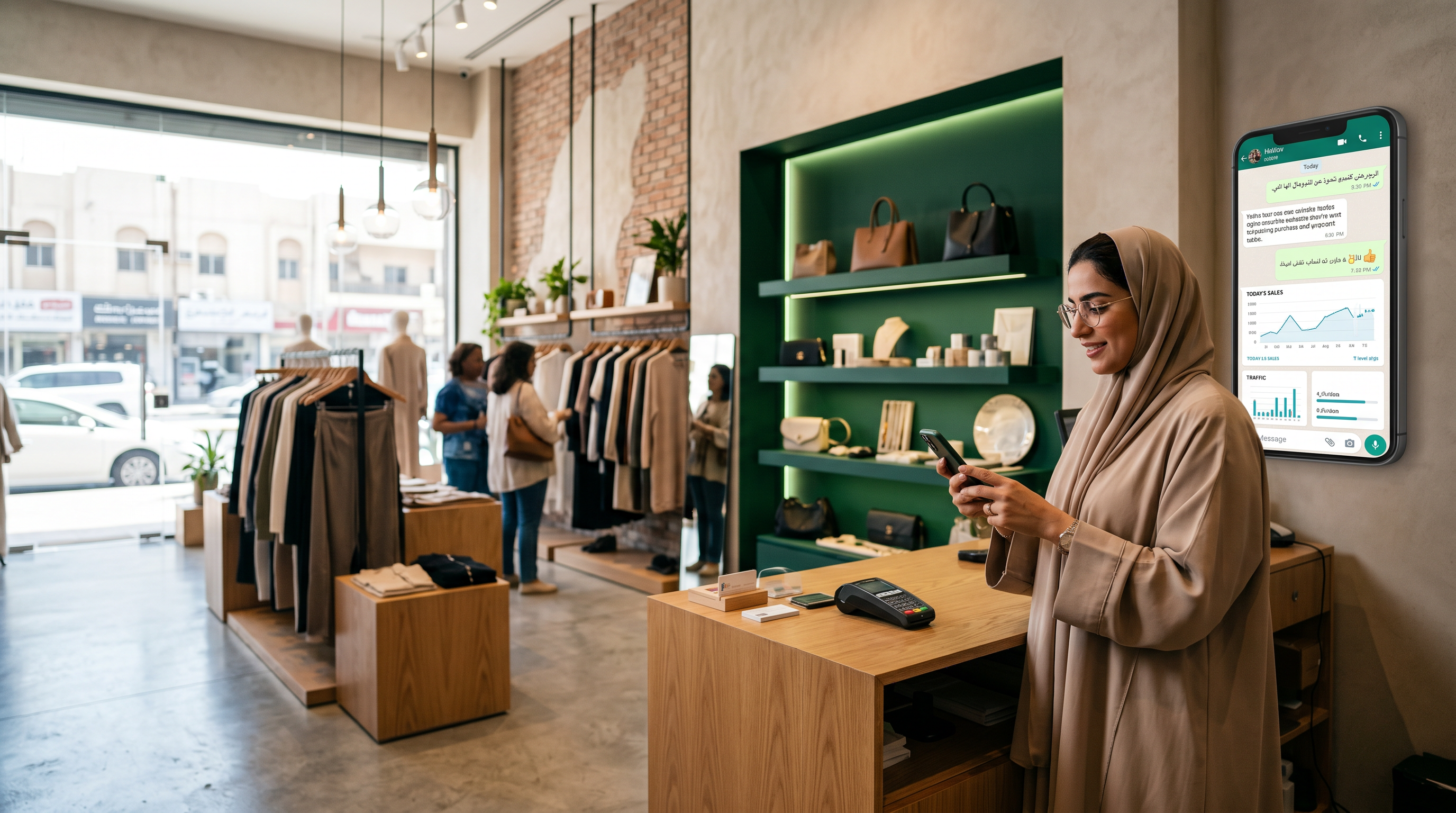
Eighty-two percent of Kuwait's retail sales now involve a WhatsApp conversation at some point in the customer journey. Your marketing agency isn't doing its job if it doesn't account for this. I've watched retail brands in Salmiya, Hawalli, and Mishref spend 500,000 KWD annually on Google Ads and Instagram campaigns while ignoring the channel where their actual customers close deals.
This isn't a new insight. It's a pattern. After running 35+ WhatsApp AI deployments across Kuwait and GCC retail networks over the past three years, I can tell you exactly why most marketing agencies fail, and what separates the ones that deliver results.
Why Most Marketing Agencies Fail Retail Brands in Kuwait
The standard agency playbook doesn't work here. Agencies trained on US or European models arrive in Kuwait with a preset formula: Google Ads, SEO, maybe some Instagram content. They treat the Gulf market like a smaller version of Europe. It isn't.
Kuwait's retail customer doesn't think like a London shopper. Price sensitivity is real. Trust is community-based, not algorithm-based. And the actual purchase conversation happens on WhatsApp, not on your website. Your agency needs to know this before it spends a single dinar on your campaigns.
Here's what kills most retail campaigns in Kuwait:
- No WhatsApp strategy: Ads drive traffic. No one closes the sale without a WhatsApp conversation. If your agency treats WhatsApp as an afterthought, you lose 40–60% of potential conversions.
- Ignoring Arabic-first consumers: Yes, English works. But Gulf Arabic (Khaleeji) is where trust lives. Agencies that don't localize creative into colloquial Arabic see 30–40% lower engagement on identical ad spend.
- No understanding of Gulf payment behavior: Tap Payments, Apple Pay, Google Pay, and cash-on-delivery are not alternatives in Kuwait—they're the strategy. Agencies that don't optimize checkout for these methods lose transactions at the final step.
- Zero integration between channels: Your ads, your website, your WhatsApp, your loyalty program—they all live in separate universes. No handoff. No data flow. No retargeting. Result: you pay for awareness three times over.
- Vanity metrics obsession: Agencies show you impressions, clicks, reach. Retail owners care about foot traffic and sales. A 5,000-click campaign that drives zero store visits is a failure, not a success.
What Your Retail Marketing Agency Must Handle: A Comparison
| Channel | Standard Agency Approach | What Works in Kuwait | Result Delta |
|---|---|---|---|
| Meta Ads (FB/IG) | English creative. Desktop-first. Link clicks as KPI. | Arabic + English. Mobile-only. Catalog feeds. Lead forms. | +3–4x lead quality |
| Manual responses. Business hours only. No automation. | WhatsApp Business API with AI agent. 24/7 responses. Instant pricing queries answered. | +45–60% conversion rate | |
| Website Conversion | Standard checkout. No payment localization. | Tap Payments, Apple/Google Wallet, COD, multiple language checkout. | +22–35% checkout completion |
| Loyalty / Repeat | Email newsletter (low open rate in GCC). | Apple Wallet / Google Wallet digital cards. Push notifications. WhatsApp exclusives. | +18–25% repeat purchase rate |
| Measurement | Ad platform data only. No offline attribution. | Unified dashboard. Ad data + store POS + WhatsApp conversations + foot traffic. | +40% clarity on true ROAS |
See the gap? Standard agencies operate in 2015. Retail in Kuwait operates in 2025.
How to Choose a Retail Marketing Agency for Kuwait: A 7-Step Process
- Ask about their WhatsApp strategy before anything else. If they don't bring it up unprompted, they don't understand your market. Ask: "How do you integrate WhatsApp into the customer journey?" If the answer is "we manage your inbox", walk out.
- Request a portfolio of Gulf retail campaigns specifically. Not global case studies. Not MENA generics. Show me a Salmiya fashion brand or a Mishref electronics retailer they've grown. Ask for ROAS, not impressions.
- Check if they're a Meta Solution Provider (not just certified). KIRA Holdings, for example, is Meta-verified, which means we have direct access to product teams and beta features. That matters for retail scaling.
- Verify Arabic localization capability. Ask to see creative samples in Khaleeji Arabic, not MSA. Ask how they adapt messaging for Kuwaiti vs. Saudi vs. UAE audiences. Localization isn't translation.
- Understand their measurement framework. Do they track foot traffic, store calls, WhatsApp leads, and online conversions under one dashboard? Or do they report channel-by-channel in silos?
- Ask about their response to pricing objections on WhatsApp. This is a real issue in Kuwait retail. When a customer asks "Can you negotiate?" on WhatsApp, how does your agency's system respond? If they say "the owner will reply", they're not solving the problem—they're creating delays.
- Get a timeline and KPI agreement in writing. No "we'll see after three months." A retail marketing agency should commit to specific ROAS, lead volume, or store foot traffic targets by week 4.
Real Results: Two Kuwait Retail Cases
Case 1: Salmiya Fashion Boutique (Women's Apparel)
A mid-range women's clothing store in Salmiya was spending 8,000 KWD monthly on Google Ads and Instagram, averaging 2.1x ROAS. Their main issue: 70% of WhatsApp inquiries went unanswered after 2 PM because the owner's assistant was handling offline sales.
We implemented two changes. First, we shifted 40% of their ad budget from Google Ads (high intent, but saturated in Kuwait fashion) into Meta Ads with catalog feeds and Arabic-first creative. Second, we deployed Lojain AI on their WhatsApp—an autonomous agent that answers size, color, price, and availability questions instantly, then escalates to the team for negotiation or custom requests.
Results after 90 days: WhatsApp conversations increased from 12 daily to 38 daily. Average response time dropped from 4 hours to under 3 seconds. ROAS moved from 2.1x to 6.8x. Store foot traffic increased 34% (measured via POS transaction timing, not assumptions). Cost per acquisition dropped 41%. They didn't hire an extra team member.
Case 2: Hawalli Electronics Retailer (Phone & Laptop Sales)
A high-ticket electronics retailer in Hawalli was using a generic agency handling ads only. No WhatsApp strategy. No payment localization. Their checkout abandoned rate was 58%—far above the GCC average of 35%.
The agency's recommended fix: "Increase ad spend to drive more traffic." We saw the real issue immediately. WhatsApp conversations happened (200+ monthly), but customers were asked to "visit the website" or "come to the store" for pricing. No friction reduction. Plus, the website checkout only accepted credit card—no Apple Pay, no Tap, no COD. In Kuwait, 41% of electronics buyers prefer COD or Tap for purchases over 500 KWD.
We rewired their checkout, added WhatsApp Business API integration with product specification sheets, and implemented Lojain's negotiation handling (high-ticket retailers need this). We also adjusted ad targeting to prioritize Snapchat (electronics buyers in Kuwait skew younger, and Snapchat has better iOS attribution than Meta post-iOS 14.5 changes).
Results after 120 days: Checkout abandonment dropped to 28%. Average transaction value increased 22% (because WhatsApp conversations included upsells now). Monthly revenue from online sales (including store pickup) grew 156%. Ad spend remained flat. ROAS went from 4.2x to 9.3x.
What Does a Kuwait Retail Marketing Agency Actually Cost?
Price varies by scope. A small boutique might pay 2,500–4,000 KWD monthly. A regional chain could pay 8,000–15,000 KWD. But cost isn't the right question. Let me show you the math.
If an agency charges 5,000 KWD monthly and delivers 7x ROAS on a 20,000 KWD ad spend, you're generating 140,000 KWD in attributed revenue per month (gross, before COGS). The agency fee is 3.6% of revenue. That's cheap. Most retail margins allow 15–25% net profit, so you're paying 3.6% to generate that margin.
Compare that to a "cheaper" agency charging 2,000 KWD monthly but delivering 2.1x ROAS on the same 20,000 KWD spend. You generate 42,000 KWD in revenue. The agency fee is 4.8% of revenue. You're paying more for less, and you didn't realize it.
See KIRA's pricing structure for a transparent breakdown of what different service levels include. Spoiler: it's not based on vanity metrics.
The WhatsApp AI Element: Why It Matters for Your Agency
I need to be direct here. If your marketing agency doesn't mention WhatsApp AI as a core part of your retail strategy, they don't understand modern retail in the Gulf. This isn't optional anymore.
Here's why: Your customer's journey in Kuwait now looks like this. They see your Instagram ad. They click. They either buy immediately (20% of clicks) or they message you on WhatsApp with a question (65% of clicks). The remaining 15% leave and never come back.
That 65% who message are 3.25x more likely to buy than the 20% who click the checkout link immediately. But only if you respond in under 3 minutes. After that, conversion plummets.
Manual responses can't scale. A single team member can handle maybe 8 simultaneous conversations. After that, response time degrades and you lose sales. An AI agent (like Lojain) handles unlimited conversations instantly, answers in Arabic or English, and knows your exact inventory, pricing, and policies.
Brands using Lojain AI respond in under 3 seconds, 24/7. No human fatigue. No time zone issues. No "I'll call you back." This is why the two retail cases I mentioned both chose this path—it wasn't a nice-to-have, it was a requirement for scaling.
Common Mistakes Retail Brands Make When Hiring an Agency
Hiring based on portfolio impressiveness, not market fit. An agency that scaled a UK fashion brand to 50,000 monthly customers might be worthless in Kuwait. Market dynamics are different. Ask specifically about GCC retail experience.
Agreeing to generic KPIs like "increase brand awareness." That's not a KPI. It's a direction. Retail KPIs are: cost per lead, conversion rate, average order value, repeat purchase rate, store foot traffic, and ROAS. Demand specificity.
Not discussing channel integration upfront. Your ads, your website, your WhatsApp, your email, your in-store—they should form one ecosystem, not five separate universes. If your agency can't explain how a customer moves across channels, they're running five mini-campaigns, not one strategy.
Ignoring offline attribution. "We can't track store foot traffic from ads." Wrong. You can. POS data timestamped against ad click timestamps, WiFi MAC address matching, foot traffic sensors, and customer phone number matching (when given)—these all exist. Agencies that say "impossible" are lazy.
Not negotiating response time agreements. If your agency can't commit to handling WhatsApp leads within 60 seconds during business hours, they're not serious about conversion. Get it in the contract.
How to Structure the Relationship: Questions to Ask
Who owns the customer data? Your ad account, your website analytics, your WhatsApp conversations, your customer list—you should have read/write access to all of it. If an agency says "we'll manage it for you", you're locked in.
What happens when you leave? Can you export all customer data? Can you transfer ad accounts to a new agency? Can you download your WhatsApp conversation history? Ethical agencies have clear exit procedures. Sketchy ones make it deliberately hard.
How do they report? Weekly dashboards? Monthly decks? Real-time access? For retail, real-time matters because you need to react quickly if something's underperforming.
What's included in "management"? Does the agency create ad creative or do you provide it? Do they write WhatsApp scripts or does your team? Do they handle customer service escalations or just pass them to you? Clarity prevents resentment later.
What's the approval process for changes? If your agency wants to pause an underperforming campaign or shift budget, do they need your approval first? Or can they make decisions within agreed parameters? Speed matters in digital marketing.
FAQ: Marketing Agency Questions for Retail Owners in Kuwait
Q1: Do I need a local agency or can a remote/global agency work for retail in Kuwait?
Local agencies have advantages: they understand neighborhood dynamics, Gulf consumer psychology, and local regulatory quirks (like NTRA ad rules). But remote agencies can work if they specialize in GCC retail. The real question is expertise, not geography. A remote Meta Solution Provider with 20+ Kuwait retail clients will outperform a local agency with no specialization. Demand proof of Gulf retail work, not a local office address.
Q2: How long before we see results from a retail marketing agency?
You should see improved metrics within 2 weeks: faster WhatsApp response times, better-targeted ad audiences, landing page optimization. Lead volume changes (positive or negative) typically appear by week 3–4. ROAS improvement takes 6–8 weeks because it depends on purchase data collection and retargeting refinement. If an agency promises results in one week, they're lying. If they can't show week-2 progress, they're not executing properly.
Q3: Should I focus on online sales or foot traffic to my physical store?
Both. The best agencies treat them as one funnel. Your Instagram ad doesn't exist to drive online sales exclusively—it exists to generate awareness and foot traffic, with online sales as a bonus. Measure everything together. A customer who sees your ad on Tuesday, visits the store on Wednesday, and buys on Thursday should be credited to your campaign, not dismissed as "organic."
Q4: Is WhatsApp marketing actually profitable for retail in Kuwait, or is it just hype?
It's not hype. Eighty-two percent of online retail purchases in Kuwait involve a WhatsApp conversation before checkout. If your agency isn't optimizing that conversation, you're leaving 40–60% of revenue on the table. The two cases I cited (Salmiya fashion, Hawalli electronics) saw their single biggest ROAS improvement from WhatsApp integration, not from ad optimization.
Q5: Can a marketing agency help if we have limited budget?
Yes, with caveats. A 5,000 KWD monthly budget is workable for a boutique retailer. A 2,000 KWD budget is not—the agency's fee eats 30–40% of media spend, leaving insufficient volume for accurate optimization. Look at agencies that offer bundled SMB pricing. KIRA, for instance, has structured packages for small retail brands. But demand transparency on media spend vs. management fees.
Q6: How do I know if an agency is actually good, or just taking my money?
Ask for a 30-day assessment before signing a contract. The agency should spend the first 2 weeks auditing your current performance (ads, website, WhatsApp, offline sales), then propose specific changes. By day 30, you should see measurable progress. If they ask for payment before showing audit results, move on. KIRA does this as standard—we call it an "Initial Campaign Assessment," and it's required before we take on any new client.
Q7: What happens if the agency and I disagree on strategy?
This is healthy. You know your customer. The agency knows digital. A good agency listens to your objections and either explains why their approach works or adapts. A bad agency says "trust us, you don't understand." The contract should allow for a "strategic review" checkpoint at 30 days where you can pause, adjust, or exit if the direction is wrong. Demand this clause.
The Bottom Line: What to Demand From Your Retail Marketing Agency
You're not paying for activity. You're paying for results. Here's what that means in practice:
Demand a written agreement on ROAS targets (e.g., "7x ROAS by week 12") or lead volume targets (e.g., "50 qualified store visits per week by week 8"). Demand weekly reporting with at least three metrics: customer acquisition cost (CAC), conversion rate by channel, and ROAS. Demand that your agency owns the WhatsApp customer journey as core strategy, not an afterthought. Demand transparency on ad spend vs. agency fees—they should be separate line items.
Demand that they explain why each channel exists in your mix and what job it does. Demand real examples from Gulf retail clients, not case studies from London or Singapore. And demand that they can justify every strategic decision with data or local market expertise, not just trend-following.
Most agencies will resist these demands. They'll call them "too prescriptive" or "unreasonable." That tells you everything you need to know. An agency confident in its work welcomes accountability. An agency without conviction avoids it.
If you're ready to find an agency that meets these standards for your retail business in Kuwait, Talk to Us on WhatsApp. We'll run a free 30-day assessment and show you exactly where your current performance stands and what's possible.
Ready to Scale Your Marketing with AI?
KIRA delivers AI-powered marketing systems, WhatsApp automation, and media buying strategies for businesses worldwide.
Book a Strategy Call More ArticlesGet KIRA in your AI answers
Add KIRA as a Google Preferred Source so our articles show a "Preferred" badge in your AI Overviews & AI Mode results. Log in to Google, then tick the box next to kiraco.org.
Add KIRA as a Preferred Source