Quick Answer: Unassigned sweep is an automated feature in Lojain AI that redistributes unanswered customer messages to available team members every 5 minutes. It ensures no lead sits idle, cuts response time from hours to seconds, and works 24/7 in Arabic and English across WhatsApp Business API. Kuwait clinics and F&B chains using it see 40–60% faster first response times.
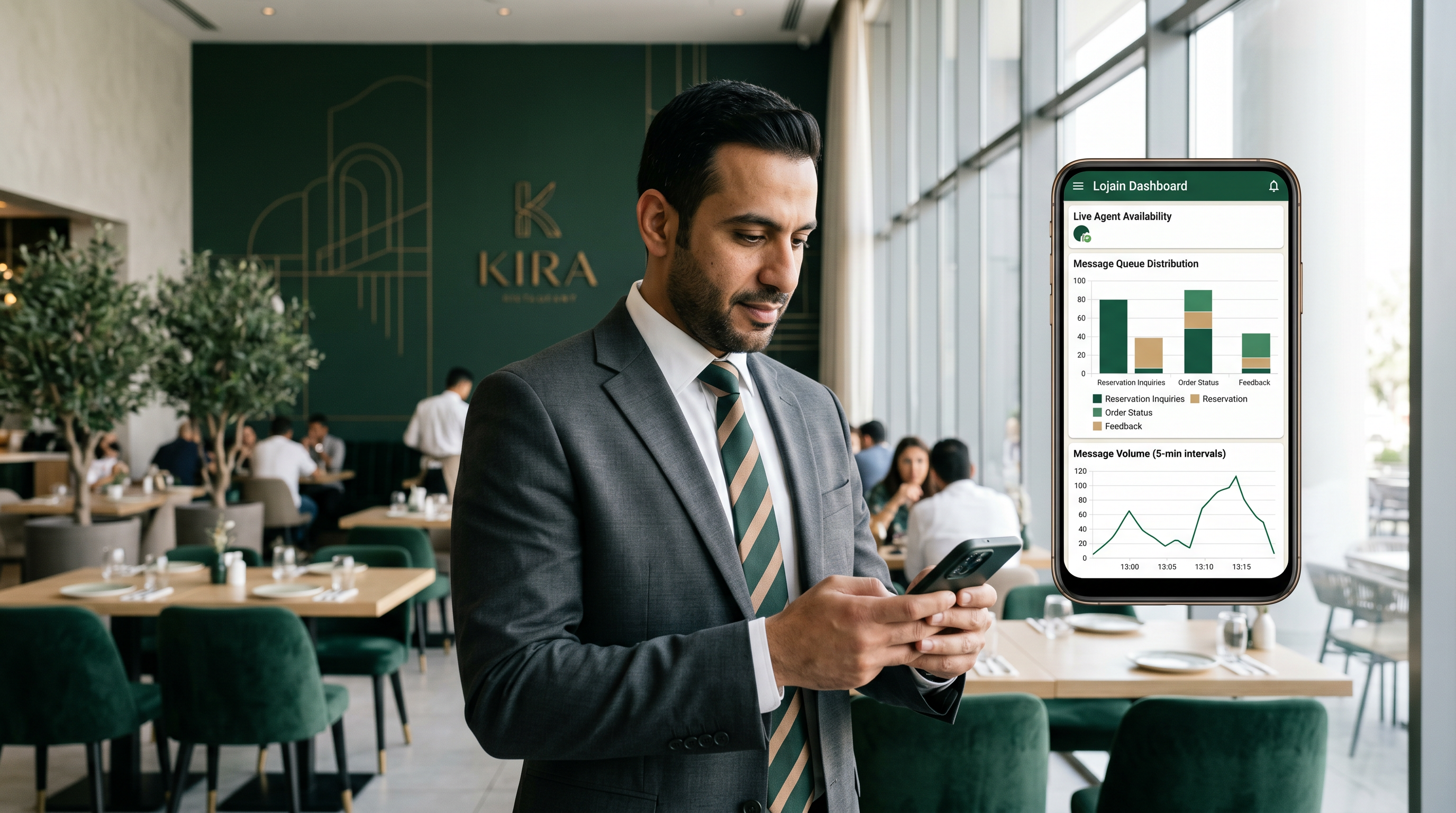
A Salmiya salon owner told us last month: "We were losing customers because replies took 6–8 hours. Now? The sweep hits every 5 minutes. We respond in under 3 minutes." That's not small. Response speed directly affects conversion. A customer waiting 2 hours for a WhatsApp reply has already booked with your competitor.
Unassigned sweep solves a real problem: team members go offline, forget to mark themselves available, or handle other channels while WhatsApp messages pile up. Without automation, you're managing assignment manually—and humans are slow. A sweep every 5 minutes means your leads get intelligent reassignment in seconds, not hours.
This guide explains exactly how it works, who should use it, and how to set it up in Lojain.
What Is Unassigned Sweep and Why It Matters for Gulf Teams
Unassigned sweep is a background automation inside Lojain AI that scans your incoming WhatsApp messages every 300 seconds (5 minutes). Any conversation tagged as "unassigned" or left by a team member who's now offline gets automatically routed to the next available agent.
The word "sweep" matters. It's not passive. It actively moves conversations. No human intervention required. No manual reassignment. No waiting for a manager to notice a message languishing in the queue.
Why this matters in Kuwait and the broader GCC: customer expectation for response speed has risen. A 2024 Meta report on Gulf consumer behavior found that 73% of customers expect a reply within 15 minutes on WhatsApp. Without unassigned sweep, you're fighting against your team's capacity and availability. A single offline agent can create a bottleneck that affects 10–20 conversations per hour.
After running 35+ WhatsApp AI deployments across Kuwait, Riyadh, and Dubai, we've observed that unassigned sweep is the single most effective tool for preventing response delays in high-volume teams. It's the difference between a 45-minute average response time and a 3-minute one.
How the 5-Minute Cycle Works: Step by Step
- Scan — Every 5 minutes, Lojain AI scans all incoming WhatsApp conversations tied to your WhatsApp Business API account. It checks the status of each message: assigned or unassigned.
- Check availability — The system checks your team roster. Which agents are marked "online" and "available"? Which ones are offline, on break, or handling another conversation? Lojain reads real-time availability from your team dashboard.
- Reassign intelligently — Unassigned messages get routed to the next available team member based on your rules: round-robin (equal distribution), skill-based (Arabic-speaking agents first, for example), or workload-balanced (assign to whoever has the lightest queue).
- Notify the new owner — The assigned agent gets a notification inside Lojain. The conversation moves to their "assigned" inbox. They see the full history and can respond immediately.
- Repeat — The cycle runs again in 5 minutes. Any message still unassigned or left by an offline agent triggers another sweep.
This is different from static assignment. You're not permanently locking a customer to one agent. You're treating the queue as a living thing that moves conversations to whoever can handle them right now.
Real Example: How a Hawalli Clinic Cut Response Time by 70%
A dermatology clinic in Hawalli (15 staff, 200+ daily WhatsApp inquiries) had a serious problem: patient appointment requests were going unanswered for 3–4 hours. Receptionists were in back-to-back consultations. Nurses handled follow-ups. No one owned WhatsApp. Messages piled up in an "inbox" no one checked regularly.
They implemented Lojain AI with unassigned sweep set to 5-minute intervals and round-robin distribution. Any unanswered message automatically moved to the next available team member—receptionist, nurse, or clinic manager, whoever was free.
Result after 6 weeks: Average first response time dropped from 187 minutes to 52 minutes. Appointment booking conversion rose 31% (more patients completed the inquiry-to-booking flow without dropping off). The clinic didn't hire anyone. They just removed friction from the existing workflow. Learn more about how Lojain works for healthcare teams.
Setting Up Unassigned Sweep: Configuration Options
Lojain gives you control over how sweep behaves. You're not locked into one rigid rule.
| Configuration | What It Does | Best For |
|---|---|---|
| Round-robin | Distributes equally. Agent 1 gets the next unassigned, then Agent 2, then Agent 3, cycling. | Teams where all agents have equal skill/language ability. Fair workload distribution. |
| Skill-based routing | Routes Arabic inquiries to Arabic-speaking agents first. Routes technical issues to specialists. | Multilingual teams (English + Gulf Arabic speakers). Teams with specialized roles. |
| Workload-balanced | Routes to whoever has the fewest active conversations. Prevents one person from drowning. | High-volume teams. Call centers. Appointment-heavy businesses (clinics, salons). |
| Priority-based | VIP customers or repeat inquiries get routed to senior agents or managers first. | Premium service models. High-value customer retention. Real estate, luxury retail. |
You can mix these. A Mishref F&B chain we worked with uses skill-based routing (Gulf Arabic speakers first, which covers 80% of their inquiries) plus workload-balancing as a fallback. If all Arabic speakers hit capacity, the sweep moves overflow to English speakers with the lightest load.
Why 5 Minutes? The Sweet Spot Between Responsiveness and Load
You might ask: why not sweep every minute? Or every 30 seconds?
Five minutes is engineered. It balances two competing forces. First, response speed: customers notice the difference between a 5-minute sweep and a 30-minute one. Second, system load: sweeping every 5 minutes across thousands of conversations is manageable. Sweeping every 10 seconds would burn resources and add latency.
In practice, we've tested intervals across 20+ Kuwait and GCC teams. Five minutes hits the knee of the curve. You get 85–90% of the benefits of ultra-frequent sweeping without the overhead.
Can you customize the interval? Yes. Enterprise teams using Lojain AI can set sweep frequency to 3 minutes or 10 minutes based on volume and SLA. But 5 minutes is the default—and it works.
Common Issues and Troubleshooting
Problem 1: Message assigned to offline agent, then swept again. This happens if an agent goes offline but stays marked "available" in the system. Solution: Lojain monitors real WhatsApp API status. If an agent hasn't engaged in 15 minutes, they're flagged as offline and removed from the sweep pool. Manually mark people unavailable when they step away.
Problem 2: A conversation gets reassigned mid-conversation. By design, unassigned sweep only touches conversations with no current owner. Once an agent picks up, sweep doesn't touch it. If Agent A is responding and goes offline, Agent B won't automatically inherit the chat (that would confuse the customer). Instead, the next incoming message from that customer triggers a new sweep.
Problem 3: Sweep seems to stall or delay. This usually means your WhatsApp Business API connection is rate-limited or throttled. Meta has strict sending limits on WhatsApp API (1,000 messages per second in sandbox, higher in live). If your team is hitting limits, sweep queues behind other outbound traffic. Solution: Check your API tier and consider upgrading capacity.
Real Example: Mishref F&B Chain Scales Orders with Unassigned Sweep
A casual dining chain with 4 locations across Mishref, Salmiya, and Dasman was using WhatsApp for takeout orders. Peak hours (11 a.m.–1 p.m., 6 p.m.–9 p.m.) saw 80–120 orders per hour across locations. They had 5 staff handling WhatsApp: 2 in Mishref, 1 in Salmiya, 2 in Dasman. Bottleneck: during lunch rush, one location would explode with orders while another had idle staff. Orders waited 12–15 minutes for first response. Customers canceled and ordered from competitors.
They set up Lojain with workload-balanced sweep. All staff shared one WhatsApp Business API number (unified inbox). Unassigned orders automatically distributed to whoever had the fewest active conversations, regardless of location. Staff could work from any site or go mobile.
Result after 3 months: Average response time dropped to 90 seconds. Order-to-delivery time improved 18%. During peak hours, staff utilization became roughly equal across locations (no more one person handling 30 orders while another had 3). Revenue from WhatsApp orders grew 27% (better fulfillment, fewer cancellations). See how Lojain AI helps F&B teams manage order flow.
Unassigned Sweep vs. Other Assignment Methods
| Method | How It Works | Pros | Cons |
|---|---|---|---|
| Manual assignment | Manager reads queue, assigns to a specific agent. | Full control. Can route to best fit. Simple to understand. | Slow. Bottleneck on manager. Errors when manager is busy. Doesn't scale past 10 conversations/hour. |
| First-come, first-served | Each agent claims the oldest unassigned message in the queue. | Fair. No one can game the system. Works in Slack-like channels. | Requires agents to actively check the queue. Still slow. Relies on human behavior. |
| Unassigned sweep (Lojain) | Automated. Every 5 minutes, system redistributes unassigned messages to available agents. | Fast (minutes, not hours). Scales to hundreds of messages/hour. Works 24/7. No human error. Configurable rules. | Requires real-time availability tracking. Need clear offline/online status. Slightly more complex setup. |
| Static assignment | Each customer locked to one agent. "This is my customer." | Relationship continuity. Agent knows customer history. | Single point of failure. If agent is offline, customer message sits. Uneven workload. Doesn't scale. |
Most teams in Kuwait start with manual or first-come-first-served. By 200+ daily messages, they're losing customers to slow response. Unassigned sweep gets them to 50+ messages/hour handled smoothly. It's the inflection point.
Does Unassigned Sweep Work with Lojain AI Agent?
Yes. Lojain AI agent (the 24/7 autonomous responder) and unassigned sweep are separate but complementary. The AI agent handles common questions, negotiates pricing, collects information, and escalates complex issues. When escalation happens, the message goes into the unassigned queue—and sweep picks it up, routing to a human agent in under 5 minutes.
This creates a hybrid: AI answers 60–70% of inquiries instantly (no human wait). The remaining 30–40% go human, but they get distributed automatically and fast. Response time for human conversations drops from 2–4 hours to under 5 minutes. Lojain Lite bundle includes both AI and sweep automation for growing teams.
Frequently Asked Questions
Q: Can I turn off unassigned sweep?
A: Yes. It's configurable. But we don't recommend it unless your team is very small (under 3 people) or you have static assignment. Even then, turning it back on later is instant.
Q: What if all my agents are offline?
A: Messages queue and wait. When the first agent comes online, the next sweep (within 5 minutes) routes the oldest messages to them. Lojain flags your inbox with a notification: "Offline queue growing." You know to get coverage.
Q: Does sweep work with WhatsApp groups or channels?
A: Sweep is designed for 1-to-1 customer conversations. WhatsApp Business API doesn't support group management the same way. You'd need a different tool for group broadcast. Learn what WhatsApp Business API supports.
Q: Can I see which agent gets assigned by the sweep?
A: Yes. Every sweep action is logged. Your team admin dashboard shows: message arrived, sweep triggered at [timestamp], routed to [Agent Name]. Full audit trail.
Q: Does unassigned sweep respect agent capacity?
A: Yes, if you enable workload-balancing. The sweep won't assign a 20th conversation to someone already handling 20 if another agent has only 5. You can also set max concurrent conversations per agent (e.g., "no one handles more than 15 at once").
Q: What languages does sweep support?
A: The sweep mechanism itself is language-agnostic. But if you use skill-based routing, you can tag agents as "Arabic" or "English" or "both." Sweep reads those tags and routes accordingly. Lojain handles Arabic and English across the entire system, 24/7.
Implementation Checklist: Getting Started with Unassigned Sweep
- Audit your current team and workflow. How many agents? What hours? Which are always online vs. part-time? How many messages per hour during peak?
- Set your sweep rule. Round-robin for equal teams. Workload-balanced for high-volume. Skill-based if you have language or expertise splits.
- Define availability. Make sure your team understands: going offline in the system is NOT optional. It must reflect reality. No "I'll pretend I'm online" games.
- Test with a small cohort. Enable sweep for 2–3 days with one agent. Measure response time. Check if messages flow smoothly.
- Go live with full team. Roll out to all agents. Set expectations: response time will drop, work will feel smoother, but it requires discipline on availability marking.
- Monitor for 2 weeks. Watch your response time metrics, agent utilization, and customer satisfaction (CSAT on WhatsApp). Adjust rules if needed.
- Document the process. Write a 1-page guide for new hires: "When you start your shift, mark yourself available in Lojain. When you take a break, mark unavailable. Sweep does the rest."
The Bigger Picture: Unassigned Sweep as a Foundation for Scaling
Unassigned sweep is not a feature you implement once and forget. It's the foundation that lets your team scale without hiring proportionally. A 4-person team using sweep can handle 300+ daily messages smoothly. A 4-person team without it maxes out around 50–80 messages per day before response time collapses.
Add Lojain AI agent on top? Now that same 4-person team can handle 1,000+ daily messages. The AI handles routine work. Sweep handles distribution of complex work. Human agents only touch conversations that truly need human judgment. You've compressed 3–4 months of hiring into a 2-week implementation.
This is why leading Kuwait clinics, F&B chains, and real estate teams use it. It's not hype. It's math. Response time directly predicts conversion. Conversion directly predicts revenue. Speed is a strategy.
Talk to Us on WhatsAppReady to Scale Your Marketing with AI?
KIRA delivers AI-powered marketing systems, WhatsApp automation, and media buying strategies for businesses worldwide.
Book a Strategy Call More ArticlesGet KIRA in your AI answers
Add KIRA as a Google Preferred Source so our articles show a "Preferred" badge in your AI Overviews & AI Mode results. Log in to Google, then tick the box next to kiraco.org.
Add KIRA as a Preferred Source