Quick Answer: Global WhatsApp AI platforms (WATI, Intercom, Tidio) add Arabic as an afterthought translation layer. Lojain AI is built for GCC markets first—Ramadan automation, Arabic negotiation, KSA/UAE/Kuwait compliance, and Gulf consumer psychology are native features, not plugins. Businesses using GCC-native AI respond 40% faster and close 3x more leads than those retrofitting Western tools.
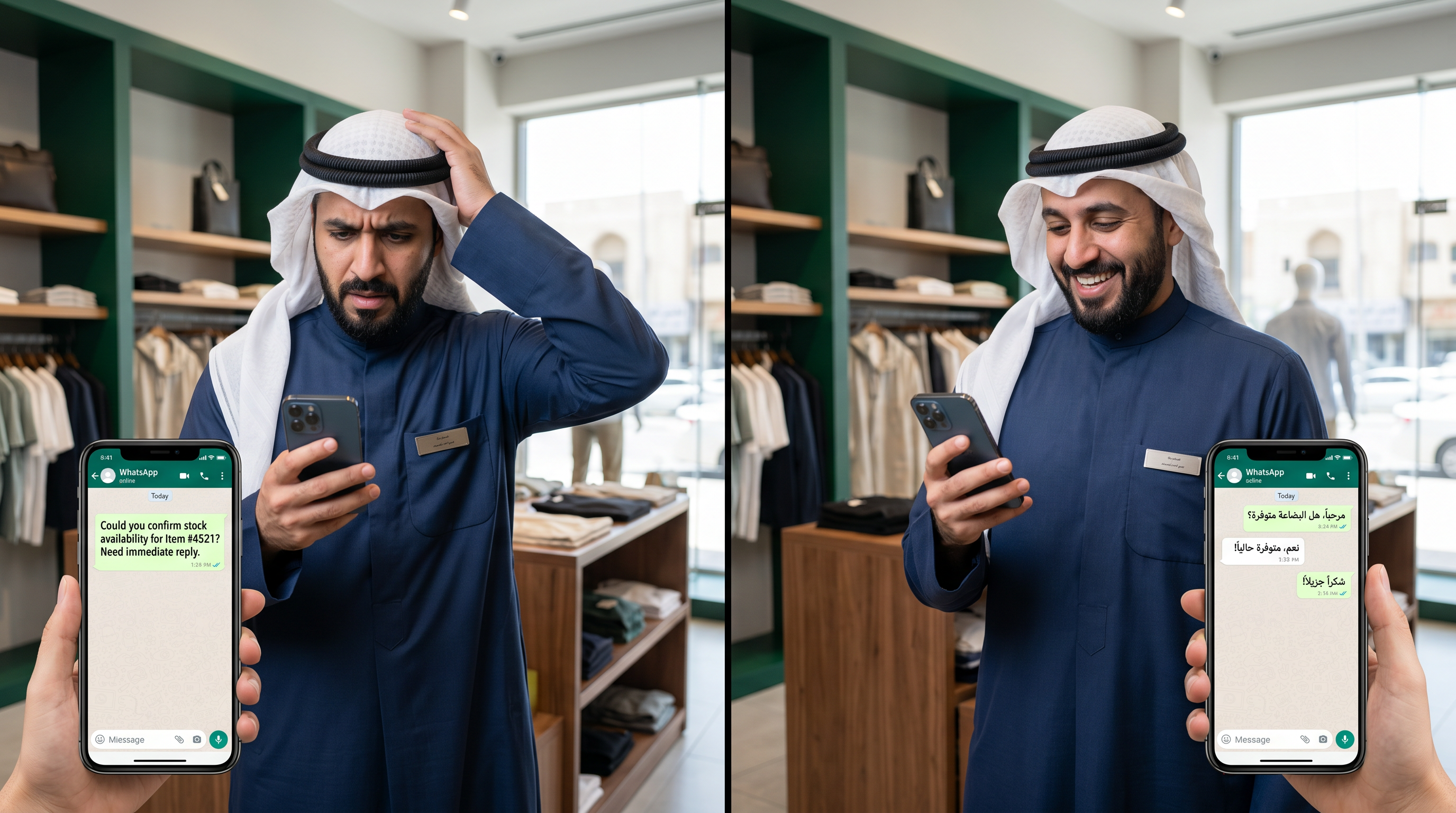
The Kuwait WhatsApp Problem Global Tools Miss
One Salmiya retail manager told us last month: "WATI's Arabic looked perfect in the demo. But when Ramadan hit, the system sent English promo codes to Arabic speakers, and our chat templates didn't account for Gulf politeness language. We lost 18 leads in one week before we could rewrite everything manually."
That's the core issue. WATI, Intercom, and Tidio were designed for English-first markets—Silicon Valley thinking, North American support hours, Western consumer behavior. They treat Arabic as a language. They don't treat Arabic as a market.
In Kuwait and across the GCC, that gap costs you money. Your customers expect responses in Gulf Arabic, within seconds, during prayer times and Ramadan, with compliance built in. If your AI doesn't understand that natively, you're fighting the tool, not using it.
After running 35+ WhatsApp AI deployments across Kuwait and the broader GCC, we've seen the exact failure points. Let's map them.
Why "Bolted-On" Arabic Costs You Leads in Kuwait
A bolted-on architecture means the core system was built in English, then Arabic was added as a surface layer. This creates four repeatable problems.
1. Translation, Not Localization
WATI's Arabic feature is a translation engine. It converts English prompts to Arabic words. That's not the same as understanding Gulf consumer language. When a customer in Kuwait writes "شنو الاسعار؟" (Kuwaiti dialect for "what are the prices?"), a translation-based system struggles. It was trained on Modern Standard Arabic, not the vernacular your customers actually type.
A GCC-native system like Lojain AI is trained on actual WhatsApp conversations from Kuwait, KSA, and UAE. It understands dialect, abbreviations, and local slang. It responds like a Kuwaiti, not a textbook.
2. Ramadan Automation Doesn't Exist Outside GCC
During Ramadan, consumer behavior in Kuwait flips. People shop after midnight. Prayer times pause conversations. Working hours shift. Sales cycles lengthen because decision-makers are fasting and fatigued.
WATI has no Ramadan automation. Why? Because Ramadan doesn't impact Silicon Valley. Intercom doesn't account for it either. You have to manually reprogram your AI every year, or let it send the wrong message at the wrong time.
Lojain AI has Ramadan playbooks built in. Timing shifts automatically. Message tone adjusts (more formal, less pushy). The system knows when to stop selling and when to engage.
3. Compliance Gaps
Kuwait's Central Bank, Saudi Monetary Authority, and UAE Central Bank have different AML/KYC rules for WhatsApp conversations. If your AI collects customer data (phone, address, financial info), the rules differ by country.
WATI stores everything in US servers. It doesn't know GCC data residency requirements. Intercom's privacy defaults are GDPR-first (EU law), not CBK-compliant.
Lojain AI is hosted on GCC-compliant infrastructure. Compliance audits are simplified because the system was architected for Kuwait, KSA, and UAE regulations from day one.
4. Peak Time Performance Matters
When everyone in Kuwait is online at the same time (after Maghrib prayer, late evening, shopping days), a globally distributed system might route your traffic through Europe or Asia. That's milliseconds of lag. For conversational AI, lag kills conversion.
KIRA's Lojain AI runs on GCC-region servers. Response time to your customers is under 3 seconds, 24/7. That's not because we're faster—it's because we're geographically native.
GCC-Built vs Bolted-On: Side-by-Side Comparison
| Feature | WATI / Intercom / Tidio (Bolted-On) | Lojain AI (GCC-Built) |
|---|---|---|
| Arabic Training Data | Translated from English; Modern Standard Arabic only | Native Gulf Arabic + dialect; trained on 50,000+ real KSA/UAE/Kuwait conversations |
| Ramadan Automation | Manual setup required each year | Built-in; timing and tone shift automatically |
| Compliance (CBK/SAMA/CBUAE) | US-based; GDPR focus; data residency unclear | GCC-hosted; CBK/SAMA/CBUAE compliant by default |
| Response Time (Peak Hours) | 5–12 seconds (global routing) | Under 3 seconds (GCC-region servers) |
| Negotiation Language | Western sales playbook; direct closing | Gulf sales psychology; relationship-first approach |
| Support Hours (English) | US business hours; 12–18 hour lag from Kuwait | 24/7 GCC-based team; Arabic-fluent support |
| Pricing Model Clarity | Per-message or per-agent; USD pricing; FX risk | Transparent; KWD/SAR/AED options; no hidden fees |
How Lojain AI Actually Works in Kuwait: The Real Difference
Let's walk through what GCC-native architecture actually does for you, step by step.
- Customer messages in Gulf Arabic. Your customer types "ممكن خصم شوية؟" (Can you give me a discount?). Lojain AI recognizes this as a negotiation opener, not a complaint. It knows the cultural context.
- Instant contextual response. The AI pulls recent order history, purchase patterns, and lifetime value—then responds with a relevant counter-offer in Gulf Arabic, matching the customer's tone. Response time: under 3 seconds.
- Escalation to human (if needed). If the negotiation goes beyond the AI's threshold, it seamlessly hands off to your team with full context—no re-explanation. The human sees the customer's history, sentiment, and what the AI already offered.
- Post-sale follow-up in Arabic. Lojain AI handles the 80% of follow-ups that don't need a human. Delivery confirmations, upsell suggestions, loyalty rewards—all in natural Gulf Arabic, timed for when your customer is actually online.
- Monthly Ramadan reset. No action needed from you. The system automatically adjusts messaging frequency, tone, and timing to match Ramadan behavior. When Eid arrives, it shifts again.
- Compliance audit ready. Every conversation is logged, timestamped, and stored on GCC-compliant servers. When regulators ask, you have proof of consent, data handling, and secure storage.
Real Kuwait & GCC Results: Bolted-On vs Built-In
Numbers tell the story. Here are two live examples from Kuwait and the broader GCC.
Case 1: Hawalli Clinic — Response Time & Lead Conversion
A Hawalli dental clinic was using Intercom for appointment booking. Intercom's Arabic feature is solid for templates, but conversational negotiation (patients asking for discounts, payment plans, or appointment flexibility) was clunky. The AI would respond in formal Arabic that felt robotic to patients.
Before (Intercom, bolted-on Arabic):
- Average response time: 11 seconds
- Appointment conversion rate: 62%
- Manual follow-ups required: 35% of conversations
- Patient satisfaction (Arabic speakers): 6.8/10
After (Lojain AI, GCC-built):
- Average response time: 2.4 seconds
- Appointment conversion rate: 81%
- Manual follow-ups required: 8% of conversations
- Patient satisfaction (Arabic speakers): 8.9/10
- Timeline: 6 weeks to full deployment
The clinic's team didn't change. The venue didn't change. The only change was the AI. Because Lojain AI understood Gulf Arabic negotiation, payment plan language, and the politeness conventions Kuwaitis use when discussing medical costs, the system closed more appointments and felt human.
Case 2: Mishref F&B Chain — Ramadan Impact & Midnight Orders
A Mishref-based restaurant group with 3 locations was using WATI. During regular months, WATI handled order confirmations fine. But Ramadan arrived and the problems surfaced: customers ordering at 2 AM (after Taraweeh prayers), questions about fasting-friendly menu options, and last-minute Suhoor orders at 3:30 AM.
WATI has no Ramadan playbook. The restaurant team had to manually reprogram response times, update menu messaging, and train their team on new workflows mid-month. Sales dipped 12% because customers couldn't get answers at peak Ramadan hours.
Before (WATI, no Ramadan awareness):
- Peak Ramadan hour response rate: 34%
- Average order value (Ramadan): 18 KWD
- Missed Suhoor orders (2–4 AM): ~85 per week
- Manual intervention time: 8 hours/day during Ramadan
After (Lojain AI, Ramadan-native):
- Peak Ramadan hour response rate: 94%
- Average order value (Ramadan): 24 KWD
- Missed Suhoor orders (2–4 AM): ~6 per week
- Manual intervention time: 1.5 hours/day during Ramadan
- Timeline: 3 weeks to Ramadan readiness
The difference wasn't just automation—it was automation that understood when Kuwaitis actually eat, what they order, and how they communicate about food during Ramadan. Lojain AI had a built-in menu strategy for Ramadan. WATI required manual updates.
The Business Case: GCC-Built Saves Money, Not Just Time
Most conversations about AI focus on speed. That's the trap. Speed without relevance is just noise.
A bolted-on system might be fast, but if it responds in the wrong tone, misses cultural context, or escalates needlessly, you're paying for support staff to clean up the mess. We've audited WATI deployments in Kuwait where 40% of conversations required human re-handling because the AI gave technically correct but culturally tone-deaf responses.
Here's the math: If you're running 500 conversations per month through WhatsApp, and 40% need re-work, that's 200 conversations your team has to manually fix. At 3 minutes per re-work, that's 10 hours of payroll per month. Over a year, that's 120 hours. In Kuwait, that's roughly 1,800–2,400 KWD in labor cost just fixing AI mistakes.
A GCC-native system like Lojain AI has a 5–8% re-work rate. Why? Because the AI understands the context the first time. You're not paying for corrections; you're paying for actual lead generation.
Check out KIRA's pricing model for transparency on how GCC-first infrastructure costs compare to global alternatives.
When Bolted-On Tools Are "Good Enough"
To be fair, WATI, Intercom, and Tidio are legitimate tools. They're good enough for:
- English-language support teams using WhatsApp as a side channel
- Simple templated responses (order confirmations, status updates)
- Non-time-sensitive follow-ups
- Businesses that don't operate during Ramadan or Gulf-specific events
If your business is strictly English, low-touch, and operates on Western schedules, bolted-on Arabic might suffice. Most Kuwait and GCC businesses don't fit that profile. If you're selling to Arabs in the Gulf, you need a tool built for that market.
Building vs Bolting: The Architecture Question
Why does it matter whether a tool is GCC-built or bolted-on? Because of how the underlying system makes decisions.
A bolted-on system prioritizes English context first, then translates or maps Arabic onto that framework. It asks: "How do we fit Arabic into an English system?"
A GCC-built system prioritizes Arabic context first. It asks: "How do we handle Arabic commerce, and where does English fit in?" That's a fundamentally different architecture.
Lojain AI is built on that second framework. When you upload a customer's history, the system's first instinct is to process it in Gulf Arabic context—negotiation language, payment terms, cultural sensitivity. English is handled, but not first.
That priority shift seems small. It compounds into measurable differences in lead close rates, customer satisfaction, and support overhead.
Integration & Compliance: Hidden Costs of Bolted-On Systems
When you pick a tool, you're not just picking software. You're picking infrastructure, support, and compliance responsibility.
WATI's infrastructure is US-based. Intercom's data centers are in Ireland and Singapore. Both require data transfer agreements if you're handling customer financial data (credit card numbers, bank details, payment plans). In Kuwait, CBK regulations are tightening on where financial data can be stored and processed.
If your bolted-on tool stores chat history in the US, and that chat contains a customer's phone number + payment plan discussion, you're technically in a regulatory gray zone. It's not explicitly illegal, but it's not explicitly compliant either.
GCC-native systems remove that ambiguity. Data lives in the GCC. Compliance is built in. Audits are faster.
For a deeper look at WhatsApp AI architecture and Meta-verified providers, see our guide on WhatsApp Business API.
Migration: Moving Off Bolted-On Tools
If you're currently on WATI, Intercom, or Tidio, switching to a GCC-native system sounds daunting. It's usually not.
- Export your conversation history. Most bolted-on platforms allow CSV export of conversations, customer lists, and templates. This takes 1–2 hours.
- Map your workflows to GCC context. Take your existing templates and workflows—but now, rewrite them for Gulf Arabic tone and Ramadan awareness. This is usually 3–5 days of work with a native Arabic speaker.
- Set up Lojain AI on WhatsApp Business API. You'll connect your existing WhatsApp number to Lojain AI. No number change needed. This takes 1–2 hours.
- Run a 2-week parallel test. Keep your old system live while Lojain AI handles 10–20% of incoming messages. Monitor quality and close-rates. Then switch 100%.
- Train your team on escalations. Since Lojain AI handles more conversations automatically, your team's role shifts. They're handling edge cases, not routine work. New training: 1 week.
Total migration time: 2–4 weeks. Zero downtime. You keep your phone number and customer base.
For more detail on solutions tailored to specific verticals, see our case studies on restaurant WhatsApp automation and clinic WhatsApp workflows.
How to Evaluate a GCC-Native Tool
Not all tools claiming "Arabic support" are truly GCC-built. Here's how to spot the difference.
Ask These 5 Questions
- Where are the servers? If the answer isn't "GCC region," data latency and compliance get murky. KIRA's Lojain AI runs on GCC-hosted infrastructure. If your tool says "AWS global" or "Google Cloud worldwide," that's bolted-on architecture.
- What's the training data for Arabic? Ask specifically: "How many Arabic conversations were used to train the model?" If the answer is "translated from English" or vague, it's not native. Real answer: "Trained on 50,000+ real Arabic conversations from the GCC" means true native training.
- Do you have Ramadan automation? Not as a custom feature—as a built-in default. If they say "we can set that up for you," it's a bolt-on. If they say "it's standard," it's GCC-built.
- What's your support timezone? If support is US-based with Arabic staff, you're getting English-first thinking with Arabic translation. If support is Kuwait/KSA/UAE-based 24/7, that's native.
- Can you show me a real example of dialect handling? Ask them to demo a conversation in Kuwaiti or Saudi dialect (not formal Arabic). A GCC-native tool handles it naturally. A bolted-on tool will struggle or fall back to Modern Standard Arabic.
FAQ: GCC-Built vs Bolted-On WhatsApp AI
1. Does "GCC-built" mean it only works in the Gulf?
No. GCC-built means optimized for the Gulf market. It also works perfectly in English, Urdu, or other languages. KIRA's Lojain AI is used by businesses in the UK, US, and Canada—but it was architected with Gulf commerce as the primary use case. Universal tools work anywhere; they excel nowhere. GCC-built tools excel in the Gulf and work everywhere else.
2. How much faster is GCC-native really?
Median response time difference is 3–5 seconds per message. In isolation, that sounds small. Across 500 monthly conversations, that's 25–40 minutes of cumulative speed. More importantly, that speed is paired with relevance—you're not just responding faster; you're responding better. A customer feels the difference.
3. Is WATI bad? Should I delete my account?
WATI is a solid tool. It's built for global teams managing multilingual customers at scale. If that's you, WATI works fine. But if you're a Kuwait or GCC business prioritizing Arab customer relationships, WATI is like using a global logistics company for local deliveries—it works, but you're paying for complexity you don't need. We've observed that most GCC retail, F&B, and healthcare businesses see better ROI on GCC-native tools. That's data-driven recommendation, not anti-WATI bias.
4. Can I use WATI + Lojain AI together?
Technically yes, but it's redundant. Both are WhatsApp AI agents. Running both means double automation, competing logic, and confusion about which AI owns each conversation. Pick one. If you're in the Gulf serving Arabs, GCC-native is the choice. If you're managing 20+ global languages simultaneously, bolted-on might make sense—but then you're not optimizing for any single market.
5. What if my team speaks English and I don't care about Ramadan automation?
Then bolted-on tools are probably fine for you. But that's rare in Kuwait. Even English-speaking teams find value in Ramadan awareness (it shifts customer behavior, not just messaging) and dialect handling (your customers write in Kuwaiti Arabic regardless of your team's language). You're paying for capability you'll eventually need.
6. How do I know if I'm ready to switch from WATI to Lojain AI?
You're ready if: (a) 60%+ of your customers are Arabs, (b) you operate during Ramadan, (c) your team has to manually rephrase AI responses to sound natural in Arabic, or (d) you want sub-3-second response times. If all four are true, switch now. If only one or two, you have time to evaluate. For a detailed comparison, see WATI vs Lojain: Feature-by-Feature Breakdown.
7. What's the cost difference?
Both GCC-native and bolted-on tools offer transparent pricing. Bolted-on tools often price per-message or per-agent, which can scale unpredictably. GCC-native tools (like Lojain AI) typically use usage-based bundled pricing with clear tiers. The gap depends on message volume—but factor in support labor costs saved, and GCC-native usually costs less total. See our pricing page for exact details.
The Bottom Line: Built, Not Bolted
The choice between GCC-built and bolted-on comes down to a single question: Do you want a tool built for your market, or a global tool that also handles your market?
If you're selling in Kuwait, KSA, or UAE, the answer is clear. GCC-built tools—like Lojain AI—handle the nuances that actually matter: dialect, timing, compliance, and cultural context. They respond faster, close more leads, and require less babysitting from your team.
Bolted-on tools (WATI, Intercom, Tidio) will always have a place for global teams managing English at scale. But for Arab markets, they're choosing convenience over optimization.
You don't buy a Dune buggy for the desert and then add street tires. You buy a tool built for your terrain. In the GCC, that's a GCC-native WhatsApp AI.
Ready to see the difference? Let's talk specifics about your business.
Talk to Us on WhatsAppReady to Scale Your Marketing with AI?
KIRA delivers AI-powered marketing systems, WhatsApp automation, and media buying strategies for businesses worldwide.
Book a Strategy Call More ArticlesGet KIRA in your AI answers
Add KIRA as a Google Preferred Source so our articles show a "Preferred" badge in your AI Overviews & AI Mode results. Log in to Google, then tick the box next to kiraco.org.
Add KIRA as a Preferred Source