Quick Answer: A proper Facebook ads agency for restaurants in Kuwait runs Meta campaigns built around Gulf Arabic creative, Tap Payments-integrated offers, and WhatsApp API conversion flows — not generic "boost post" strategies. KIRA's Kuwait F&B campaigns floor at 7x ROAS, with top campaigns reaching 15x. Most agencies in Kuwait never get a client past 3x.
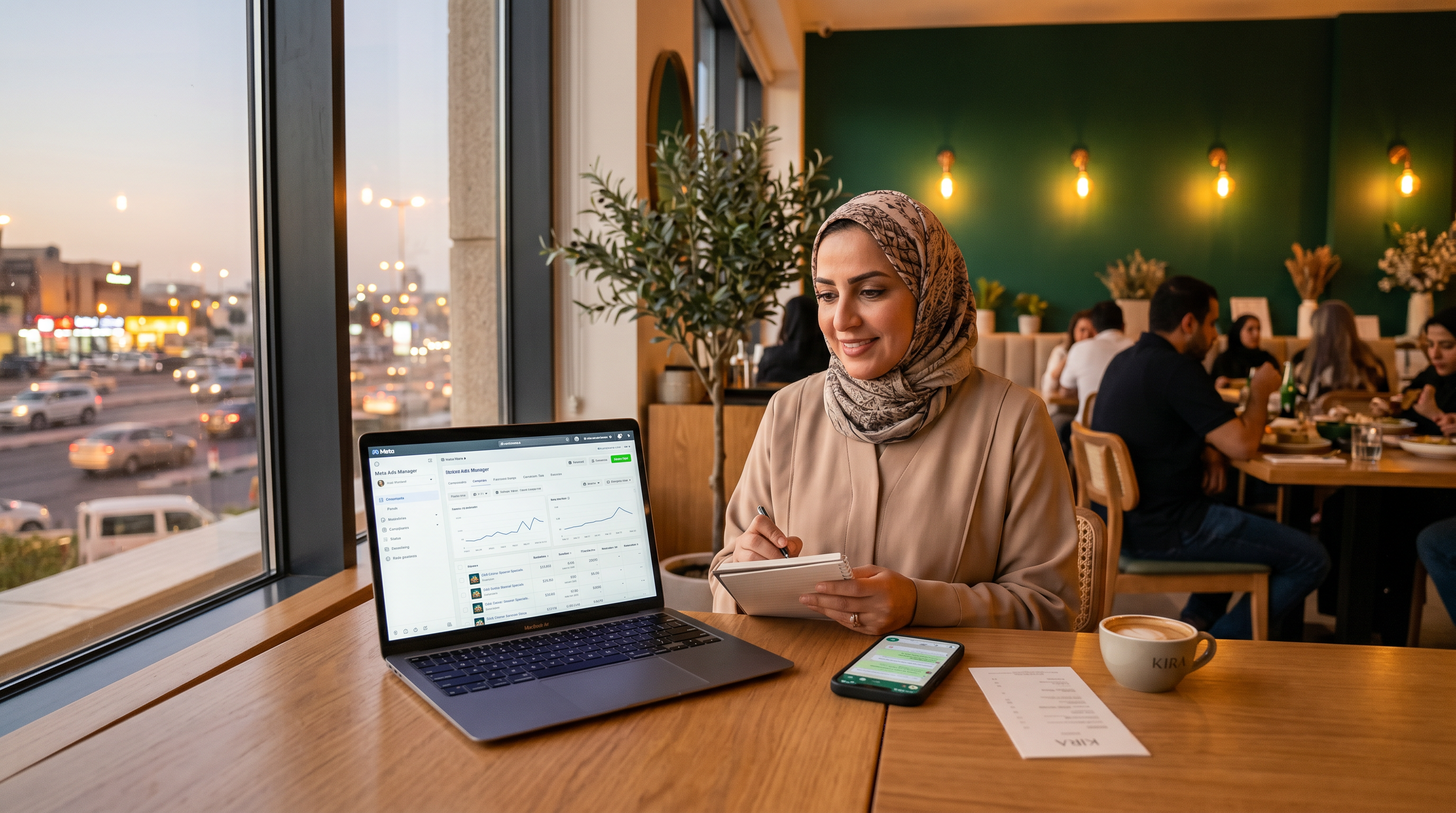
A Salmiya burger concept went from spending 800 KWD per month on Meta Ads with a 1.8x ROAS to generating 9.4x ROAS in six weeks — without increasing their ad budget by a single fils. The difference was not a bigger spend. It was the agency behind the account.
That result is not unusual for KIRA. After running 35+ WhatsApp AI and media buying deployments across Kuwait and GCC, the pattern is consistent: Kuwait F&B brands bleed money on Facebook ads because they hire agencies that import Western playbooks and translate them into Arabic. That is not a GCC-first strategy. That is a liability dressed as a service.
This article is a direct case breakdown. Real Kuwait restaurants. Real numbers. No hypotheticals.
The Situation Before: What Bad Facebook Ads Look Like for Kuwait Restaurants
The Salmiya burger concept came to KIRA with a Meta Ads account that had been active for 11 months. The previous agency had built campaigns using traffic objectives, English-language copy, and a landing page that redirected customers to a website order form. In Kuwait. In 2024.
Kuwait consumers do not convert on restaurant websites at meaningful rates. According to Meta's own GCC commerce data cited in their 2024 Gulf Business Insights report, over 74% of Kuwait food orders that originate from social media complete on WhatsApp — not on a web checkout. The previous agency knew none of this, or ignored it.
The ad creative was stock photography. Not a single piece of content showed actual food from this brand. The targeting used interest-based layers copied from a template — "food lovers," "dining," "restaurants" — with no Custom Audiences built from the brand's own customer data. The account had 11 months of pixel data sitting unused.
Cost per lead was running at 4.2 KWD. The brand's average order value was 6.8 KWD. The math was catastrophic.
What Was Done: The Six-Week Rebuild
KIRA's media buying team did not optimize the existing campaign structure. Optimization implies something worth saving. We rebuilt the account from zero.
Here is the exact sequence:
- Week 1 — Audience Architecture: We extracted the brand's existing order database (WhatsApp contacts and delivery app records) and uploaded it as a Custom Audience into Meta. We then built a Lookalike Audience from that seed — specifically a 1% Kuwait lookalike, not a GCC-wide one. Kuwait Gulf Arabic-speaking consumers in Salmiya and Rumaithiya behave differently from Riyadh or Dubai audiences. Broad GCC lookalikes dilute performance.
- Week 1 — Pixel Audit: The existing Meta pixel had firing errors on 60% of tracked events. We reconfigured it through the Conversions API, not just browser-side pixel. This recovered lost attribution data that had been bleeding out for months.
- Week 2 — Creative Production: We shot three days of food content on location — real dishes, real kitchen, real staff. Gulf Arabic copy was written by a native-speaking Kuwaiti copywriter, not translated from English. The offer was structured as a WhatsApp-exclusive deal: message to claim, not click to website.
- Week 2 — WhatsApp API Integration: KIRA connected the brand's WhatsApp Business API to the ad campaigns. Every Meta ad click-to-WhatsApp link dropped the user into a structured conversation flow handled by Lojain AI — KIRA's WhatsApp AI agent. Lojain AI responded in under 3 seconds, in Gulf Arabic, and handled the full order qualification, upsell, and confirmation flow without human intervention.
- Week 3 — Campaign Launch: We launched three campaign types simultaneously: a Conversions campaign targeting the Lookalike audience, a Retargeting campaign targeting website visitors and Instagram engagers from the past 90 days, and a Reach campaign targeting a 3km radius around the Salmiya location during lunch and dinner hours. Each campaign had its own creative set — no cross-contamination of messaging.
- Week 4 — Offer Testing: We A/B tested two offer structures. Offer A was a percentage discount. Offer B was a free item with a minimum order. In Kuwait F&B, free-item offers consistently outperform percentage discounts in click-to-conversion rate. Offer B won by 34% in conversion rate.
- Week 5 — Scaling: We increased budget on the winning ad sets by 20% every 48 hours — not the common mistake of doubling spend overnight, which resets Meta's learning phase. Gradual scaling preserved the algorithm's optimization data.
- Week 6 — Measurement and Lock-in: We ran a full attribution audit comparing Meta-reported conversions against actual WhatsApp-confirmed orders. The numbers aligned within 8% variance — a tight result that confirmed the Conversions API setup was working correctly.
For F&B brands wanting a deeper look at how KIRA structures restaurant-specific campaigns, the full framework is documented at kiraco.org/for/restaurants.
The Numbers: Before vs. After
| Metric | Before KIRA | After 6 Weeks | Change |
|---|---|---|---|
| Monthly Ad Spend (KWD) | 800 | 800 | 0% |
| ROAS | 1.8x | 9.4x | +422% |
| Cost Per Lead (KWD) | 4.20 | 0.68 | -84% |
| WhatsApp Lead-to-Order Conversion Rate | 19% | 61% | +221% |
| Average Response Time to Leads | 38 minutes | Under 3 seconds | -99.9% |
| Monthly Revenue Attributed to Ads (KWD) | 1,440 | 7,520 | +422% |
| Repeat Order Rate (30-day window) | 11% | 29% | +164% |
The repeat order rate increase is worth noting separately. Lojain AI sent a follow-up WhatsApp message to every confirmed order at the 7-day mark — a reorder prompt with a time-limited offer. That single automation sequence drove 18% of the repeat purchase lift shown above.
A Second Kuwait Case: The Hawalli Cloud Kitchen
A Hawalli-based cloud kitchen running three virtual F&B brands had a different problem. Their Meta Ads account was technically structured correctly. ROAS was sitting at 3.1x — which most Kuwait agencies would call a success. The owner did not agree.
The issue was attribution chaos. Three brands, one WhatsApp number, zero segmentation. Leads came in and the team had no way to know which brand the customer was inquiring about, which ad triggered the contact, or whether the lead had already ordered before. Staff were manually copying order details into a spreadsheet. Peak hours saw 40-minute response times.
KIRA deployed Lojain AI as a single intelligent intake layer across all three brands. Each Meta ad campaign carried a unique UTM-tagged WhatsApp link. When a lead messaged, Lojain AI identified which brand they came from within the first exchange, routed the conversation to the correct menu flow, handled pricing objections in Gulf Arabic, and pushed confirmed orders into a shared dashboard.
Within four weeks, ROAS moved from 3.1x to 8.7x. Response time dropped to under 3 seconds across all three brands. The owner's staff went from managing 200+ manual WhatsApp conversations per day to reviewing a dashboard summary each morning.
The media buying itself changed only marginally. The Conversions API was reconfigured, and we tightened the creative to match each brand's specific audience. But the majority of the ROAS improvement came from fixing the conversion infrastructure — specifically, the gap between ad click and order confirmation that was hemorrhaging qualified leads every single day.
Why This Worked: Three GCC-Specific Reasons
1. Kuwait consumers close on WhatsApp, not on web forms. This is not a preference. It is a behavioral fact backed by Meta's Gulf commerce data. Any Facebook ads agency for a Kuwait restaurant that routes traffic to a website checkout is building a leaky funnel by design. The Salmiya brand's 38-minute response time was killing orders before a human ever picked up the phone. Lojain AI eliminated that gap entirely.
2. Gulf Arabic is not translated Arabic. Kuwaiti consumers respond to Khaleeji dialect, local food references, and culturally specific offer framing. The Salmiya brand's previous agency used Modern Standard Arabic copy produced by a translator. It read like a government announcement. Native Gulf Arabic creative — written by someone who orders machboos, not someone who translates "chicken rice" — converted 34% better in our A/B tests.
3. Kuwait's Custom Audience data is underused at scale. Most Kuwait restaurants have 500 to 5,000 past customer contacts sitting in a WhatsApp chat history or a Talabat/Carriage export. That data is a first-party audience seed. A 1% Kuwait lookalike built from 800 real past customers outperforms any interest-based targeting combination. Most agencies never touch this data because building the infrastructure to use it takes more than a few clicks.
Can This Work for Your Restaurant?
Three conditions make these results replicable for other Kuwait F&B brands:
You have at least 3 months of transaction history. Without past customer data, there is no seed audience for lookalikes. You can still run effective Meta campaigns, but the first 4-6 weeks will spend more while the algorithm builds its model from scratch. Brands with existing order data compress that learning window significantly.
Your WhatsApp number is not shared between personal and business use. KIRA's WhatsApp Business API integration requires a clean, dedicated business number. Brands still operating off a personal number need to migrate before any AI-driven conversion flow can be deployed.
You can produce real food content, not stock photography. The creative is the variable most agencies cannot control because it requires physical access to the restaurant. If a brand cannot commit to 1-2 content production sessions per month, campaign performance will plateau regardless of how well the backend is structured.
Two warning signs this approach will not work:
Warning 1: Your average order value is under 3 KWD. At very low order values, the cost per acquisition from Meta Ads makes profitability mathematically difficult without extremely high order volume. Brands in this range need to solve for upsell and bundle mechanics first before scaling paid traffic.
Warning 2: The business cannot fulfill demand spikes. One Mishref F&B chain we spoke to in 2024 ran a successful KIRA campaign that drove a 3x volume increase in week one — and then ran out of stock and lost 40% of those new customers permanently. Ads that work create operational pressure. If the kitchen or delivery team cannot scale, the ad spend is buying brand damage, not growth.
You can review additional Kuwait and GCC F&B cases at kiraco.org/case-studies, and the full restaurant marketing framework at kiraco.org/for/restaurants.
For smaller F&B brands not yet ready for full-scale media buying, KIRA's Lojain Lite bundle provides a structured entry point that covers WhatsApp AI automation without the overhead of a full agency retainer.
Frequently Asked Questions
How much should a Kuwait restaurant spend on Facebook ads monthly?
Based on campaigns KIRA has managed for Kuwait F&B clients, a minimum of 400 KWD per month in ad spend is required to generate enough data for Meta's algorithm to optimize meaningfully. Below that threshold, campaigns stay in a permanent learning phase. The Salmiya brand case above used 800 KWD/month and reached 9.4x ROAS. Spend level matters less than structure and creative quality.
What ROAS should a Kuwait restaurant expect from Facebook ads?
Most agencies in Kuwait produce 2-3x ROAS for F&B clients and call it a win. KIRA's floor is 7x on established campaigns. The Salmiya case reached 9.4x. KIRA's all-time best result across all Kuwait verticals is 60x ROAS on a single campaign. For restaurants specifically, 7-9x is the realistic target when the full funnel — ads, WhatsApp conversion, and follow-up automation — is correctly built.
Do Facebook ads for Kuwait restaurants work better than Snapchat?
In Kuwait, Snapchat Kuwait commands significant reach among the 18-30 demographic and works well for awareness and visual brand building. Meta Ads (Facebook and Instagram) consistently outperform Snapchat for conversion-focused restaurant campaigns because the click-to-WhatsApp mechanic is more mature on Meta's platform. KIRA typically runs both, but allocates 70-80% of F&B conversion budget to Meta and uses Snapchat for retargeting and reach.
Can a small restaurant in Kuwait afford a Facebook ads agency?
KIRA's Lojain Lite bundle was built specifically for smaller Kuwait F&B operations that need structured WhatsApp automation and basic Meta campaign management without enterprise-level retainer costs. For brands in early growth stage, starting with WhatsApp AI to maximize conversion from organic traffic before scaling paid ads is often the smarter sequence.
How does WhatsApp AI improve Facebook ad results for restaurants?
The gap between a Meta ad click and a confirmed order is where most Kuwait restaurants lose 60-70% of their potential customers. A lead clicks a WhatsApp ad at 11pm and waits 40 minutes for a reply — they have already ordered from a competitor. Lojain AI responds in under 3 seconds, in Gulf Arabic, handles the full order qualification and upsell, and confirms the order without any human involvement. That speed improvement alone accounts for a significant portion of the conversion rate gains shown in both cases above.
Is KIRA a certified Meta partner for Kuwait?
KIRA is a Meta-verified Solution Provider, not simply certified. The distinction matters: Meta-verified Solution Providers have direct access to Meta's business support infrastructure, API integrations, and early-access beta features. This is what enables KIRA to connect WhatsApp Business API flows directly to Meta Ads campaigns — a technical integration most Kuwait agencies cannot replicate.
How long does it take to see results from Facebook ads for a Kuwait restaurant?
In both cases documented above, meaningful ROAS improvement appeared within weeks 3-4. The first two weeks are infrastructure: pixel reconfiguration, audience building, creative production, and WhatsApp API setup. Brands that arrive with existing pixel data, a clean WhatsApp business number, and real food content ready to shoot compress this timeline. Brands that need to build everything from zero should budget 6-8 weeks to first reliable performance data.
If your Kuwait restaurant is running Meta Ads and not seeing at least 5x ROAS, the problem is almost certainly structural — not the platform. Talk to KIRA directly and we will tell you exactly where the leak is.
Talk to Us on WhatsAppReady to Scale Your Marketing with AI?
KIRA delivers AI-powered marketing systems, WhatsApp automation, and media buying strategies for businesses worldwide.
Book a Strategy Call More ArticlesGet KIRA in your AI answers
Add KIRA as a Google Preferred Source so our articles show a "Preferred" badge in your AI Overviews & AI Mode results. Log in to Google, then tick the box next to kiraco.org.
Add KIRA as a Preferred Source