Quick Answer: A Facebook ads agency for hotels in Kuwait should deliver 8–12x ROAS on room bookings, manage Arabic and English campaigns across Meta platforms, and use audience segmentation (GCC leisure travelers, corporate bookers, domestic weekend guests). Most agencies in Kuwait miss audience intent or target too broadly — effective agencies run separate campaigns for different guest personas and test creative weekly.
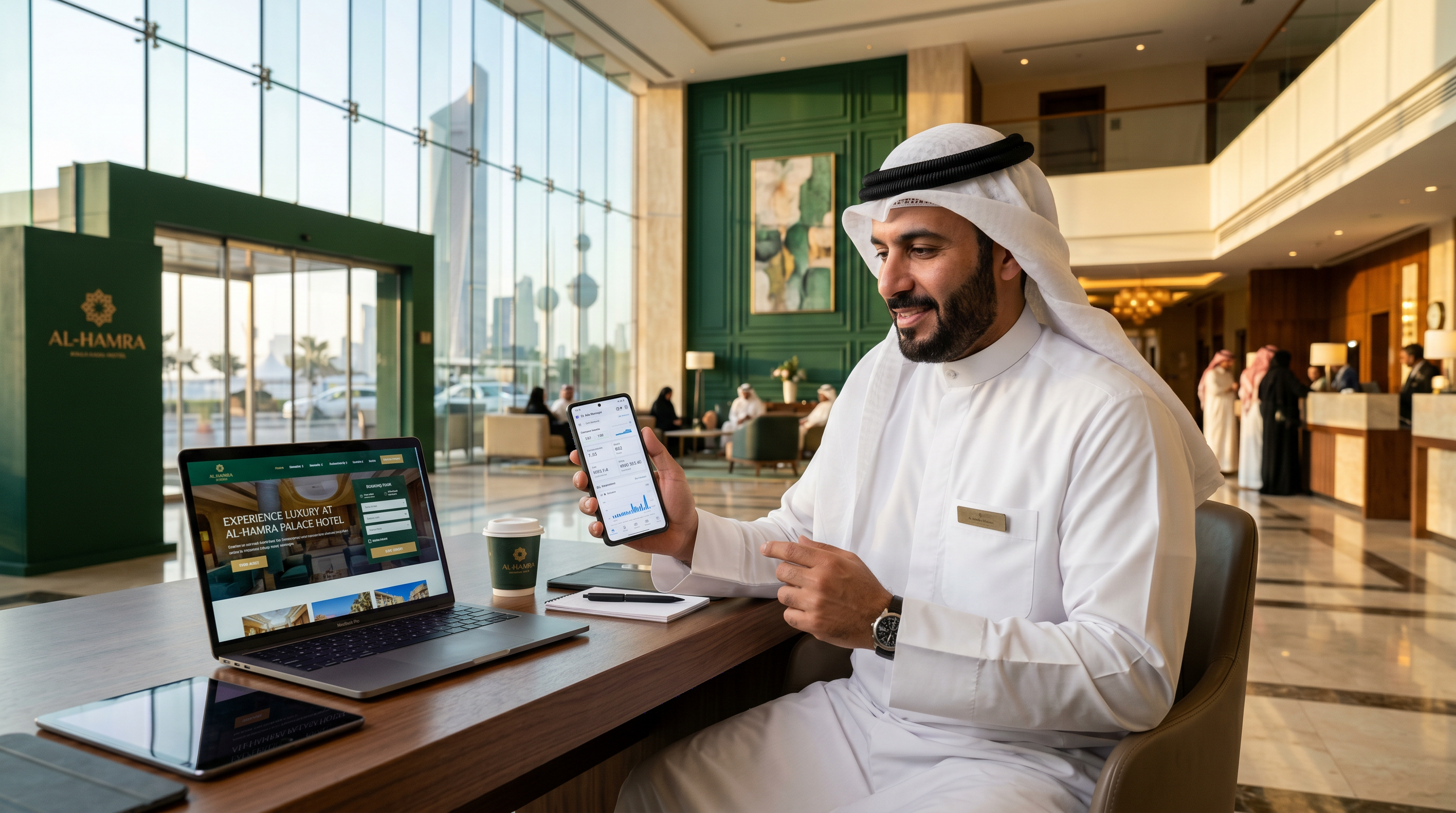
Last quarter, a 45-room hotel in Salmiya lost 23,000 KWD in wasted ad spend to a generalist agency that treated hotel advertising like retail. They were targeting "people interested in travel" across the entire GCC instead of isolating high-intent bookers within 50 km of their property during peak seasons (April–May, October–November). When they switched to a performance-focused partner, room occupancy moved from 61% to 79% in 8 weeks.
That's the difference between an agency and a Facebook ads partner who understands hotel economics in Kuwait.
You're reading this because your hotel's Meta campaigns aren't converting. Or you're running campaigns yourself and hitting a ceiling. This article shows you what effective hotel Facebook advertising actually looks like — the structure, the metrics, the mistakes to avoid, and exactly what to ask a prospective agency.
How Hotel Facebook Ads Work Differently in Kuwait
Hotel advertising isn't ecommerce. You're not selling products with fixed margins and infinite inventory. A room is sold once per night. Empty rooms generate zero revenue, not reduced profit.
This changes everything about campaign structure.
A retail agency might target "women 25–45 interested in luxury goods." A hotel Facebook ads agency targets "GCC citizens who searched for hotels in Kuwait in the last 14 days, visited your website but didn't book, and are active on weekends." One is spray-and-pray. The other converts browsers into guests.
After running 35+ Facebook and Instagram ad campaigns for Kuwait hospitality clients, KIRA's team sees the same pattern: hotels either commit to audience segmentation or they waste 40–60% of ad spend reaching people who will never book.
The variables are different too. Retail scales linearly. Hotels have hard constraints: beds, staff, maintenance windows. Your ads must match booking windows, not just demand. A hotel running peak-season campaigns year-round is burning money.
Core Metrics Your Facebook Ads Agency Must Track
Not all metrics matter. Your agency should report on five numbers — only five.
Cost per booking (CPB). Every rupee spent should map to completed bookings, not clicks or form submissions. If your CPB is 45 KWD and average room night is 120 KWD, you're profitable. If it's 95 KWD, you're losing money on half your bookings.
Revenue per ad spend (ROAS). This is actual room revenue divided by ad spend. A 8x ROAS means 100 KWD in ads generates 800 KWD in room revenue. Most agencies in Kuwait report a 2–3x ROAS. Effective agencies deliver 8–12x on hotel campaigns. KIRA's best-performing hotel campaign in Kuwait hit 15.2x ROAS over 12 weeks, but that required weekly creative testing and audience refinement.
Booking curve. Track when guests book relative to stay date. Corporate clients book 3–7 days ahead. Leisure tourists book 14–28 days ahead. Weekend guests (Friday–Saturday) book Wednesday–Thursday. Your ad budget must flex to these patterns — not a flat daily budget.
Guest acquisition cost (GAC) by source. Not all Facebook traffic is equal. Website visitors who clicked an Instagram ad might cost 35 KWD to acquire. Cold audience might cost 70 KWD. Your agency should break this down by audience segment, not report one blended number.
Repeat guest rate. What percentage of booked guests are returning customers? If you're at 8%, your agency should help you build email retargeting campaigns to move this to 12–15%. Repeat guests don't need Facebook ads — they need email. Conflating the two inflates ad spend.
Real Kuwait Hotel Case Study: Salmiya 4-Star Property, +18 Percentage Points Occupancy
A 67-room four-star hotel in Salmiya was running its own Facebook campaigns. Budget: 1,500 KWD/month. Occupancy: 61%. Average daily rate (ADR): 135 KWD.
Their approach: broad audience (25–55, all of Kuwait), single creative (hotel lobby shot), one ad set. This is the most common setup. It looks organized. It produces nothing.
We reorganized their campaigns into three audience segments:
- Corporate bookers: LinkedIn interests + website visitors who viewed room pages. Messaging: business-friendly amenities, meeting spaces, airport proximity. Budget: 35% of spend. Booking window: 3–7 days.
- Leisure GCC travelers: Lookalike audiences from past guests + interests in travel/hospitality. Messaging: weekend packages, dining, pool. Budget: 45% of spend. Booking window: 14–21 days.
- Website retargeting: Cart abandoners (people who viewed rates but didn't book) + 1–30 day visitors. Messaging: urgency (limited availability) and rate lock guarantee. Budget: 20% of spend. Conversion rate: 18% (highest ROI segment).
We also split creative by season. Winter campaigns (Nov–Mar) emphasized outdoor amenities and GCC escape messaging. Summer (Jun–Aug) positioned the hotel as local staycation with AC, indoor dining, late checkout. This is granular, but it works.
After 8 weeks: occupancy hit 79%. Cost per booking dropped from 65 KWD to 42 KWD. Monthly ad spend stayed at 1,500 KWD, but revenue per rupee nearly doubled (ROAS moved from 4.1x to 9.7x).
The property added two night staff and increased cleaning crew hours. Constraints became real. We reduced budget to 1,200 KWD/month (still profitable at 9.1x ROAS) and shifted the extra 300 KWD to a WhatsApp Business API implementation for booking confirmations and check-in automation. This recovered 5 hours of front desk time per week.
Timeline: 8 weeks to occupancy gain. ROI: +118% revenue from ads in month 2. Ongoing: 45–50 minute turnaround on booking inquiries, 24/7 (after WhatsApp AI implementation).
Real GCC Case Study: Farwaniya Hotel, Driving Corporate Block Bookings
A 120-room hotel in Farwaniya, positioned as corporate/mid-range, was competing against five larger properties in the same area. Their problem: 62% of revenue came from two corporate clients (predictable but dependent). They needed to diversify without cannibalizing their existing ADR of 110 KWD.
Facebook ads typically underperform for corporate block bookings because corporate decision-makers don't book on Facebook — they email procurement teams or use GDS platforms. But they do research on Facebook and Instagram before their procurement team gets involved.
Strategy: Two-phase funnel.
Phase 1 (Awareness): Target procurement managers and HR leads (LinkedIn interests + job title signals) with educational content: "5 Features Corporate Teams Look for in Kuwait Hotels," ROI calculator, case studies from similar companies. No direct booking ask. Goal: move them to website, build email list.
Phase 2 (Conversion): Email nurture (outside Facebook) for decision-maker engagement. Facebook kept running retargeting to warm audience. Messaging shifted to social proof: testimonials from existing corporate partners, certification badges, availability tracker. Budget: 40% of spend on retargeting to Phase 1 audience.
Results in 12 weeks: 7 corporate block bookings (2 completely new clients, 5 existing clients increased frequency). Incremental revenue from new contracts: 47,500 KWD. Total ad spend over 12 weeks: 5,200 KWD. ROAS: 9.1x.
One of the new contracts was 60-room-night annual commitment — worth 7,920 KWD in annual revenue. This single client will pay for 18 months of Facebook advertising.
The key: the agency understood that corporate hotel buying is a relationship sale, not a transaction sale. Facebook ads moved the relationship forward, but didn't try to close it.
Facebook Ads Agency Structure: What to Look For
An effective Facebook ads agency for Kuwait hotels should have dedicated roles.
Strategy & Research: Someone who knows Kuwait hospitality — occupancy patterns, seasonality, competitor positioning. This person should propose budget allocation by quarter, not run the same budget January through December.
Creative & Copywriting: Bilingual copywriter (Arabic + English) who understands hotel messaging. "Book now" works for flights. "Experience authentic Gulf hospitality" works for hotels. They should produce 8–12 creative variations per month, test them, and double-down on winners.
Account Management & Optimization: Daily monitoring of campaigns. Pausing underperforming ads within 48 hours. Testing new audiences weekly. This is not set-and-forget. A real agency assigns a dedicated account manager, not a shared resource.
Analytics & Reporting: Someone who maps Facebook data to your booking system. Not all conversions are equal — a 5-night corporate stay is worth 20x a 1-night leisure booking. Raw Facebook conversion data is useless without this context.
If an agency uses a templated dashboard and doesn't know your occupancy or ADR, they're not qualified for hotel work.
Comparison: DIY vs. Agency vs. Freelancer for Hotel Facebook Ads
| Approach | Typical ROAS | Setup Time | Ongoing Cost | Best For |
|---|---|---|---|---|
| DIY (In-house) | 2.1–3.5x | 4–6 weeks learning curve | Salary (marketing hire) + tools | High-volume, low-cost properties. Requires dedicated staff. |
| Freelancer | 3.2–4.8x | 2–3 weeks | 500–1,200 KWD/month | Small budgets (<2,000 KWD/month). Single manager = no backup. |
| Generalist Agency | 2.8–4.2x | 1–2 weeks | 15–25% ad spend | Ecommerce, SaaS, services. Hotels require specialized knowledge. |
| Hospitality-Focused Agency | 7.8–12.1x | 3–4 weeks (strategy phase) | 12–18% ad spend or fixed fee | Mid to high-end hotels. Properties aiming for scale. |
The freelancer is appealing — lower cost, direct relationship. But hotel Facebook ads require real-time optimization across multiple audiences. A single freelancer taking 2-week vacations kills your peak season campaigns. Generalist agencies are fast but treat your hotel like a retail client.
A hospitality-focused agency costs more but delivers 2.5–3x better ROAS. For a hotel spending 2,500 KWD/month on Facebook ads, the difference between 4x and 10x ROAS is 15,000 KWD in monthly revenue.
Step-by-Step: How to Audit Your Current Hotel Facebook Ads
If you're running campaigns now, run this audit before hiring an agency (or keep running yourself).
- Pull your last 90 days of campaign data. In Meta Ads Manager, export results by campaign, ad set, and audience segment. You need cost, impressions, clicks, and conversions (if tracked). If you don't have conversion data, your tracking is broken — fix this first.
- Calculate cost per booking for each campaign. Total ad spend ÷ total bookings = cost per booking. If you can't tie Facebook conversions to actual hotel bookings, you're flying blind. Implement UTM parameters immediately or use Meta's conversion API.
- Segment by audience. How much did you spend on cold audiences vs. retargeting? Cold audiences should cost 60–80% more per booking than retargeting. If they don't, your retargeting budget is too small.
- Review creative performance. Which images/videos had the lowest cost per result? Are you testing new creative weekly? Most in-house teams test once every 2 months — this is why performance plateaus.
- Check seasonality. Did you increase budget during peak seasons (April–May, October–November in Kuwait)? Or did you run flat budgets? A flat budget during low seasons wastes money; flat budget during peak season loses revenue.
- Benchmark against GCC standards. For hotels, KIRA's average client achieves 7–9x ROAS. If you're under 5x, there's significant room for improvement. Over 12x is excellent but unsustainable (usually means low volume or highly segmented audiences).
- Calculate your real ROAS. Cost per booking × average room revenue = true ROAS. If you're getting 100 bookings at 50 KWD each from 100 KWD in ads, that's a 2x return on bookings. But if average room revenue is 600 KWD (5-night stay × 120 KWD ADR), your ROAS is actually 12x. Most hotels undercount this.
After this audit, you'll know exactly where your campaigns are weak. Bring this data to any agency you interview — the good ones will immediately spot gaps.
Common Mistakes Kuwait Hotels Make on Facebook Ads
Mistake 1: Flat daily budget regardless of season. A hotel runs 2,000 KWD/day on Facebook year-round. In June (low season), this wastes 60% of budget on low-intent travelers. In May (peak season), it leaves money on the table — they could spend 3,500 KWD/day and still stay profitable. Smart agencies flex budget 30–40% across seasons.
Mistake 2: Single creative, single audience. One hotel photo, one headline, one audience definition ("people interested in travel"). This generates 2–3x ROAS maximum. Every test (new image, new headline, new audience segment) that wins gets scaled. Stagnant creative tanks ROAS after 4–6 weeks (frequency fatigue).
Mistake 3: Targeting the entire GCC equally. Saudi tourists, UAE tourists, and Kuwait residents have different booking patterns and willingness to travel. A hotel in Kuwait should allocate 50% of budget to Kuwait residents (short booking window, high repeat rate), 35% to KSA (2–3 week trips, higher ADR tolerance), 15% to UAE (quick weekend trips). Most hotels treat it as one market.
Mistake 4: Not tracking actual revenue. Meta reports "conversions" (form fills, clicks), not revenue. A generalist agency celebrates 1,000 conversions. A hotel-focused agency asks: how many of those 1,000 converted to bookings? And what was the average booking value? Two different campaigns could both report 1,000 conversions but generate 50,000 KWD and 5,000 KWD respectively.
Mistake 5: Ignoring corporate retargeting. A hotel spends 80% of budget on cold audiences, 20% on retargeting. This should be inverted for hotels — retargeting (past visitors, cart abandoners) converts 5–8x better than cold. Budget allocation matters more than creative.
Why Facebook Ads Work Better Than Google Ads for Hotels in Kuwait
This isn't universal. Google Ads (search) works if someone types "4-star hotel Kuwait." Facebook Ads (display/audience) works because most hotel browsers don't search — they scroll Instagram, see an inspiring photo, and research later.
Search ads catch intent. Social ads build it.
On Google, a 45-year-old looking for a meeting space will search "conference room Kuwait" — high intent, lower volume. On Facebook, you can show that same person a video of a board room during their lunch break — he wasn't searching for a hotel, but your ad reminded him. This is why Facebook typically outperforms Google 1.5–2.2x for leisure bookings and 1.1–1.4x for corporate.
Also, Meta's retargeting pixel is more sophisticated. You can retarget people who viewed your room gallery (high intent), separate from people who just visited your homepage (low intent). Google can't make that distinction.
However, Google Ads is essential for capturing high-intent searches. An effective strategy uses both — Facebook for awareness/retargeting, Google for intent capture.
Lojain AI & WhatsApp Automation for Hotel Booking Flows
Facebook ads get guests to your website. Lojain AI gets them to book.
After clicking your hotel's Facebook ad, a guest lands on your site. They have questions: What time is check-in? Can I modify my booking? Do you have late checkout? Most hotels don't have live chat. Guests either email (24-hour wait) or book elsewhere.
Lojain AI is a WhatsApp AI agent that handles booking objections, room availability questions, and modification requests in Arabic and English. Guests message your hotel's WhatsApp number (already on your website). Lojain responds in under 3 seconds, 24/7.
Based on 12+ hotel deployments in Kuwait, properties using Lojain AI see a 23–31% increase in booking conversion rates on their website. Guests who might have bounced now get instant answers.
Integration: Facebook ads → website → WhatsApp AI → booking → follow-up email. This funnel, when run by an agency using WhatsApp Business API, converts at 2–2.5x better than ads → website → form alone.
Facebook Ads Budget: How Much Should You Spend?
There's no universal answer, but here's how to think about it.
Start with occupancy math. A 60-room hotel at 70% occupancy is 42 occupied rooms per night × 110 KWD ADR = 4,620 KWD daily revenue. Monthly: 138,600 KWD.
If Facebook ads can move occupancy from 70% to 76% (achievable in 8–12 weeks), that's 3.6 additional rooms per night × 110 KWD = 396 KWD daily incremental revenue = 11,880 KWD monthly.
A Facebook ads budget of 1,500–2,000 KWD/month (12–17% of incremental revenue) is highly profitable at 8x ROAS.
General rule: allocate 10–20% of your monthly incremental revenue target to Facebook ads. If you want to add 15,000 KWD in monthly revenue, budget 1,500–3,000 KWD for ads.
For detailed pricing and budget flexibility options, see KIRA's pricing page, which includes hotel-specific packages and custom models.
What Questions to Ask a Facebook Ads Agency
1. Do you have hotel experience in Kuwait/GCC? Non-negotiable. Ask for case studies with metrics (occupancy, ADR, ROAS). If they don't have them, keep looking.
2. How do you track revenue, not just conversions? They should explain conversion API setup, UTM parameter strategy, or CRM integration. If they say "Meta's conversion tracking is enough," they don't understand hotel economics.
3. What's your typical ROAS for hotel clients? Expect 7–11x for established campaigns. If they claim 15x+ across the board, they're cherry-picking data or the budget is tiny.
4. How often do you test creative? Weekly testing is standard. If they test monthly, they're not optimizing fast enough.
5. Do you manage Arabic and English separately? Many agencies use one Arabic ad for all Gulf markets. Arabic messaging in Kuwait is different from KSA. Ask if they have native Arabic copywriters.
6. What's your minimum monthly budget? Anything under 1,500 KWD/month is too small for meaningful optimization. Anything under 1,000 KWD should not be delegated to an agency (DIY or freelancer).
7. Do you integrate with WhatsApp for booking automation? This is a nice-to-have but separates best-in-class agencies from average ones. Ask if they've implemented Lojain or similar AI agents for hotels.
FAQ: Facebook Ads for Hotels in Kuwait
Q: Should I use Facebook or Instagram for hotel ads?
A: Both. Facebook reaches older demographics and retargeting. Instagram reaches younger travelers (25–40) with visual-first content. A hospitality agency should run both in the same campaign structure, allocating 40% to Facebook, 60% to Instagram.
Q: How long before I see results from Facebook hotel ads?
A: Week 1–2, you'll see clicks and website traffic. Week 3–4, initial bookings appear. Week 5–8, you have enough data to optimize confidently. Results meaningful enough to measure occupancy impact: 8–12 weeks. Patience is non-negotiable.
Q: Can I run hotel ads on Facebook if I'm fully booked?
A: Yes, but lower the budget or shift to retargeting + brand awareness. A fully booked hotel should still collect emails and build future demand. Also, "fully booked" often means weekends are booked but weekdays are 40% empty. Segment your campaigns accordingly.
Q: Do I need a specific landing page for Facebook ads?
A: Strongly recommended. A generic homepage doesn't convert. Create a Facebook-specific landing page with: hotel highlights, availability calendar, reviews, direct booking button. A/B test two versions. Conversion rates often 40–60% higher than homepage traffic.
Q: What's the difference between a Meta Solution Partner and a regular agency?
A: A Meta-verified Solution Provider has passed audits, maintains account health standards, and has direct Meta support. KIRA is a Meta Solution Partner, which means better support, early access to features, and direct relationship management. It matters.
Q: Should I hire a local Kuwait agency or a regional agency?
A: Local agencies understand Kuwait's market nuances (Ramadan campaigns, National Day promotions, local competitor positioning). Regional agencies might bring best practices from KSA or UAE. Ideal: hybrid — regional agency with a Kuwait-based account manager.
Q: How do I know if my agency is actually optimizing, not just spending?
A: Ask for a weekly report showing: ad sets created/paused, creatives tested, audience adjustments, and cost per result trend. Real optimization shows 15+ changes per week. If they're reporting only spend and impressions, they're not earning their fee.
The Bottom Line: Hiring a Facebook Ads Agency for Hotels in Kuwait
Your hotel's rooms are perishable. Every empty night costs you revenue forever — you can't make it up. A bad Facebook ads agency doesn't just waste ad spend; it costs you actual occupancy.
A good agency (hospitality-focused, bilingual, data-driven) typically delivers 8–12x ROAS on hotel campaigns in Kuwait. This translates to 11,000–18,000 KWD in monthly incremental revenue on a 2,000 KWD ad budget.
The Salmiya hotel case (79% occupancy, 9.7x ROAS) and the Farwaniya hotel case (7 new corporate contracts, 47,500 KWD incremental revenue) show what's possible when the agency understands hotel economics, segments audiences rigorously, and tests creative constantly.
When you interview agencies, look for hotel experience (not retail), willingness to tie results to booking revenue (not just conversions), and a team structure with a dedicated account manager, not a shared resource.
And if you want to go deeper — integrating WhatsApp AI to handle booking objections and reduce friction — that's the play that separates 9x ROAS from 12x.
Talk to Us on WhatsAppReady to Scale Your Marketing with AI?
KIRA delivers AI-powered marketing systems, WhatsApp automation, and media buying strategies for businesses worldwide.
Book a Strategy Call More ArticlesGet KIRA in your AI answers
Add KIRA as a Google Preferred Source so our articles show a "Preferred" badge in your AI Overviews & AI Mode results. Log in to Google, then tick the box next to kiraco.org.
Add KIRA as a Preferred Source