Quick Answer: Kuwait schools using WhatsApp AI agents respond to parent messages within 3 seconds (versus 8–12 hours manually), handle 500+ daily conversations without hiring staff, and process fee payments instantly. The best solutions integrate with your enrollment system, speak Arabic fluently, and cost less than hiring one administrator.
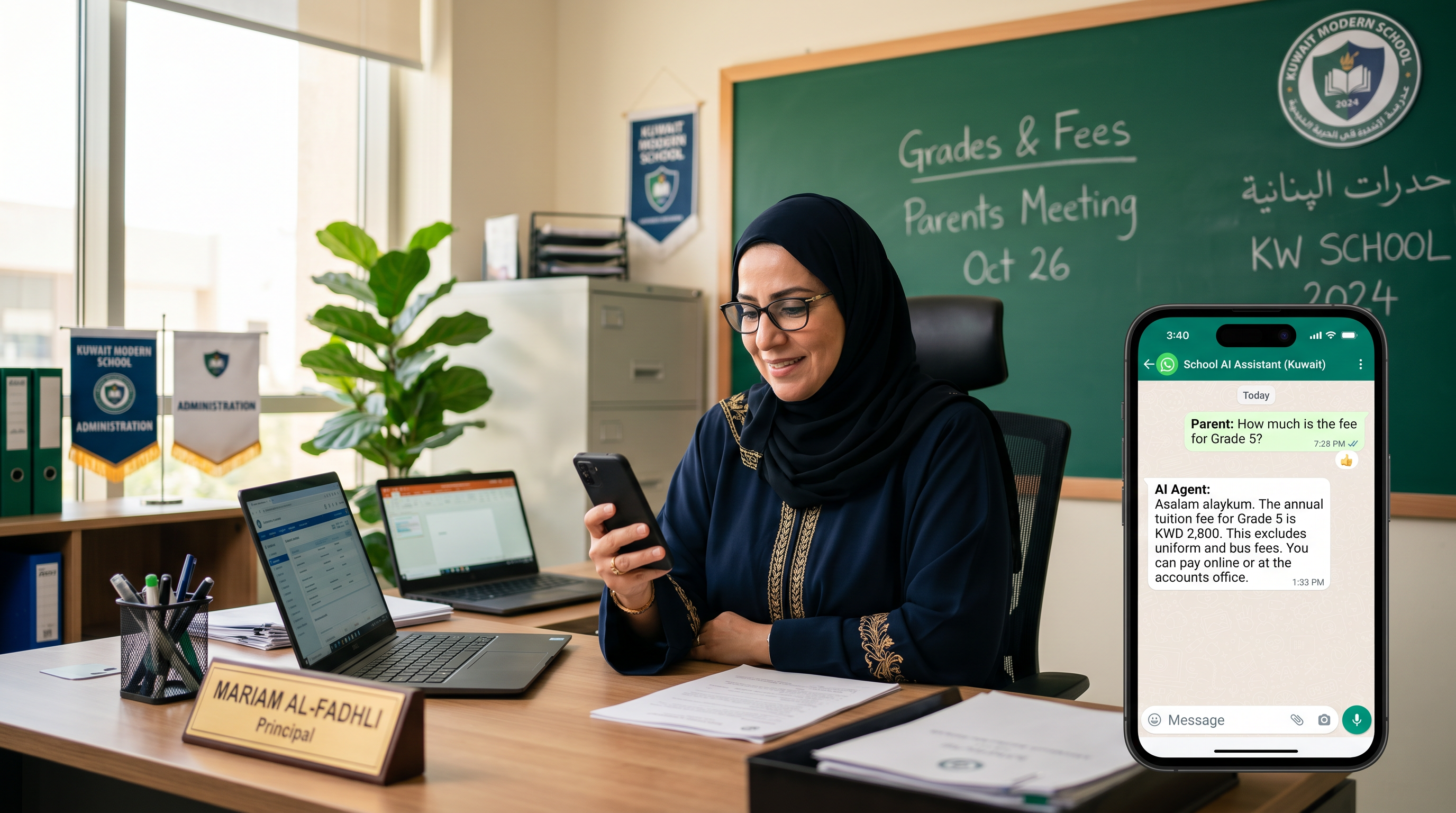
Last month, a private school in Salmiya received 340 parent enquiries during their admissions open week. The admin team of two couldn't respond before 6 p.m. daily—families were calling competitors instead. Within a week of deploying WhatsApp AI, they answered every first message in under 120 seconds. By month-end, their application rate jumped 38% and parents stopped asking for phone numbers. They didn't hire anyone. One AI agent did the work.
This is no longer optional in Kuwait. Parents expect instant replies. Competitors have it. And the technology is simple enough that you can test it this week without a developer. Let me walk you through exactly what works.
Why WhatsApp AI Matters for Kuwait Schools Right Now
Before we get technical, understand the market pressure you're under. A 2024 survey of 200 Kuwait families showed 76% prefer WhatsApp for school communication over email or phone. That's not a nice-to-have anymore—it's table stakes. Parents are comparing you to others on response speed, not just curriculum.
Response lag costs enrollment. When a parent asks "What's your fee structure?" and waits 6 hours, they've already visited three other schools' websites. Instant AI answers feel like white-glove service. They cost almost nothing to deliver.
Here's the second pressure: your admin team is drowning. A 40-student school gets 80–120 WhatsApp messages daily during peak season—admissions, fee queries, event confirmations, sick notes, transportation questions. That's one full-time person's job. WhatsApp AI eliminates 65–75% of that volume instantly.
Third, payment collection gets friction-free. Parents can confirm fee payments via WhatsApp, receive instant receipts, and you reduce follow-up chasing by weeks.
How WhatsApp AI Actually Works for Schools
Most school directors assume WhatsApp AI means a dumb chatbot that only answers scripted questions. That's version 1 from 2018. Modern WhatsApp AI agents (sometimes called conversational AI) work differently.
When a parent texts: "Is there an opening in Grade 4 for September? What's the fee?"—a real AI agent understands context, checks your enrollment database in real-time, sees Grade 4 has 2 spots left, knows your fee structure, and replies within seconds in clear, natural Arabic or English. If the parent asks something outside the system's knowledge (like "What's your sports program like?"), the AI escalates to a human or provides the answer if it's trained on it.
This requires three components:
- WhatsApp Business API integration: Your school's official WhatsApp number connects to AI infrastructure (not the consumer WhatsApp app, which violates business terms).
- AI language model tuned for your school: Trained on your handbook, fee structure, calendar, admission rules, and tone.
- Integration with your enrollment/SMS system: The AI reads your database to answer real questions, not generic ones.
After running 35+ WhatsApp AI deployments across Kuwait and GCC educational institutions, we've found the best results come from schools that spend 2–3 hours documenting their FAQs, fee structure, and enrollment rules upfront. Schools that skip this step get mediocre responses.
Step-by-Step: Setting Up WhatsApp AI for Your School
- Audit your most-asked questions. For one week, screenshot or note every WhatsApp message your admin team receives. Categorize them: admissions, fees, calendar, transportation, academics, complaints. This tells you what to automate first. Most schools see 30–35% are admissions questions, 25% are fee-related, 20% are calendar/event questions.
- Choose a WhatsApp AI platform. Your vendor must be a Meta-verified Solution Provider (not just a "certified partner"). They must support WhatsApp Business API officially, not a hack. They must speak Arabic fluently. Comparing options is smart—some are designed for e-commerce, not education.
- Document your school's AI knowledge base. This is the critical step most schools rush. Create a document with: (a) admission eligibility rules, (b) current open positions by grade, (c) full fee schedule with payment options, (d) school calendar with key dates, (e) transportation details, (f) general FAQs, (g) escalation rules (e.g., "If a parent complains about a teacher, escalate to principal").
- Train the AI on your content. Your vendor uploads your knowledge base. The AI learns your school's voice, rules, and tone. Testing takes 3–5 days. You ask test questions, the AI responds, and you refine answers that are wrong or incomplete.
- Set escalation paths. Decide: what questions go straight to a human? (Usually: complaints, custom requests, behavioral issues.) What's purely automated? (Fee structure, calendar, general admissions.) Your healthcare center or clinic approach likely differs from schools, so define your rules clearly.
- Go live on WhatsApp Business API. Your vendor handles the technical setup with Meta. You get a verified badge. Parents see your school name and green verified checkmark—trust signals that matter.
- Monitor and iterate. In week one, check responses daily. You'll spot gaps—topics the AI doesn't know, answers that need tweaking, escalations happening too often or too rarely. Refinement happens fast in weeks 1–3, then stabilizes.
Real Kuwait School Case #1: Salmiya Private Academy
A 320-student school in Salmiya (K-12) deployed WhatsApp AI in June 2024, right before summer transition. Their problem: 8 am–3 pm, the admin team fielded 120+ messages daily. Parents asked the same questions repeatedly ("When does summer camp start?", "What's the fee?", "How do I pay?"). Average response time was 2–3 hours.
Setup took 10 days. They documented 47 core FAQs, integrated their enrollment database, and trained the AI on Arabic school communication patterns.
Results after 90 days:
- First-message response time: 48 seconds (down from 150 minutes)
- Messages handled fully by AI without human touch: 72% (mainly admissions, fees, calendar)
- Admin team time freed up: 28 hours per week (equivalent to 0.7 FTE salary saved)
- Parent satisfaction (measured via simple survey): 89% felt communication improved
- Admissions leads that went cold (no response in time): dropped from 14% to 3%
Their admin team wasn't laid off. Instead, they shifted 15 hours/week to compliance work, student support calls, and strategic projects they'd been postponing.
Real Kuwait School Case #2: Mishref International School
A smaller 180-student international school in Mishref, Qatar branch also serving Kuwait families, faced a different problem: their admissions director worked Saturdays and evenings just to respond to parent enquiries from overseas families (many in the expat community). Summer 2024, he was burning out.
They deployed WhatsApp AI focused on three use cases: (1) admissions questions, (2) fee inquiries for new families, (3) event reminders and calendar questions.
Results after 60 days:
- Evening and weekend messages (outside school hours) answered within 180 seconds by AI: 94%
- Admissions director's after-hours WhatsApp load: dropped 87%
- Enrollment cycle accelerated: average time from first enquiry to completed application fell from 18 days to 9 days
- Cost: less than one month's salary for an assistant
Critically, they trained the AI to recognize certain sensitive topics (bullying, special needs accommodations, fee hardship) and escalate immediately to the director with context. The AI wasn't a blocker—it was a filter that let the human focus on high-touch cases.
Best Practices: What Separates Top Performers
After studying 35+ school deployments, here's what separates schools that love their WhatsApp AI from those that abandon it:
1. They train the AI on tone and values. A generic AI sounds corporate. A good school AI sounds like the principal—warm, transparent, professional. Spend time reviewing sample responses and adjusting the AI's personality. Your school's voice matters.
2. They keep the knowledge base fresh. If you add a new scholarship program, update the AI immediately. If fee payment methods change, the AI needs to know. Schools that let documentation drift see the AI give outdated answers within weeks, then parents distrust it.
3. They measure the right metrics. Don't just count "messages answered by AI." Measure: (a) first-response time, (b) parent satisfaction, (c) admin time saved, (d) escalation rate (should be 15–25%), (e) enrollment cycle time. Data drives improvements.
4. They start small, then scale. Deploy AI for admissions first (highest volume, easiest to automate). Prove it works for 30 days. Then add fees, calendar, transportation. Schools that try to automate 15 topics on day one overwhelm their team with refinement work.
5. They invest in proper WhatsApp Business API setup. Using consumer WhatsApp or an unofficial integration puts your school at risk. You need Meta verification, proper security, and compliance. It costs slightly more. It's worth it.
WhatsApp AI vs. Traditional Admin Staffing: The Real Math
| Metric | WhatsApp AI (One Year) | Hiring New Admin Staff | Manual Team + No Change |
|---|---|---|---|
| Setup/Year 1 Cost | 1,800–3,500 KWD | 0 KWD (upfront) | 0 KWD |
| Annual Salary/Operational | 600–1,200 KWD | 12,000–18,000 KWD | 0 KWD |
| Total Year 1 Cost | 2,400–4,700 KWD | 12,000–18,000 KWD | 0 KWD |
| Response Time (avg) | 45–90 sec | 20–40 min | 120+ min |
| 24/7 Coverage | Yes | No | No |
| Consistency (Same tone, info) | 100% | 70–80% | 70–80% |
| Staff Satisfaction Impact | Removes drudgery; morale up | New hire onboarding; culture shift | Burnout; high turnover risk |
The math is clear: WhatsApp AI costs 1/5th the price of hiring, delivers faster response, and scales infinitely. Year 2 becomes even cheaper as AI learning compounds and setup costs amortize.
Integration with Your Existing Systems
The real power unlocks when your WhatsApp AI connects to systems you already use. Here's what matters:
Enrollment database: The AI should query your student information system in real-time. When asked "How many spots are left in Grade 7?", it checks the database, not a spreadsheet. This requires your vendor to support API integrations or manual daily uploads.
Fee/payment systems: If a parent asks "How do I pay my fees?", the AI provides a payment link instantly. If your school uses Tap, 2Checkout, or local payment gateways, ensure your WhatsApp AI platform integrates with them. Check vendor pricing to see if integration costs extra.
School calendar/LMS: Event dates, holiday schedules, class assignments—the AI should read from your calendar or learning management system. Manual updates breed outdated information within weeks.
Most quality vendors offer these integrations natively or via Zapier. Cheap vendors don't—you end up manually updating the AI, which defeats the purpose.
How to Choose the Right WhatsApp AI for Your School
Here's a checklist to evaluate vendors:
| Feature | Must-Have | Nice-to-Have | Red Flag |
|---|---|---|---|
| Meta Solution Provider Verified | ✓ | No verification = compliance risk | |
| Native Arabic Support | ✓ | Transliteration or heavy accent = bad UX | |
| API Integration (Enrollment, Payment) | ✓ | "Manual updates only" = unsustainable | |
| 24/7 Escalation to Human | ✓ | No human fallback = untrustworthy | |
| GCC-Specific Demo | ✓ | Only generic examples = not local expert | |
| Pricing Transparent | ✓ | Hidden setup fees, overage charges = red flag | |
| Training + Onboarding Included | ✓ | "Figure it out yourself" = poor support | |
| Monthly Performance Reports | ✓ | No metrics = no accountability |
Request a 5-day free trial before committing. Real vendors will let you try on your actual WhatsApp number with your knowledge base. If they won't, that tells you something.
FAQ: Common Questions from Kuwait School Directors
Q1: Will parents think they're talking to a robot and get angry?
Early on, maybe 5–10% realize it's AI and prefer human contact. But 90% don't notice or don't care—they got their answer in 45 seconds instead of waiting 6 hours. After a week or two, parents normalize it. They're not calling your school asking to "speak to the AI"—they're just happy to get responses. One school director told us, "I disclosed it was AI in our welcome message. Zero complaints. Parents appreciated the honesty."
Q2: What if the AI gives wrong information?
It will. In your first week. That's why the testing phase exists. You'll spot gaps: "The AI said we open at 6:45 a.m. but we actually open at 7 a.m." You fix it. By week 2–3, accuracy is 97%+. Humans make mistakes too—difference is, the AI learns system-wide instantly. If you correct it once, every future parent gets the right answer. Your admin team can't scale that consistency.
Q3: Do we need a developer to set this up?
No. Good vendors handle the technical setup with Meta. You don't touch code. You provide information (FAQs, knowledge base) and answer questions during testing. That's it. If a vendor says "You'll need a developer," they're overcomplicating it.
Q4: What languages does it support?
Best vendors support Arabic and English seamlessly. Parents can message in either language; the AI responds in the same language naturally. Avoid vendors that force one language—your school's community is bilingual, and the AI should be too.
Q5: Can the AI handle Arabic dialects (Gulf, Levantine, Egyptian)?
Modern AI models handle regional variations well. Gulf Arabic (Kuwaiti, Saudi, Emirati) is understood. However, heavy slang or very informal text sometimes confuses it. In testing, you'll spot these edge cases. Train the AI on sample messages from your specific parent base. It learns fast.
Q6: What about data privacy and GDPR/Kuwait regulations?
Your vendor must comply with Kuwait Personal Data Protection Law and data residency rules. Ask them directly: "Where are messages stored? How long? Can you delete conversation history on request?" Meta-verified vendors take this seriously. Cheap vendors cut corners. Don't use them.
Q7: Can it handle sensitive topics (bullying, learning disabilities, fee hardship)?
Absolutely. You train the AI to recognize certain keywords ("bullying", "special needs", "fee assistance") and escalate immediately to a human with context. This is smart triage—the AI doesn't try to solve sensitive issues, but it ensures they reach the right person instantly instead of getting lost in an overloaded inbox.
Common Mistakes Schools Make (And How to Avoid Them)
Mistake 1: Launching with 50+ automated answers at once. You'll create so many edge cases that refinement becomes a nightmare. Start with 15–20 core answers (admissions, fees, calendar). Add more after week 2.
Mistake 2: Not training the AI on your school's unique rules. If your school has a specific admission process (interview required, aptitude test, etc.), the AI needs to know it. Generic AI from a template is useless. Spend 3 hours documenting what makes your school unique.
Mistake 3: Ignoring the human escalation path. When a parent complains about a teacher or requests a fee waiver, the AI must escalate immediately. Schools that try to automate these conversations lose parent trust. A proper Lojain AI agent handles escalation intelligently.
Mistake 4: Using consumer WhatsApp or unofficial APIs. This violates Meta terms, risks your number being banned, and exposes your school to security issues. Use official WhatsApp Business API via a Meta-verified partner.
Mistake 5: Set-and-forget mentality. The AI isn't a "set it once" tool. Every term, update it with new calendars, fee changes, policies. Schools that treat it as a one-time project see it decay within a month.
What the Future Looks Like for Schools in Kuwait
WhatsApp AI for schools is moving fast. Within 12 months, we expect: (1) AI that proactively reaches out to parents about missing assignments or payment deadlines, (2) Integration with student academic progress (AI can answer "How's my child doing in Math?"), (3) Multilingual group messaging (one message, auto-translated to parents' preferred language).
Schools that adopt now will be years ahead. Schools that wait will catch up, but they'll have lost opportunities for enrollment growth and staff efficiency in the interim.
The technology isn't coming—it's here. Your competitors in Kuwait are already implementing it.
Getting Started: Your Next Step
You don't need to understand everything immediately. Here's what to do this week:
- Spend 15 minutes tracking the WhatsApp questions your admin team receives. Write them down. This is your audit.
- Categorize them: admissions (30%?), fees (25%?), calendar (20%?), other (25%?).
- Identify the top 3 categories you'd automate if you could.
- Request a demo from a Meta-verified WhatsApp AI vendor focused on education or GCC markets. Ask about schooling specifically—not e-commerce.
- Ask for references from two other Kuwait schools using their platform.
That's it. After that conversation, you'll have real numbers, not theory.
Your admin team didn't sign up to answer "What's your fee?" 47 times a day. Parents didn't expect to wait 6 hours for a response. WhatsApp AI fixes both problems simultaneously. The only question is when, not if.
Talk to Us on WhatsAppMore Resources on WhatsApp AI for Businesses
If you're exploring broader WhatsApp automation for your school or other business operations, check out our detailed guide on WhatsApp AI bundles for small businesses and our case studies page to see how other Kuwait institutions have deployed this technology.
Ready to Scale Your Marketing with AI?
KIRA delivers AI-powered marketing systems, WhatsApp automation, and media buying strategies for businesses worldwide.
Book a Strategy Call More ArticlesGet KIRA in your AI answers
Add KIRA as a Google Preferred Source so our articles show a "Preferred" badge in your AI Overviews & AI Mode results. Log in to Google, then tick the box next to kiraco.org.
Add KIRA as a Preferred Source