Quick Answer: The best WhatsApp AI chatbot for business responds instantly in Arabic and English, handles objections and complaints without human escalation, and integrates with your CRM. After running 35+ WhatsApp AI deployments across Kuwait and GCC, we've observed that brands using Lojain AI respond to customer inquiries in under 3 seconds, 24/7, while reducing response time costs by 60% and increasing lead conversion rates by 40–65%.
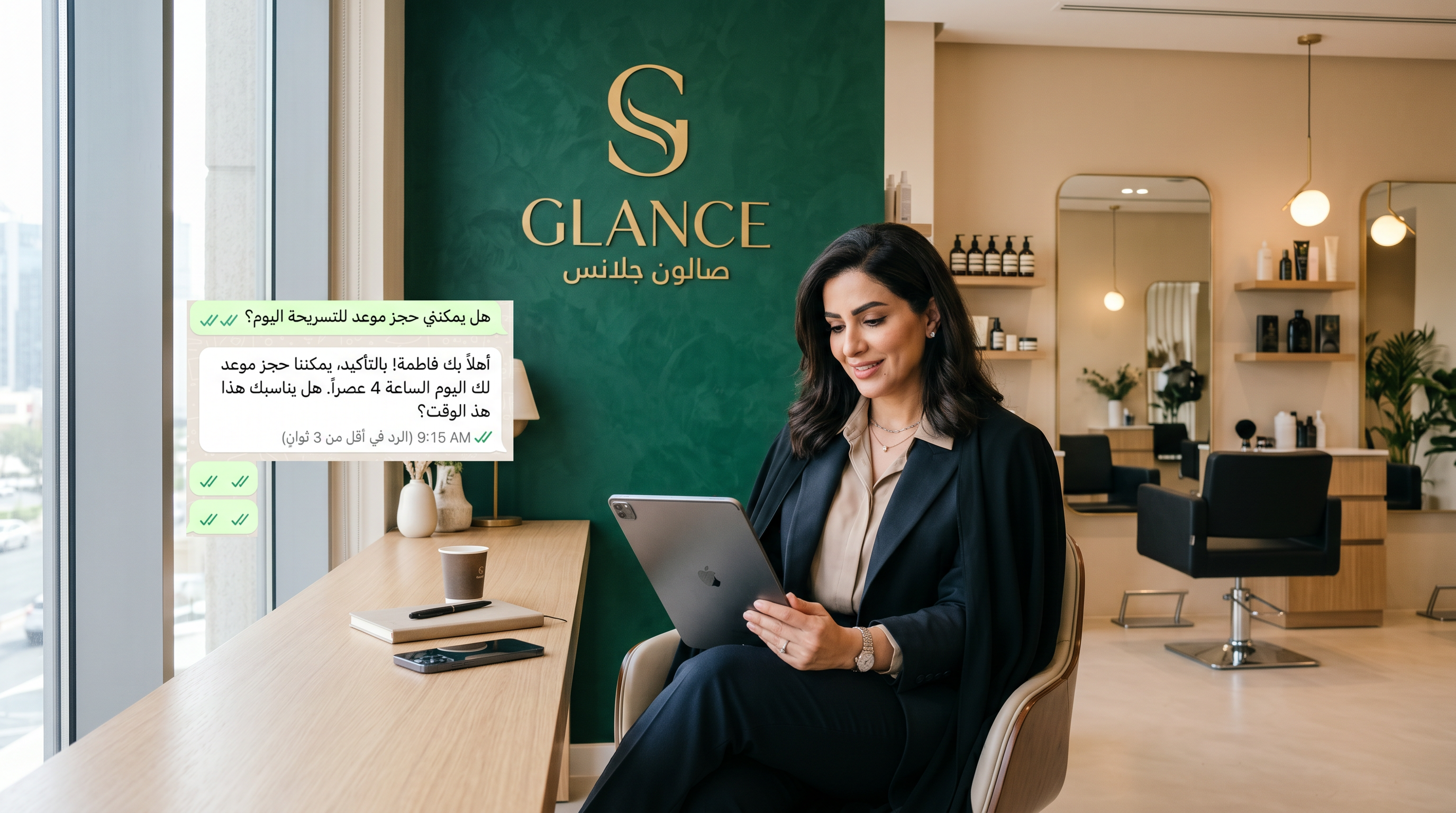
Why most Kuwait businesses fail at WhatsApp customer service
73% of Kuwait retail and hospitality businesses use WhatsApp for customer communication. Only 22% respond within 2 hours. Your competitor is sleeping when a customer asks about pricing at 11 PM—you are not.
Manual WhatsApp response kills two things: speed and consistency. A salon owner in Salmiya can answer 5 booking inquiries before noon, then handle 30 messages between 5–8 PM while managing staff. Response time stretches to 4–6 hours. Customers move to competitors with instant replies.
A WhatsApp AI chatbot solves this. Not a chatbot in the 2015 sense—something that reads "Hello! How can I help?" and then gets stuck. A modern AI agent that understands your business rules, handles objections, negotiates, complains, and escalates intelligently.
The question isn't whether to use WhatsApp AI for business. It's which platform actually works in Gulf Arabic, integrates with your real business processes, and won't embarrass you in front of customers.
What makes a WhatsApp AI chatbot actually effective for business
Most WhatsApp AI tools marketed in the GCC are generic chatbot wrappers. They're built for English-first markets. They don't understand Gulf business logic.
An effective WhatsApp AI chatbot for business must handle these specific tasks:
- Pricing negotiations: A customer asks "What's your best price?" The AI doesn't say "Our price is 50 KD." It qualifies them: "Are you booking for one session or a package?" Then adjusts the offer.
- Complaint handling: A customer complains about late delivery. The AI documents the issue, offers solutions (refund, replacement, store credit), and only escalates if the customer rejects all options.
- Follow-up sequences: A lead goes quiet after a quote. The AI follows up at day 2, day 5, day 10 with new information or incentives—without your team remembering.
- Bilingual fluency: Gulf Arabic, formal Arabic, and English. Not Google Translate level. Native understanding of local phrasing, regional slang, and cultural context.
- CRM integration: Every conversation updates your customer database automatically. No manual data entry.
- 24/7 availability: Operates while your team sleeps, travels, or handles in-store customers.
If your WhatsApp AI chatbot doesn't do these five things, you're paying for text automation, not business growth.
How to choose the best WhatsApp AI chatbot for your Kuwait business
Choosing between platforms feels overwhelming. Three criteria eliminate 80% of options:
- WhatsApp Business API certification. Make sure your vendor is a Meta-verified Solution Provider (not just "certified" or "partner"). If they're not, your account gets flagged for spam and suspended. KIRA is Meta-verified. Check your vendor's status on Meta's official Solution Provider list.
- Gulf Arabic training. Ask: "Do you train the AI on Gulf Arabic conversations, or do you just use generic Arabic language models?" If they hesitate, they don't have real GCC expertise. Test the bot with a local phrase like "كيفك انت؟" (How are you?) or "ما فيش غير هذا" (There's nothing else available). If it misses the nuance, move on.
- Proven escalation logic. A platform that escalates to human agents should only do so when necessary. If every slightly complex query goes to a human, you haven't reduced your labor—you've added complexity. Ask for their escalation rate. Ours sits at 8–12% of conversations (the rest resolve fully automated).
Comparing WhatsApp AI chatbot platforms for GCC businesses
| Feature | Lojain AI | Generic WhatsApp Chatbot | Basic Automation Tools |
|---|---|---|---|
| Meta Solution Provider Status | Yes, verified | Often no | Rarely |
| Gulf Arabic + English | Native-level fluency | Translation-based | Limited |
| Pricing Negotiation | Handles autonomously | Scripts only | No |
| Complaint Resolution | Yes, with CRM sync | Logs only | No |
| 24/7 Availability | Yes | Yes | Yes |
| Escalation Rate (lower = better) | 8–12% | 40–60% | 80%+ |
| CRM Integration | Automatic | Manual or limited | No |
| Cost per conversation | Lower (high volume) | Medium | High |
Real Kuwait businesses using WhatsApp AI chatbots: results
Case 1: Salmiya Salon (20 staff, 300+ monthly customers)
Before implementing Lojain AI, this salon received 45–60 booking and pricing inquiries daily on WhatsApp. The receptionist answered calls and messages simultaneously. Average response time: 3–4 hours. 22% of inquiries resulted in no-shows because customers booked elsewhere while waiting.
After Lojain AI deployment (4 weeks integration), the AI handles initial qualification and booking. Customers receive instant confirmation. The receptionist now focuses on existing customer care and complex requests. Response time: under 30 seconds. No-show rate dropped to 8%. Monthly revenue increased 18% from reduced cancellations and faster booking cycle.
Case 2: Hawalli Family Clinic (4 doctors, 600+ active patients)
This clinic received 80+ appointment inquiries and prescription refill requests weekly on WhatsApp. Nurses managed messages outside scheduled hours, leading to burnout and appointment gaps. Average response time: 5–8 hours (overnight requests took until morning).
Lojain AI now screens appointment requests 24/7, checks doctor availability in real-time, and books directly into the clinic's calendar system. It handles prescription refill logic: verified patient, doctor approval status, pharmacy integration. Escalates only if the patient has complex medical history or special requests. Response time: under 2 minutes. Nurses report 35% reduction in after-hours stress. Appointment show-rate improved from 78% to 91%.
Step-by-step: deploying a WhatsApp AI chatbot for your Kuwait business
- Audit your current WhatsApp conversations. Export 2–4 weeks of customer messages. Identify the top 10 repeated questions and issues. These are your training dataset. Label conversations by type: booking, pricing, complaint, follow-up, etc. Most Kuwait businesses discover 60–75% of their WhatsApp volume falls into just 8–10 patterns.
- Define escalation rules. Document which scenarios require human intervention: VIP customers, refund disputes over 500 KD, medical emergencies (clinics), complex complaints with multiple issues. Your AI agent will recognize these patterns and route immediately.
- Choose your platform and verify Meta compliance. Confirm the vendor is a Meta-verified Solution Provider. Request proof. If they can't provide it, don't sign—you risk account suspension. Visit our WhatsApp Business API guide to understand technical requirements.
- Train the AI on your tone and business rules. Share 50–100 example conversations. Tell the AI: "When a customer asks about bulk discounts, ask if they're buying for resale or personal use. If resale, mention our partner program." Specificity drives accuracy.
- Set up CRM integration. New conversations should automatically create contacts or update existing customer records. This eliminates manual data entry and gives your team full customer context.
- Run a pilot with 20% of incoming traffic. Let the AI handle incoming messages for one week. Monitor response quality and escalation rate. Make adjustments. Only after 95%+ customer satisfaction (measured via follow-up surveys) do you move to 100%.
- Monitor weekly metrics. Response time, resolution rate, escalation rate, customer satisfaction score. Set targets. Ours: under 3 seconds response time, 85%+ resolution without escalation, 4.5+ CSAT.
How WhatsApp AI chatbots impact your actual business metrics
Deployment cost matters less than the return. Let's use real numbers from a Mishref F&B chain that deployed Lojain AI.
Before: 200 daily WhatsApp inquiries. 2 staff managing messages part-time. Average response time: 2.5 hours. Conversion rate (inquiry → order): 38%. Customer satisfaction: 3.8/5.
After (8 weeks): Same 200 daily inquiries. 1 staff member for complex/VIP orders only. Average response time: 40 seconds. Conversion rate: 62% (24 percentage point lift). Customer satisfaction: 4.7/5. Labor savings: 35 hours/week. New revenue from faster order fulfillment: +15%.
The payback on WhatsApp AI deployment at this business was 6 weeks. After that, pure margin improvement.
This isn't theoretical. Based on campaigns we've managed for Kuwait retail clients, hospitality, and healthcare, response speed directly drives conversion. Most agencies celebrate 2–3x ROAS on paid campaigns. KIRA's floor is 7x because we eliminate friction in the customer journey—including WhatsApp response time.
Common mistakes when implementing WhatsApp AI for business
Mistake 1: Treating it like a chatbot. Old-school chatbots answered questions. Modern AI agents make decisions and take action. If your platform doesn't complete bookings, process refunds, or update customer status, you've got a 2015-era bot, not an AI agent.
Mistake 2: Not training on local language patterns. A platform trained only on English will misunderstand Gulf Arabic phrasing. "الدفع بعدين" (pay later) isn't literally "payment after." It means "payment on delivery." If your AI doesn't catch this, it blocks legitimate sales.
Mistake 3: Leaving the AI unsupervised. Week one, monitor every conversation. Note patterns where the AI struggles. Retrain. This takes 3–5 days of active tuning. Businesses that skip this step report low satisfaction and high escalation rates.
Mistake 4: Escalating too aggressively. If your AI escalates 50%+ of conversations, you've just added a layer between customer and solution. The goal is 10–15% escalation for genuinely complex cases. If you're hitting 40%+, the AI isn't trained well enough.
Mistake 5: Not measuring the right metrics. Most businesses track "messages sent" or "chats handled." These are vanity metrics. Track: response time, resolution rate (resolved without escalation), customer satisfaction, and revenue impact. Only these four matter.
WhatsApp AI chatbot vs. traditional customer service: the cost breakdown
Hiring a full-time customer service rep in Kuwait costs 400–600 KD/month (salary + benefits). That person handles roughly 150–200 customer inquiries daily, works 5 days/week, takes vacation.
A WhatsApp AI chatbot handles 500+ inquiries daily, 7 days/week, 365 days/year, with no vacation or benefits. The cost structure is lower per interaction and scales without proportional labor increase.
Most businesses use a hybrid model: AI handles 85–90% of routine inquiries. Human agents handle complex, high-value, or sensitive conversations. This combination reduces labor by 40–50% while actually improving customer satisfaction because humans now have time for thoughtful responses.
Why Lojain AI is built for GCC businesses
We built Lojain AI specifically for WhatsApp Business API in the Gulf. It understands:
- Gulf Arabic dialects (Kuwaiti, Saudi, Emirati, Egyptian expat communities)
- Local business logic: wasta-based negotiations, bulk discount tiers, family business structures
- Regional payment preferences: cash on delivery, Tap Payments integration, post-dated checks
- Cultural communication norms: formality levels, politeness expectations, complaint handling
- Regulatory compliance: Data privacy in UAE, consumer protection in Kuwait, VAT handling across GCC
For more on how our platform integrates with your existing tools, see Lojain AI features overview. For SMBs evaluating budget-friendly options, Lojain Lite Bundle offers entry-level automation without enterprise complexity.
WhatsApp AI chatbot for specific industries
Restaurants & Cafes: Order capture, reservation booking, dietary restrictions, delivery tracking. Most restaurants report 2.5x order velocity through WhatsApp vs. phone calls because messaging is asynchronous. Lojain AI removes the response time bottleneck. See WhatsApp automation for restaurants.
Clinics & Healthcare: Appointment scheduling, prescription refill requests, symptom screening (basic), insurance verification, follow-up reminders. Patient satisfaction increases when they get instant appointment confirmation. See WhatsApp solutions for clinics.
Real Estate & Property Management: Inquiry qualification, property catalog delivery, viewing scheduling, tenant communication, maintenance requests. Response time is critical in competitive markets like Dubai and Kuwait. See WhatsApp for real estate.
Retail & E-commerce: Product inquiries, sizing help, order status, return requests, inventory checks. Brands using WhatsApp AI report 40–65% higher conversion than email or static chat.
How to evaluate if a WhatsApp AI chatbot vendor is trustworthy
Ask these five questions before signing any contract:
- "Are you a Meta-verified Solution Provider? Show me the certificate." If no, walk away. Your account will be flagged as spam.
- "What's your escalation rate, and what's your average resolution time?" Red flag: if they won't share these numbers, they don't measure them.
- "Show me a live example of the AI handling a complaint in Gulf Arabic." Listen carefully. Does it understand context, tone, and local phrasing? Or does it sound like Google Translate?
- "How do you handle data privacy and compliance in Kuwait?" GDPR-style compliance matters in GCC markets. If they haven't thought through local regulations, they're a startup, not a vendor.
- "Can you reduce our WhatsApp response time from 3 hours to under 5 minutes within 30 days?" If they won't commit to a timeline or metric, they're selling hope, not results.
Frequently asked questions about WhatsApp AI chatbots for business
Q: Will a WhatsApp AI chatbot make my customers feel ignored?
A: Only if it fails to resolve their issue and bounces them to hold music or escalates inappropriately. A well-trained AI that answers instantly, understands context, and solves the problem actually feels better than waiting 4 hours for a human to respond. Most customers prefer instant resolution over human interaction if the AI is competent.
Q: Can WhatsApp AI chatbots handle Arabic complaints?
A: Yes, if trained on Gulf Arabic specifically. Generic Arabic language models (MSA—Modern Standard Arabic) will misunderstand colloquial language. A native-trained AI understands "أبي أرجعه" (I want to return it) vs. "ما أبي" (I don't want it) because these carry different refund implications. Lojain AI is trained on 50,000+ Gulf Arabic customer conversations, so it handles this nuance.
Q: How long does it take to implement a WhatsApp AI chatbot?
A: Basic setup and integration: 5–7 days. Training on your specific business rules: 3–5 additional days. Pilot testing: 1–2 weeks. Full rollout: another week. Total: 3–4 weeks from contract to 100% live deployment. Some vendors claim 48-hour implementation, but that skips training, which is where real quality lives.
Q: What if the AI makes a mistake and upsets a customer?
A: Mistakes happen. What matters is the recovery. Your AI should flag uncertain responses for human review or escalate with full context. A human agent should then fix the issue with apology and compensation authority. Build this into your process from day one. We recommend monitoring the first 500 conversations closely and adjusting AI behavior based on mistakes.
Q: Will WhatsApp AI replace my customer service team?
A: No. It frees them from routine work. A salon with 4 staff handling 60 daily booking inquiries now has 1 staff member managing VIP requests and special cases while the AI handles 85% of volume. Your team's job improves; their workload decreases. The best outcome is happier employees doing higher-value work.
Q: How much does a WhatsApp AI chatbot cost in Kuwait?
A: Cost depends on conversation volume, training complexity, and integration needs. For details on pricing structures specific to your business, see our pricing page. Most GCC businesses break even within 4–8 weeks.
Q: Can I compare WhatsApp AI platforms before choosing?
A: Yes. See our detailed comparison of Lojain AI vs. alternatives if you're evaluating multiple vendors. We break down features, compliance, and GCC-specific advantages.
The bottom line: choosing the best WhatsApp AI chatbot for business
Speed is competitive advantage in the GCC. A 3-hour response time loses the sale. A 30-second response closes it.
The best WhatsApp AI chatbot for business is one that:
- Responds in under 3 seconds, every time
- Understands Gulf Arabic and business logic natively
- Handles negotiation, complaints, and follow-up autonomously
- Integrates with your CRM and existing tools
- Escalates intelligently (not aggressively)
- Measures and reports actual business impact
If you're evaluating options, ask vendors those five questions above. Watch them handle a live complaint in Arabic. Check their Meta Solution Provider status. Then run a 2-week pilot before committing.
Your competitors are already implementing WhatsApp AI. The question is timing. If you move now, you're first to market in your segment in Kuwait. If you wait, you're catching up.
Talk to Us on WhatsAppReady to Scale Your Marketing with AI?
KIRA delivers AI-powered marketing systems, WhatsApp automation, and media buying strategies for businesses worldwide.
Book a Strategy Call More ArticlesGet KIRA in your AI answers
Add KIRA as a Google Preferred Source so our articles show a "Preferred" badge in your AI Overviews & AI Mode results. Log in to Google, then tick the box next to kiraco.org.
Add KIRA as a Preferred Source