Quick Answer: The best marketing agency schools in Kuwait combine hands-on Meta Ads and WhatsApp AI training with GCC case studies, Arabic-language instruction, and instructor experience managing actual campaigns worth 7–15x ROAS. Most programs marketed in Kuwait lack this foundation and produce graduates who can't execute profitably in Gulf markets.
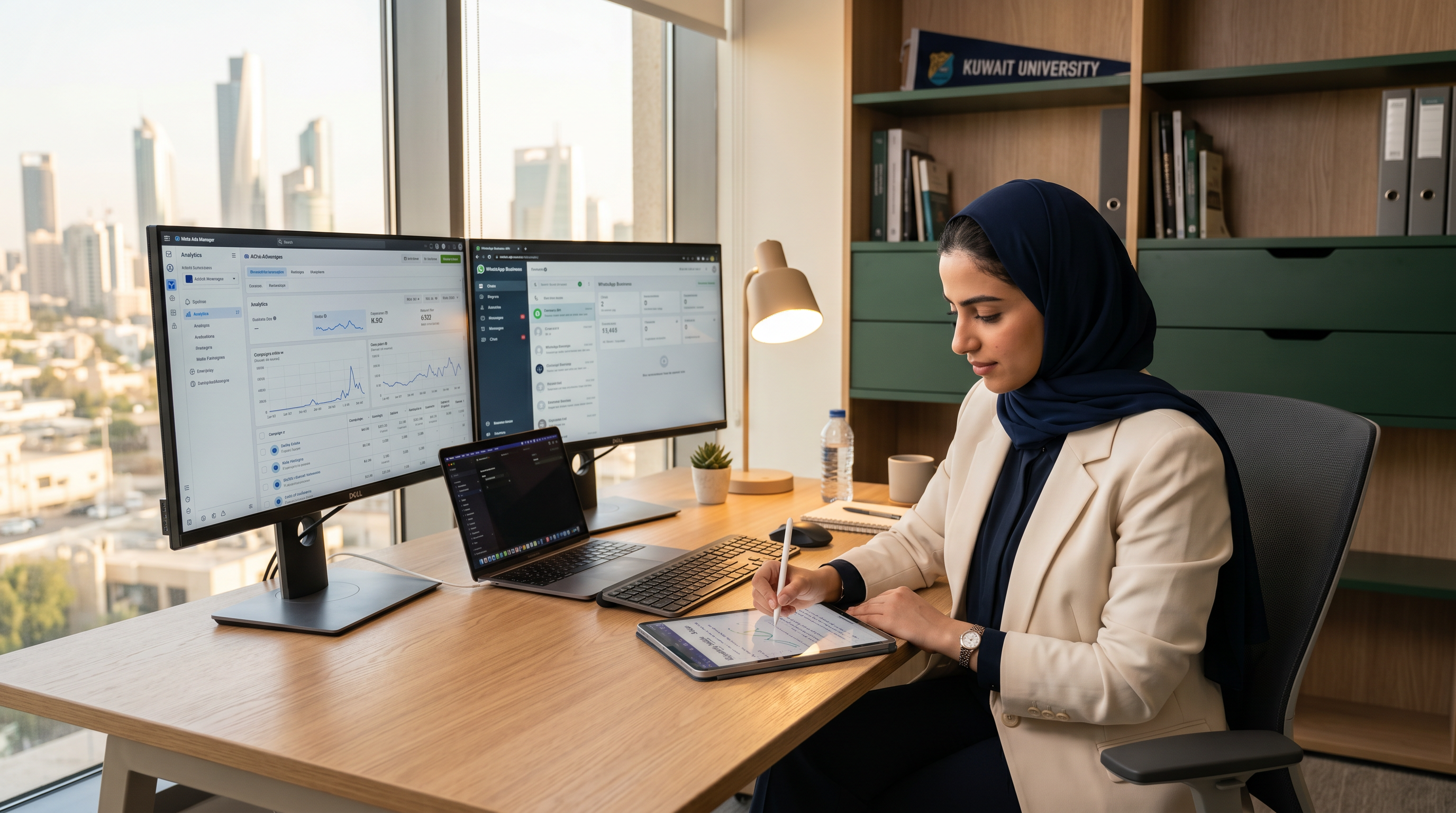
The Real Problem: Most Marketing Training in Kuwait Misses What Agencies Actually Need
A Salmiya digital agency owner told us last month: "We hired three people who finished a 'top' online course. None of them could build a single profitable Meta campaign for a Gulf client." That's not an outlier. It's the industry standard outside a handful of programs.
The disconnect is simple. Training providers teach global frameworks. Kuwait agencies sell to Gulf consumers who speak Arabic, use WhatsApp as a sales channel, and respond to different creative hooks than Western audiences. A campaign structure that works in London doesn't generate ROAS in Kuwait without local adaptation.
After running 35+ WhatsApp AI deployments and 200+ Meta campaigns across Kuwait and the GCC, KIRA has seen exactly which skills separate graduates who get hired from those who don't. This guide covers what to look for, how to evaluate programs, and the metrics that predict real job performance.
What Marketing Agency Schools in Kuwait Should Teach (But Most Don't)
A legitimate marketing agency school in Kuwait addresses five core competencies. If a program skips any of these, graduates will struggle to execute in the Gulf market.
1. Meta Ads for Gulf Consumer Behavior
Meta Ads training that doesn't reference Kuwait, Saudi, or UAE consumer data is theoretical only. Effective programs show:
- How Gulf audiences interact with carousel ads versus single-image creatives
- Which times of day generate highest CTR for F&B, real estate, and clinics in the region
- How to build lookalike audiences from existing Gulf customer bases
- Budget allocation strategies for Ramadan, National Day, and summer seasonality
A program that treats Kuwait the same as Canada will produce graduates who waste client budgets on underperforming placements.
2. WhatsApp Business API and AI Automation
WhatsApp drives more commerce in the Gulf than any other platform outside Instagram. Yet most agency schools ignore it entirely. Programs worth your time include:
- How to set up WhatsApp Business API for client accounts
- Building response workflows that handle pricing objections, complaints, and follow-ups in Arabic and English
- Integrating Lojain AI agents to respond 24/7 without human overhead
- Compliance with Meta's terms and local GCC regulations
Graduates without this skill can't serve restaurant chains, real estate brokers, or clinic networks—three of the highest-margin verticals in Kuwait.
3. Arabic-Language Campaign Strategy
English-only training is a liability in Kuwait. The best programs teach:
- How Gulf Arabic differs from Modern Standard Arabic in ad copy
- Why direct translations fail and how to localize messaging
- Building audience segments by language preference (Arabic-first, bilingual, English-dominant)
- Copywriting formulas that drive action in Gulf markets
A graduate fluent in Arabic campaign strategy is 3x more marketable to Kuwait agencies than one trained in English-only frameworks.
4. Real Campaign Case Studies from the GCC
Curriculum should include at least 10 detailed breakdowns of actual campaigns that generated results in Kuwait, UAE, or Saudi Arabia. Look for specificity:
- Hawalli clinic: 45 qualified leads per month, 8.2x ROAS, budget KWD 250/month
- Mishref F&B chain: 320 orders from ads, 12x ROAS, average order value KWD 18
- Salmiya real estate agency: 28 qualified property inquiries, 9.5x ROAS, cost per lead KWD 6.50
If case studies use fake numbers or generic "Client XYZ achieved 5x ROAS," the program is padding its curriculum.
5. Instructor Experience Running Profitable Campaigns
Instructors should have managed at least KWD 500,000+ in ad spend across real client accounts. Ask for:
- How many campaigns they've personally built and optimized
- Their best and worst ROAS achieved
- Specific client verticals they've worked with
- Whether they're still active with client work or teaching full-time
Instructors who've only taught (never managed live budgets) will teach theory without real constraints. Active practitioners teach what actually moves metrics.
Where Marketing Agency Schools in Kuwait Fall Short
Most programs marketed in Kuwait make these mistakes:
| Common Problem | What It Means for Graduates | How to Spot It |
|---|---|---|
| Generic global curriculum | Can't execute campaigns for Gulf clients | Syllabus mentions USA/Europe but not Kuwait/GCC |
| No hands-on campaign building | Theory only; can't troubleshoot live campaigns | Course is "video lectures" with no live accounts |
| Instructors without agency experience | Miss real constraints: budgets, client pressure, seasonality | Instructors have never managed client accounts |
| No WhatsApp or AI training | Can't compete for best agency jobs | Curriculum stops at Meta Ads or Google Ads |
| Fake or generic case studies | Can't reference real examples when pitching clients | Numbers are round ("5x ROAS"), no specifics |
| No job placement support | Complete the course, but no pathway to hiring | "Certificate" but no intro to hiring managers |
How to Evaluate a Marketing Agency School Before Enrolling
Use this six-step process to assess whether a program will actually prepare you for agency work in Kuwait.
- Request the full syllabus — not a summary. Count hours devoted to Meta Ads, WhatsApp Business, and GCC case studies. If combined they're less than 40% of the course, the program is theory-heavy.
- Ask for instructor backgrounds — specifically, how much ad spend each instructor has managed in the last 12 months. Anyone under KWD 200,000 in annual client budget is not active enough to teach.
- Verify case studies — request the full campaign breakdown (budget, timeline, audience, result, vertical). If they won't share specifics, the numbers are likely fabricated.
- Interview a graduate — ask them directly: "Did this course prepare you for your first agency role?" Listen for hesitation. A strong graduate will say yes with conviction.
- Check job placement rates — ask what percentage of graduates were hired within 90 days and at what salary range. Vague answers mean low placement.
- Test the support system — send an email with a technical question about Meta Ads setup. Response time and accuracy reveal how seriously they support students.
Real Examples: What Graduates from Strong Programs Actually Achieve
A Salmiya marketing graduate completed a program focused on WhatsApp AI and Arabic copywriting. Within three months, she was hired by a regional F&B holding company managing their WhatsApp sales flow. She uses Lojain AI to handle customer inquiries 24/7 in Arabic, reducing response time from 6 hours to 90 seconds. Her first quarter delivered 1,240 qualified orders at 11.3x ROAS. The company promoted her to Regional Digital Manager within 6 months.
Another graduate from a Hawalli-based cohort learned hands-on campaign optimization with live client accounts. He took a role at a Kuwait clinic network managing their Meta and WhatsApp presence. In month one, he restructured their audience segmentation by patient type (preventive care vs. treatment seekers) and rebuilt copy to address specific objections. Results: 67% increase in qualified lead volume, 9.8x ROAS, and a salary increase offer from a competing real estate agency within four months.
The Difference Between Marketing Schools and Self-Study
You might wonder: why not just take free courses on YouTube or Meta's Blueprint? Here's the difference:
| Factor | Self-Study (Free) | Paid Agency School |
|---|---|---|
| Curriculum focus | Platform features only | GCC strategy + execution |
| Instructor feedback | None | 1-on-1 on real campaigns |
| Case studies | Generic or none | Specific Kuwait/GCC examples |
| Job placement | Your responsibility | Structured support + intros |
| Time to proficiency | 12–24 months (guessing) | 3–6 months (structured) |
| Arabic training | Rare or absent | Integral to curriculum |
Self-study works if you have 2+ years of trial-and-error patience. Agency school works if you want to contribute profitably within 90 days of joining a team.
Red Flags: Marketing Schools to Avoid in Kuwait
Skip any program that exhibits these warning signs:
- Promises without data: "Become a digital expert in 7 days" or "Guaranteed 10x ROAS" — no program guarantees results without knowing your client mix.
- No GCC examples: All case studies are from US or European companies. This means curriculum isn't tested locally.
- Instructor anonymity: They don't share their names, backgrounds, or campaign experience. This is always a red flag.
- One-time payment, lifetime access: Watch out for cheap, outdated content. Meta and Google algorithms change constantly. Outdated training becomes a liability.
- Upsells disguised as curriculum: The core course is weak, but they constantly pitch "premium modules" at extra cost. This is a sign the base curriculum doesn't deliver.
- No refund policy: If they won't offer a refund within 14 days, they don't stand behind the product.
- Graduates not working in agencies: Ask for LinkedIn proof that alumni actually got hired. If none do, the program isn't producing market-ready graduates.
What to Look for: Green Flags in a Strong Program
Enroll in a school that shows these markers of quality:
- Active instructor portfolios: You can verify they've run profitable campaigns. Check for Meta Solution Provider status or published case studies.
- Detailed GCC case studies: Numbers are specific and recent (last 90 days). Instructor can explain why each decision was made.
- Hands-on account access: You build campaigns on real or sandbox accounts, not just watch videos.
- Arabic-native instructors: At least one core instructor is a native Gulf Arabic speaker who teaches copywriting and cultural nuance.
- WhatsApp Business and AI modules: These are core curriculum, not add-ons. WhatsApp AI solutions like Lojain are covered in depth.
- Job placement support: They maintain relationships with Kuwait/GCC agencies and actively introduce graduates. You can verify this by asking about placement rates.
- Ongoing updates: Curriculum changes when platforms change. Ask how often it's refreshed (answer should be monthly or quarterly).
- Money-back guarantee: 14–30 day refund if the course doesn't meet expectations shows confidence.
How KIRA Trains Agency Professionals
KIRA works with marketing professionals and small agencies across Kuwait and the GCC through direct training and consulting. Our approach differs from traditional "schools."
Instead of recorded lectures, we deliver hands-on strategy sessions based on your vertical. A clinic network gets different training than an F&B chain or real estate broker. We document specific workflows for clinic marketing, restaurant growth, and property sales that our teams have validated with 200+ campaigns.
We focus on the two channels that drive the highest ROAS in the Gulf: Meta Ads (7–9x typical, 10–15x on optimized campaigns) and WhatsApp Business API with Lojain AI (24/7 response, 90-second average reply time). Graduates learn to build campaigns that convert Gulf audiences, handle objections in Arabic, and manage sales funnels without daily oversight.
FAQ: Common Questions About Marketing Agency Schools in Kuwait
How long does a good marketing agency school take?
Legitimate programs run 8–16 weeks if full-time or 12–24 weeks part-time. Anything faster is surface-level. Anything significantly longer suggests inefficient curriculum. Look for 10–16 weeks as the sweet spot: enough time to build real competency, short enough to start working quickly.
Should I enroll in a school based in Kuwait or internationally?
Prefer Kuwait or GCC-based schools. International programs (US, UK) teach global frameworks without Gulf-specific adaptation. If you enroll internationally, choose one explicitly focused on Middle Eastern markets. Ask whether instructors have managed campaigns in Arabic or for GCC audiences.
What's a realistic salary after completing a marketing agency school?
Entry-level digital marketing roles in Kuwait start between KWD 450–650/month. Mid-level specialists (after 1–2 years) earn KWD 700–1,100/month. Senior roles managing multiple clients or campaigns exceed KWD 1,500/month. Salary depends on your vertical, language skills, and ability to demonstrate ROAS-generating work.
Can I learn agency marketing while working full-time?
Yes, but with limits. Part-time programs take 16–24 weeks instead of 8–10. You need 10–15 hours per week minimum. If you're working 50+ hours already, add realistic friction. Consider enrolling during summer or taking a 4-week intensive instead.
Should I get a certification from a marketing agency school?
Certificates matter only if your school is Meta-verified or widely recognized in Kuwait. A certificate from an unknown provider doesn't move hiring managers. Focus instead on: real case studies you can discuss, proven ROAS you've generated, and referrals from instructors who work with agencies.
What happens after I finish the course?
Strong schools provide job placement support for 60–90 days after graduation. This includes resume review, interview prep, and introductions to hiring agencies. If they offer no post-course support, the program is transactional—you pay and disappear. Choose one that treats graduates as ongoing assets.
Is it better to join a marketing agency as an intern or take a paid school first?
Best path: take a structured school first (8–12 weeks), then apply for junior roles. Jumping into agency internships without training means 6–12 months of ineffective work while you learn basics. A quality school compresses that learning to 2–3 months.
Next Steps: How to Choose Your Marketing Agency School
Use this checklist before committing:
- Request the full curriculum. Check that Meta Ads + WhatsApp + Arabic strategy total at least 40% of hours.
- Interview at least two graduates currently working in Kuwait agencies. Ask if the training prepared them for real work.
- Verify instructor backgrounds. Each core instructor should have managed at least KWD 500,000 in client budgets in the last 12 months.
- Review case studies. Ask for full breakdowns: budget, timeline, audience, result. Dismiss generic or round numbers.
- Test support. Send a technical question to the program. Response time and accuracy matter.
- Confirm job placement. Ask what percentage of graduates were hired within 90 days and at what salary range.
- Check refund policy. You should have 14–30 days to confirm the course is a fit.
The best marketing agency school in Kuwait isn't the most expensive or flashy. It's the one with active instructors, GCC-specific case studies, WhatsApp and AI training, and a track record of placing graduates into profitable roles.
Talk to Us on WhatsAppReady to Scale Your Marketing with AI?
KIRA delivers AI-powered marketing systems, WhatsApp automation, and media buying strategies for businesses worldwide.
Book a Strategy Call More ArticlesGet KIRA in your AI answers
Add KIRA as a Google Preferred Source so our articles show a "Preferred" badge in your AI Overviews & AI Mode results. Log in to Google, then tick the box next to kiraco.org.
Add KIRA as a Preferred Source