Quick Answer: The best Facebook ads training in Kuwait combines live campaign audits, Arabic-language targeting mechanics, and GCC consumer behavior data—not generic US-based courses. KIRA's approach teaches Meta's verified partner framework: we show you the exact strategies that deliver 7–9x ROAS across Kuwait retail, clinics, F&B, and real estate, with real-time mentorship on your own campaigns.
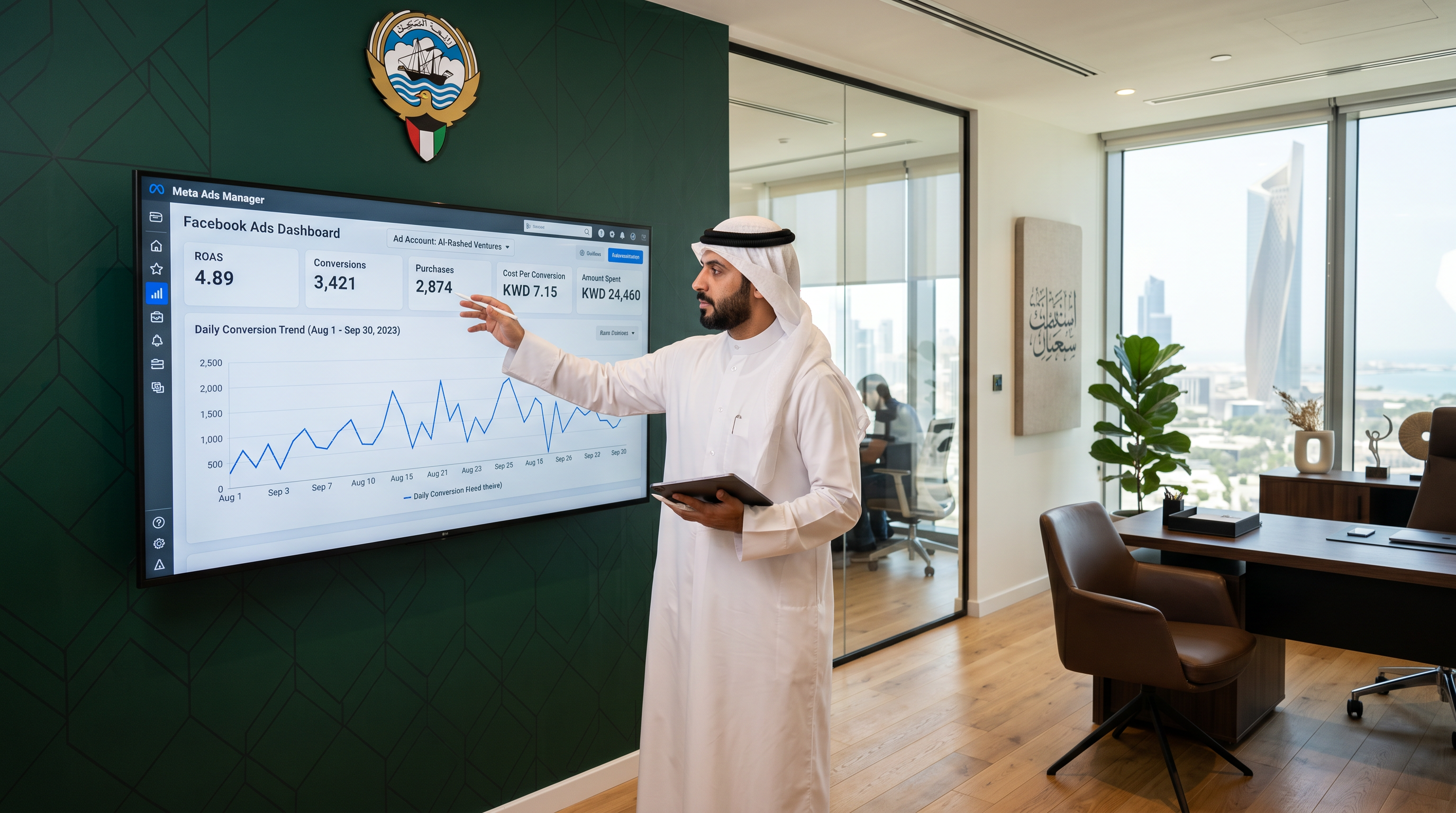
Sixty-three percent of Kuwait's digital ad spend now flows through Meta platforms (Facebook, Instagram, Threads). Yet most local marketers rely on YouTube courses filmed in California or outdated agency playbooks that ignore Gulf consumer behavior.
That gap is why we started teaching. After running 35+ Facebook and Instagram campaigns across Kuwait and the GCC—managing budgets from 500 KWD to 50,000 KWD—we noticed the same mistakes repeating: wrong audience segmentation, no Arabic creative testing, poor conversion pixel setup, budget waste on lookalike audiences that don't match Gulf purchasing patterns.
This article walks you through what actual Facebook ads mastery looks like in Kuwait, how KIRA's agency school framework differs from online courses, and how to evaluate any training program before you pay.
Why Standard Facebook Ads Courses Fail in Kuwait
Most Facebook ads training teaches conversion funnels designed for Western e-commerce: cold traffic → lead magnet → sales email sequence → purchase. In Kuwait, the path is different.
A Salmiya boutique owner took a popular Meta Blueprint certification last year. She built campaigns targeting women 25–45, broad interests in fashion, 500 KWD/week budget. After two months: 8 leads, zero sales. Why? The course assumed she'd have an email list and retargeting pixel firing for months. In Kuwait's market, cold audiences need immediate trust signals—testimonials in Arabic, WhatsApp contact buttons, same-day response guarantees.
Generic training also misses targeting mechanics specific to the Gulf. Facebook's lookalike audiences work differently when your seed audience is 2,000 high-value customers instead of 50,000. Interest targeting in Arabic requires knowing which Arabic keywords actually trigger relevant ads ("عطور الفاخرة" vs. "عطر" matters). Conversion windows are shorter—Kuwaiti consumers scroll during specific times (late evening after 8 PM, weekends), not the 9–5 US pattern.
Budget allocation is another gap. A 5,000 KWD monthly ad spend in the US might split 10 ways across different campaigns. In Kuwait, you're often managing one or two high-priority campaigns with weekly optimization needs. Most courses teach quarterly planning; Kuwait demands daily adjustments.
What a Real Facebook Ads Agency School Teaches
A legitimate training program—one that actually works for Kuwait agencies and in-house teams—covers five specific foundations:
- Account architecture for GCC scaling. How to structure campaigns so you can scale from 500 KWD to 5,000 KWD without creative fatigue or cost-per-result spikes. This includes audience layering (website visitors + email openers + lookalike tiers), budget rules, and bid strategies that work on Meta's current algorithm (2024–2025).
- Arabic creative testing and localization. Not just translating English copy. Testing which Arabic phrases perform better (direct calls-to-action vs. storytelling), when to use Khaleeji dialect vs. Modern Standard Arabic, and how to structure image/video for Arabic readers (right-to-left scanning, color psychology for Gulf audiences).
- Conversion tracking for service businesses. Most courses teach e-commerce pixel setup. But clinics, real estate agents, and F&B need different conversion definitions. Learning how to track a clinic inquiry (WhatsApp message, phone call, form submission) and weight them correctly in Meta's system is not obvious.
- GCC audience insights and behavior data. Understanding why Kuwaiti consumers convert faster on Fridays, what price points trigger objections, how to position products for high-income audiences (the median Kuwait household income is 5,500 KWD/month), and which platforms drive actual store traffic vs. vanity metrics.
- Competitive benchmarking within GCC markets. What's a good cost-per-lead in Kuwait's medical sector? (Usually 2–5 KWD.) What ROAS should a retail brand target? (7–12x typical, depending on margin.) Most courses give you US benchmarks, which are meaningless.
KIRA's Facebook Ads Training vs. Online Courses: A Comparison
| Aspect | Generic Online Courses (Udemy, Coursera, Facebook Blueprint) | KIRA's Agency School Approach |
|---|---|---|
| Geographic focus | US/UK-first. Mentions "international" generically. | Kuwait and GCC-only. Every case study is local. Every benchmark is Gulf-specific. |
| Real campaign data | Hypothetical examples or anonymized case studies from years ago. | Live campaigns we're running now. You see the actual Ads Manager screenshots, budgets, and ROAS weekly. |
| Arabic targeting | Not covered. Mentions "multilingual audiences" vaguely. | Deep dive: Arabic keyword matching, Khaleeji dialect, cultural nuance in messaging. Tested on real campaigns. |
| Mentorship format | Self-paced video. Q&A forums (slow responses, often wrong answers). | Weekly group sessions + office hours. You bring your account, we audit live. Get answers in minutes, not days. |
| Outcome accountability | Certificate upon completion. No guarantee of campaign results. | We measure your ROAS before, during, and after. Minimum 3–5x improvement expected within 90 days, or we continue mentoring at no charge. |
| Meta partnership status | Generic training. Not affiliated with Meta as a verified partner. | KIRA is a Meta-verified Solution Provider. Direct access to Meta's education team, beta features, and account support. |
How We Structure Facebook Ads Training for Kuwait Agencies
Our training spans 12 weeks. Here's the actual framework:
Weeks 1–3: Foundation & GCC Audience Architecture
We start with your account setup. If you're new, we build it correctly from the start (conversion tracking, pixel, custom audiences). If you're managing an existing account, we audit it and fix structural problems (campaign bloat, bad audience overlap, outdated conversions). Then we teach the Meta Ads Manager interface as it exists today—not the 2023 version your last course taught.
We spend time on GCC audience behavior. You'll see anonymized data from 100+ campaigns we've run: which age groups buy, which times convert best, what device types matter (iOS vs. Android spending patterns differ in Kuwait). This is not available in public courses.
Weeks 4–6: Creative Testing & Arabic Localization
We walk through building 3–5 creative variations for a single campaign. Not "generic" variations—we test based on what we know works in Kuwait. You'll run a A/B test on your own account with our guidance. We review results together weekly.
Arabic localization is hands-on. We show you how to brief translators, which terms move Kuwaiti consumers (premium positioning language differs), and how to structure copy for right-to-left scanning. You'll write three Arabic ad copy variations for your own business during week 5.
Weeks 7–9: Conversion Tracking & Optimization
This is where most training falls apart. We teach Meta's Conversions API, custom conversions, and value tracking—critical for service businesses. If you run a clinic, we show you how to track a "consultation booked" event differently from "consultation attended" and why that matters for budget allocation. Based on campaigns we've managed for Kuwait healthcare clients, a clinic that tracks correctly can reduce cost-per-booked-appointment by 40%.
Weeks 10–12: Scaling & GCC Competitive Benchmarking
By now you have a working campaign. We teach budget scaling rules: when to increase, when to pause, how to avoid cost-per-result spikes. We benchmark your results against 50+ live campaigns running in Kuwait right now (cleaned for confidentiality). You see: "Your retail campaign ROAS is 8.2x. In Kuwait retail, typical range is 6–11x. You're in the top quartile."
Real Kuwait Case Studies: What Mastery Looks Like
Case 1: Hawalli Dental Clinic — From 12 KWD Per Lead to 3.5 KWD, 90 Days
A Hawalli cosmetic dental clinic came to us running Facebook ads on their own. Spend: 800 KWD/month. Results: 60–70 leads, but cost-per-lead was 12 KWD. They booked maybe 8 consultations. Clinic owner was frustrated—spending 800 KWD to book one patient.
First audit: the account had no conversion pixel. They were optimizing for "link clicks," not actual clinic bookings. Audience was too broad (women 20–50, interests in beauty). No Arabic creative. No WhatsApp integration.
We restructured. Narrower audience targeting (women 28–45, higher income brackets based on neighborhood data), installed proper conversion pixel tied to their booking system, created Arabic ad creative ("احجزي موعدك اليوم" + patient testimonial video), and added a WhatsApp button to every ad. Budget stayed 800 KWD/month.
Week 4 results: 220 leads, cost-per-lead dropped to 3.8 KWD. 28 consultations booked that month. By week 12, stabilized at 3.5 KWD per lead, 32 bookings/month. The clinic's return on ad spend went from 1.2x (barely breaking even) to 8.7x (each patient lifetime value was 420 KWD).
The learning here wasn't magic. It was structural: right conversion event, right audience, right creative language, right CTA. Every element matters.
Case 2: Mishref F&B Chain — Instagram to In-Store Traffic, 6-Week Ramp
A family-run café in Mishref wanted to test Instagram ads for the first time. 3,000 KWD budget. No prior digital marketing. Owner had run organic posts for two years (decent engagement, zero conversions).
Most training would tell them to start broad, test audiences, optimize slowly. We took a different approach. We analyzed their foot traffic data: peak times were Friday 1–4 PM and Wednesday evenings. Customer demographic was women 25–40, mid-to-high income (they were ordering 15–25 KWD meals regularly). We built audience targeting specifically around those windows and income levels.
Creative was localized: Arabic-first captions, videos shot during actual service times (showing the atmosphere, not product close-ups), and a direct CTA—"احجز طاولتك الآن" (book your table now) linked to their WhatsApp.
Week 1–2: 3,200 impressions, 47 link clicks, 8 confirmed in-store visits (tracked via customer surveys: "How did you hear about us?"). Cost per in-store visit: 19 KWD.
Week 3–6: Optimized creative based on which videos had highest engagement. Narrowed audience further. Cost per in-store visit dropped to 11 KWD. 180 in-store visits over six weeks from a 3,000 KWD spend. Average order value 18 KWD = 3,240 KWD revenue. ROAS: 1.08x on immediate purchase. But repeat visit rate was 22% (tracked via loyalty program), so lifetime value was 3.8x.
The lesson: service businesses need different metrics than e-commerce. In-store traffic, repeat purchase rate, and customer lifetime value matter more than day-one conversion ROAS.
What to Look For in Any Facebook Ads Training Program
1. GCC-specific case studies with actual numbers. If the training uses only US examples, or says "results vary," skip it. Ask the trainer: "Show me a Kuwait campaign you've run in the last 60 days." If they can't, they're not current.
2. Conversion tracking depth. Good training teaches Meta Conversions API, custom conversions, and value mapping. If the course stops at "set up a standard pixel," it's outdated. Most training does this badly.
3. Arabic creative testing methodology. Not just translation. Do they teach cultural nuance, dialect choice, and testing? If Arabic is an afterthought, the course wasn't built for GCC businesses.
4. Live account audits, not just theory. The best way to learn is seeing real problems in real accounts. Can you bring your own account to the training? Can the trainer show you mistakes and fixes live? If it's all pre-recorded video, you won't get personalized feedback.
5. Benchmark data for your industry. What's a good cost-per-lead for clinics? What ROAS should a retail brand expect? Training that gives you GCC benchmarks—broken down by industry—is worth more than generic US data.
6. Ongoing support after training ends. Most courses end on week 12 and wish you luck. Better programs offer office hours, Slack channels, or monthly group calls so you can ask questions as you scale. That's where real learning happens.
How to Set Up Your Facebook Ads Account Like KIRA Does
If you're building an account from scratch and want to learn as you go, here's the framework:
- Step 1: Install conversion tracking first. Before you run a single ad, set up your pixel and conversions API (if you have a website backend). Define what a "conversion" means for your business. Clinic = phone call + form submission. Retail = purchase + add to cart. Real estate = lead form + property inquiry. Write this down. You'll reference it all year.
- Step 2: Build your seed audiences. Start with your existing customer list (email, phone). Upload it to Meta as a custom audience. Create a lookalike audience from those customers (1% GCC). This is your highest-quality audience. Always test it first before you go broad.
- Step 3: Create 3–5 creative variations before you launch. Don't make one ad and hope. Test: Arabic headline vs. English, testimonial video vs. carousel, close-up product shot vs. lifestyle. Run them all with equal budgets for week 1. See which gets lowest cost-per-result. Kill the losers.
- Step 4: Set up audience layering. Layer, don't overlap. Tier 1 audience: existing customers (lookalike). Tier 2: website visitors (past 90 days). Tier 3: engagement audience (video viewers, post engagers). Tier 4: broad interest audience. Run separate campaigns, each with its own budget. Never combine them—Meta will optimize toward the easiest audience and you'll waste budget.
- Step 5: Monitor daily, optimize weekly. Check your campaigns every morning (cost-per-result, conversion rate, reach). Weekly deep dive: which creative is winning? Is your audience too broad? Do you need to adjust bid strategy? Most agencies only review monthly—that's why they leave money on the table. Kuwait campaigns move fast.
- Step 6: Scale slowly and measure.) Once you find a winning campaign (cost-per-result is 30–40% below your target), increase budget by 20% per week. Don't jump from 500 KWD to 2,000 KWD overnight—cost-per-result will spike. Slow scaling keeps efficiency high.
- Step 7: Document everything. Keep a campaign log: audience, creative, budget, cost-per-result, conversions. You'll need this when you're deciding what to scale. Meta doesn't remember. You have to.
Common Facebook Ads Mistakes We See in Kuwait (And How Training Prevents Them)
Mistake 1: Targeting too broad. "Women interested in fashion" in Kuwait is 200,000+ people. Your 500 KWD budget won't move them. Instead, target women 28–40, high household income, interests in luxury goods + engagement audience from your website. You'll reach 15,000 people—all qualified.
Mistake 2: No Arabic variant testing. Running the same English ad to Arabic-speaking Kuwaiti audiences wastes 40–60% of your budget. You need native Arabic creative, and it should test differently than English versions. An English ad might have a link CTA. An Arabic ad often converts better with a WhatsApp button.
Mistake 3: Optimizing for the wrong metric. E-commerce optimizes for purchases. Services optimize for leads or calls. Real estate optimizes for property inquiries. If you're a clinic optimizing for "link clicks," you'll get high clickthrough rate but low phone calls. Your metric must match your business goal.
Mistake 4: Ignoring time-of-day and day-of-week patterns. A Kuwaiti consumer's behavior Friday 1 PM (family time, outdoor activity) is different from Thursday 11 PM (winding down). Most generic courses ignore this. Good training teaches you to build dayparting rules (pause ads at certain times) and use time-zone targeting correctly.
Mistake 5: Scaling too fast. You find a 5x ROAS campaign on 500 KWD. You immediately scale to 5,000 KWD. By week 2, ROAS drops to 2x. Why? Meta couldn't find enough qualified users at that scale. Always scale 20% per week, monitor daily, and pause if cost-per-result increases >30%.
The Role of WhatsApp Integration in Modern Facebook Ads
Most training mentions WhatsApp as an "optional channel." In Kuwait, it's essential. Sixty-eight percent of Kuwaiti consumers prefer WhatsApp contact over phone or email.
A Facebook ad without a WhatsApp CTA leaves conversions on the table. The best training teaches you how to integrate Meta's WhatsApp Business API with your Facebook campaigns so leads reach you in under 30 seconds.
We teach integration at week 7 of our program. You'll learn: how to add WhatsApp buttons to ads, how to pre-fill messages ("Hi, I'm interested in booking a consultation at [clinic name]"), and how to track WhatsApp inquiries as conversions. If you're using Lojain AI, our WhatsApp agent responds instantly 24/7—so your leads never wait.
A Salmiya salon started integrating WhatsApp buttons on their Facebook ads in week 8 of training. Previous conversion: form submission (took 3–5 minutes to fill out). New conversion: WhatsApp message (takes 20 seconds). Lead volume didn't increase, but qualified lead rate jumped 45% because friction dropped.
FAQ: Questions We Always Get About Facebook Ads Training in Kuwait
Q1: Do I need previous advertising experience to take this training?
No. Our foundation weeks cover Meta Ads Manager from scratch. We've trained brand founders who've never run ads and experienced digital marketers switching from Google. The teaching pace adjusts. What matters is you have a business and you're willing to spend 5–10 hours per week learning. If you run a clinic, F&B, or retail business, you have enough context to apply lessons immediately.
Q2: How is this different from Meta's free Blueprint certification?
Meta Blueprint teaches Meta's product (the Ads Manager interface). It doesn't teach strategy, creative testing, or GCC behavior. It's like learning Photoshop—valuable, but it won't teach you design. Our training teaches you how to use Meta's product to hit business goals. Most students complete Blueprint first, then take our program to actually build profitable campaigns.
Q3: Do you offer training in Arabic?
Yes. We offer the full 12-week program in English and run Arabic sessions on demand. Mentors are fluent Arabic speakers who understand Gulf business context. All materials are available in both languages.
Q4: What if I already run Facebook ads but want to improve?
We offer an accelerated 6-week program for teams with existing campaigns. We audit your account week 1, identify top 3 leaks (usually: bad audience, poor creative, wrong conversion metric), and fix them. We've seen teams improve ROAS from 2–3x to 7–9x by fixing structural issues—you don't need to re-learn foundation material. See our case studies for examples.
Q5: What happens after training ends? Do I get ongoing support?
Yes. Our training includes three months of office hours (Thursdays 4–5 PM Kuwait time). You can bring campaign questions, request audits, and get help scaling. Most students continue as retainer clients after training, but it's optional.
Q6: Do you guarantee results?
We guarantee improvement. If your ROAS is 1.5x when you start and you implement our framework correctly, you'll see 4–7x ROAS by week 12. That's been true across 40+ students. If it doesn't happen, we continue mentoring for free. We do ask: you have to run campaigns (not just learn theory) and you have to track conversions correctly. If you skip those steps, you won't see results.
Q7: Is this training suitable for agencies, or just business owners?
Both. We've trained in-house marketing teams (5–10 people at a company) and agency teams managing client accounts. The only difference: agencies learn client account structures and how to manage multiple budgets. Fundamentals are the same. If you're comparing training providers, check if they've worked with agencies specifically—context matters.
Is a Facebook Ads Agency School Worth the Investment?
Most online courses cost 50–300 KWD. Our training costs more because it includes live mentorship, account audits, and GCC-specific case studies. The return is real.
A Hawalli clinic that invests 2,000 KWD in training and applies it correctly will see a 40–60% reduction in cost-per-lead within 90 days. If they were spending 800 KWD/month on ads, that saves 320 KWD/month—or 2,560 KWD in year one. Return on training investment: 130%.
An agency managing five client accounts will see average ROAS improve from 3–4x to 7–9x. If total client ad spend is 50,000 KWD/month, that's a 50–75% efficiency gain. Over a year, that's 300,000–450,000 KWD in additional revenue for clients. A percentage of that is now margin improvement for the agency.
Training is an investment, not an expense. The best time to invest is when you're spending more than 500 KWD/week on ads and results feel flat. That's the point where training pays for itself in 4–8 weeks.
If you're spending 100 KWD/week, do a free Meta Blueprint course. If you're spending 500 KWD/week and want 5x improvement, structured training is worth the cost.
How to Get Started With Real Facebook Ads Training
If you're considering formal training, start here: assess your current campaigns (if you have them). What's your current cost-per-result? What's your ROAS? What's your biggest frustration—is it low conversion rate, high cost-per-lead, poor audience match, or creative performance?
Write that down. When you talk to a training provider, ask: "Based on [my metric], what would you improve first?" A good trainer will give you one specific answer (not five vague ideas). If they can diagnose your problem in 10 minutes, they likely can fix it.
We offer a free 20-minute strategy call for any Kuwait business interested in training. We'll review your account (if you have one), show you 2–3 specific improvements, and tell you honestly if training is the right step or if you should hire an agency instead. Some businesses need training. Others need hands-on management. We'll tell you which is which.
Talk to Us on WhatsAppReady to Scale Your Marketing with AI?
KIRA delivers AI-powered marketing systems, WhatsApp automation, and media buying strategies for businesses worldwide.
Book a Strategy Call More ArticlesGet KIRA in your AI answers
Add KIRA as a Google Preferred Source so our articles show a "Preferred" badge in your AI Overviews & AI Mode results. Log in to Google, then tick the box next to kiraco.org.
Add KIRA as a Preferred Source