Quick Answer: The right attribution model for GCC paid ads is a custom multi-touch setup that accounts for WhatsApp as a conversion endpoint, Snapchat's assisted-click behavior in Kuwait, and the Gulf consumer's 3–7 day consideration window. Last-click attribution alone will misattribute up to 60% of your conversions.
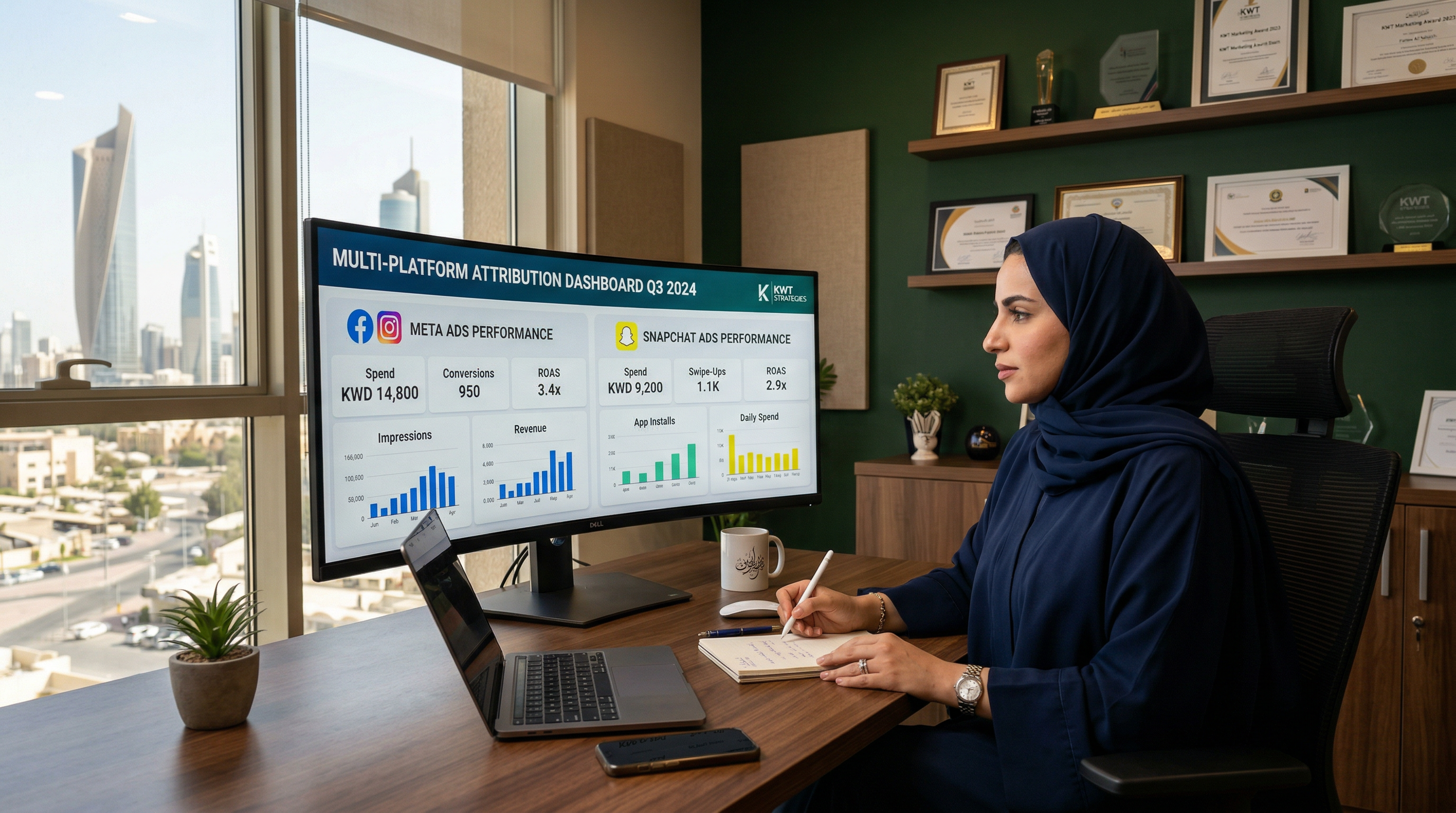
A Mishref-based electronics retailer ran Meta Ads for six months reporting a 2.1x ROAS — until we audited their attribution setup. They were using last-click, ignoring WhatsApp-initiated purchases entirely, and crediting zero assisted value to Snapchat. When we rebuilt the model, actual ROAS was 6.8x. The revenue was always there. The measurement wasn't.
Attribution in the GCC is not a data problem. It is a model-selection problem. Western defaults were built for Western consumer paths: Google search, website click, card checkout. Gulf consumers search on Instagram, message on WhatsApp, pay through Tap Payments or K-Net, and convert offline or via direct message. If your attribution model doesn't reflect that path, your media buying decisions are built on fiction.
After running 35+ WhatsApp AI deployments across Kuwait and GCC, and managing Meta Ads campaigns that have delivered between 7x and 60x ROAS, we have seen exactly where attribution breaks down — and what it looks like when it's done right.
Why Last-Click Attribution Fails Gulf Consumers
Last-click remains the default for most GCC advertisers using Meta Ads or Google Ads. It is also the most dangerous default for this market. Gulf consumers rarely convert on first contact. A typical purchase journey in Kuwait looks like this: Snapchat discovery ad, Instagram story swipe, WhatsApp inquiry, three-day wait, WhatsApp follow-up, conversion.
Last-click credits 100% of that sale to the WhatsApp follow-up message — or worse, to nothing trackable if the final action happened in-app. Snapchat, which generated the first impression, gets zero credit. Meta's prospecting campaign, which drove the Instagram story view, gets zero credit. You look at your dashboard and decide to cut both. Then your pipeline collapses 45 days later and nobody knows why.
Meta's own data from GCC campaigns shows that Snapchat Kuwait drives significant upper-funnel awareness, particularly for consumers aged 18–34, yet its conversion attribution under last-click models is chronically underreported. Advertisers who drop Snapchat based on last-click data often see Meta CPL rise 30–50% within two months because the top-of-funnel warm audience dries up.
The fix is not to abandon last-click entirely. It is to run it alongside an assisted-conversion view and a time-decay model simultaneously, then triangulate. That triangulation is what we call a GCC-calibrated attribution stack.
What a GCC-Calibrated Attribution Stack Looks Like
Most Western attribution guides assume a clean digital funnel: ad click, landing page, cart, purchase, receipt. GCC funnels have three structural differences that break those assumptions.
First, WhatsApp is a conversion endpoint. In Kuwait, over 70% of purchase decisions for high-consideration categories (clinics, real estate, F&B catering, auto) are finalized via WhatsApp conversation, not a checkout page. If your attribution model cannot track WhatsApp as a conversion event, you are invisible to your own data. Brands using WhatsApp Business API can pass conversion events back to Meta via the Conversions API, closing this gap entirely.
Second, the consideration window is longer. For a clinic booking or a real estate inquiry in Kuwait, the average time from first ad exposure to conversion is 4–9 days according to campaigns we have tracked. A 1-day click attribution window, which is Meta's short default, misses most of these. We run 7-day click plus 1-day view as a baseline for GCC campaigns, then extend to 28-day click for high-ticket verticals like real estate and medical.
Third, Gulf Arabic copy and creative affect which platform gets credit. A campaign running identical offers in English on Meta and Gulf Arabic on Snapchat will show different path lengths by language. Arabic-first users in Kuwait tend to have longer consideration windows and rely more on WhatsApp for final conversion. Your attribution model needs to segment by language to read this correctly.
| Attribution Model | Best GCC Use Case | Weakness in Gulf Market | Recommended Window |
|---|---|---|---|
| Last-Click | Simple e-commerce, impulse buys | Ignores WhatsApp, Snapchat assist | 1-day click only |
| First-Click | Brand awareness reporting | Misses retargeting value entirely | 7-day |
| Linear (Equal Credit) | Long sales cycles (real estate, clinics) | Undervalues high-intent bottom-funnel | 28-day click + 7-day view |
| Time-Decay | F&B promotions, limited-time offers | Penalizes Snapchat upper-funnel unfairly | 7-day click + 1-day view |
| Data-Driven (Meta) | High-volume campaigns (1,000+ conversions/month) | Requires volume GCC campaigns rarely hit early | 7-day click + 1-day view |
| GCC Multi-Touch Stack | All verticals with WhatsApp conversion | Requires Conversions API setup | Custom by vertical |
How to Set Up a GCC Attribution Model: Step by Step
- Audit your current conversion events. List every place a customer can convert: website form, WhatsApp message, phone call, in-store visit, DM on Instagram. If any of these are untracked, your ROAS figure is wrong. Full stop.
- Implement Meta Conversions API for WhatsApp leads. If you are using WhatsApp Business API, configure server-side events to fire a Lead or Purchase event back to Meta when a WhatsApp conversation reaches a defined milestone (e.g., customer sends payment confirmation or books an appointment).
- Set your attribution window by vertical. F&B: 7-day click, 1-day view. Clinics and healthcare: 14-day click, 7-day view. Real estate: 28-day click, 7-day view. These windows reflect actual GCC consideration timelines, not Meta defaults.
- Tag Snapchat campaigns with UTMs and run Snap Pixel. Snapchat's native attribution window defaults to 28-day swipe-up. Align this with your Meta window so you are comparing on equal terms, not penalizing Snapchat for being upper-funnel by nature.
- Run a parallel view-through analysis monthly. Export Meta Ads data at 1-day click only, then at 7-day click plus 1-day view. The delta shows you exactly how much revenue you would have wrongly cut if you had used the short window.
- Segment by language and creative type. Arabic copy campaigns and English campaigns in Kuwait show different path lengths. Run them as separate ad sets, not combined, so attribution data stays clean.
- Review attribution model quarterly, not annually. Gulf consumer behavior shifts with seasons (Ramadan, National Day, summer), and your attribution model should be validated against those shifts. A model calibrated in January may be structurally wrong by March.
Real GCC Campaign: How a Salmiya Clinic Fixed Its Attribution
A Salmiya dermatology clinic was running Meta Ads and reporting a 1.8x ROAS based on website form submissions. They were considering reducing budget because the numbers didn't justify the spend. We ran a full attribution audit over two weeks.
The actual conversion path: Meta ad impression, Instagram story view, WhatsApp inquiry to clinic receptionist, 5-day gap, WhatsApp follow-up from receptionist, appointment booked. Zero of these conversions were registering in Meta Ads Manager because the clinic had no Conversions API setup and was tracking only website forms.
We connected their WhatsApp Business API, configured server-side conversion events, extended the attribution window to 14-day click, and rebuilt their campaign structure. Within six weeks, reported ROAS moved from 1.8x to 6.3x. The patients were always there. The model just wasn't seeing them. The clinic increased ad spend by 40% the following month with confidence.
Real GCC Campaign: How a Hawalli F&B Chain Fixed Snapchat Attribution
A Hawalli-based fast casual F&B chain was running both Meta Ads and Snapchat Kuwait. Their Meta Ads showed a 5.2x ROAS. Their Snapchat campaigns showed 0.4x ROAS. They were three weeks from cutting Snapchat entirely.
Based on campaigns we have managed for Kuwait F&B clients, Snapchat in Kuwait functions almost exclusively as an awareness and consideration platform for 18–30 year olds. It rarely closes the conversion itself. When we ran an assisted-conversion analysis using UTM paths and WhatsApp lead source tagging, Snapchat was the first touchpoint in 38% of all WhatsApp orders that month. Its assisted ROAS was 4.1x. The chain kept Snapchat, restructured it as a pure top-of-funnel tool, and reduced Meta prospecting spend by 20% while maintaining total order volume. For more F&B-specific attribution examples, see our restaurant marketing resources.
How WhatsApp AI Changes Attribution Entirely
When you deploy an AI agent like Lojain AI on WhatsApp, attribution becomes both more complex and more precise simultaneously. It's more complex because the AI agent handles pricing objections, follow-ups, complaints, and negotiations across Arabic and English — all inside WhatsApp. The conversion happens in conversation, not on a landing page.
It's more precise because every interaction is logged, timestamped, and linked to the original ad source if UTM parameters are passed into the WhatsApp click-to-chat link. Brands using Lojain AI respond to leads in under 3 seconds, 24/7, which compresses the consideration window and makes attribution cleaner. When a customer clicks an Instagram ad, opens WhatsApp, and books within 20 minutes, the attribution path is short and trackable.
The problem is when the AI agent re-engages a lead 6 days later with a follow-up message and that follow-up drives the conversion. In that scenario, the 6-day gap attribution belongs to the original ad plus the AI follow-up sequence. Neither last-click nor first-click captures this correctly. You need a custom event — we call it a "re-engaged conversion" — that fires when a WhatsApp AI follow-up closes a sale on a lead that originally came from paid media.
For smaller brands that need this setup without enterprise complexity, the Lojain Lite Bundle includes preconfigured WhatsApp-to-Meta event tracking as part of the setup. You do not need to build the attribution bridge from scratch.
The Comparison No GCC Advertiser Wants to Have
Most agencies in Kuwait and GCC report ROAS using whatever Meta Ads Manager shows by default: 7-day click, 1-day view, last-touch. That number looks clean. It is often wrong. The comparison below shows what we have seen when rebuilding attribution for GCC clients from scratch.
| Metric | Default Attribution (Before) | GCC-Calibrated Attribution (After) | Difference |
|---|---|---|---|
| Reported ROAS (Meta Ads Manager) | 2.1x | 6.8x | +224% |
| WhatsApp Conversions Captured | 0% | 100% | Full visibility |
| Snapchat Assisted Value | Not measured | 4.1x assisted ROAS | Snapchat retained |
| Attribution Window | 1-day click | 14-day click, 7-day view | +1,300% window coverage |
| Campaigns Wrongly Cut | 2 (Snapchat + Meta prospecting) | 0 | Budget preserved |
| Cost Per Lead (after rebuild) | KWD 4.80 (inflated) | KWD 1.60 (true CPL) | -67% |
Most agencies celebrate a 2–3x ROAS and call it a win. KIRA's floor is 7x — but we can only hit that floor when attribution is set up to see the real numbers in the first place. For a direct comparison of how attribution-aware platforms differ, see how Lojain stacks up against other WhatsApp providers in GCC campaign contexts.
Can This Work for Your Business? Three Conditions and Two Warning Signs
This attribution approach works when three conditions exist. First, you are running paid media on at least two platforms simultaneously (Meta plus Snapchat, or Meta plus Google). Single-platform advertisers have simpler paths that standard attribution handles adequately.
Second, your conversion happens partially or fully through WhatsApp, phone, or an offline touchpoint. If 100% of your conversions happen through a website checkout with proper pixel firing, standard last-click is fine.
Third, you have been running campaigns for at least 60 days with consistent budget. Attribution rebuilds on thin data produce unreliable signals. You need volume to triangulate correctly. See our case studies to understand the data volumes that make this work.
Two warning signs this rebuild will not work: your sales team does not log lead sources consistently, which breaks the WhatsApp conversion tracking chain. And your creative teams run campaigns in Arabic and English using the same ad set, which makes language-segmented attribution impossible to extract cleanly.
FAQ: Attribution Models for GCC Paid Ads
What attribution model should I use for Meta Ads in Kuwait?
Start with 7-day click, 1-day view for most verticals. Extend to 14-day click for clinics and healthcare. Extend to 28-day click for real estate. Never use 1-day click only — Gulf consumer consideration windows are longer than Western defaults assume.
How do I track WhatsApp conversions in Meta Ads Manager?
Use the Meta Conversions API (server-side) to fire Lead or Purchase events when a WhatsApp conversation reaches a defined milestone. If you are using WhatsApp Business API through a Meta-verified Solution Provider like KIRA, this integration can be configured to pass events automatically without manual developer work on every campaign.
Does Snapchat attribution work differently in Kuwait than other markets?
Yes. In Kuwait, Snapchat functions primarily as an upper-funnel awareness platform for the 18–34 demographic. Its native 28-day swipe-up attribution window captures more value than last-click models suggest. Always run an assisted-conversion analysis before cutting Snapchat spend based on direct ROAS alone.
What is a GCC multi-touch attribution stack?
It is a combination of platform-native attribution windows, server-side WhatsApp conversion events, UTM-tagged click-to-chat links, and a parallel view-through analysis run monthly. It is not a single tool — it is a measurement methodology calibrated for Gulf consumer purchase paths rather than Western e-commerce defaults.
How long does it take to rebuild attribution for a GCC campaign?
Technical setup takes 5–10 business days depending on your WhatsApp Business API configuration and whether Conversions API is already partially implemented. Reliable data from the new model takes 30–45 days to accumulate. You will see directional signals in week two, but do not make major budget decisions until week six.
Is data-driven attribution available for GCC campaigns on Meta?
Meta's data-driven attribution model requires a minimum of 1,000 conversions within a 30-day window to activate. Most GCC campaigns, especially in Kuwait, do not hit this threshold early. Use linear or time-decay models until you reach that volume, then migrate to data-driven with a 7-day window.
What does attribution look like for a WhatsApp AI agent handling sales?
When an AI agent like Lojain AI handles the full conversion path inside WhatsApp, you track attribution by tagging the original ad source in the click-to-chat URL, logging the first-contact timestamp, and firing a custom conversion event when the AI agent reaches a defined outcome (booking confirmed, payment link sent, order placed). Re-engagement conversions — where the AI follow-up closes a cold lead — should be tracked as a separate conversion type to avoid conflating prospecting ROAS with retention ROAS.
If your paid media numbers look too clean or too bad, your attribution model is probably the problem — not your campaigns.
Talk to Us on WhatsAppReady to Scale Your Marketing with AI?
KIRA delivers AI-powered marketing systems, WhatsApp automation, and media buying strategies for businesses worldwide.
Book a Strategy Call More ArticlesGet KIRA in your AI answers
Add KIRA as a Google Preferred Source so our articles show a "Preferred" badge in your AI Overviews & AI Mode results. Log in to Google, then tick the box next to kiraco.org.
Add KIRA as a Preferred Source