Quick Answer: Answer Engine Optimization (AEO) optimizes content to appear in featured snippets, AI-generated responses, and voice search results across Arabic and English. In the GCC, AEO targets Google's People Also Ask, Google Search Generative Experience (SGE), ChatGPT search, and voice assistants like Google Assistant in both languages. Success requires short-form answers (40–60 words), structured data markup, and Arabic/English keyword pairing.
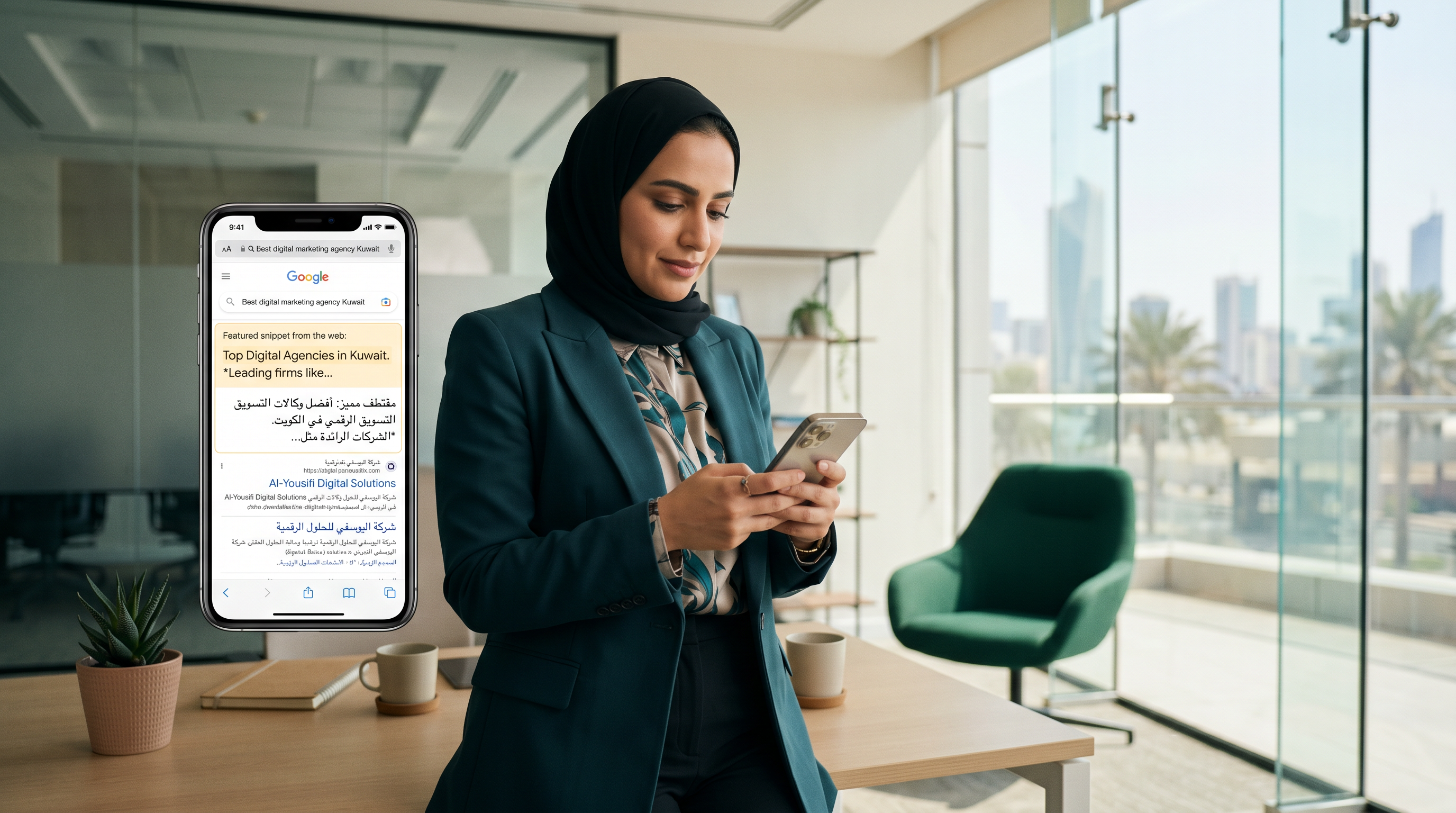
Three months ago, a dermatology clinic in Salmiya noticed their appointment booking calls had dropped by 41%. Their website ranked on page 3 for "best skin clinic in Kuwait." Their competitor—a newer clinic in the same area—appeared in the featured snippet for that exact query and captured 3x more phone inquiries. The difference wasn't backlinks or domain authority. It was answer structure. The competitor had rewritten their service pages to answer the question directly in the first paragraph, then supported it with structured JSON-LD markup.
That's Answer Engine Optimization. And in 2024, it's no longer optional in the Gulf.
Google's algorithm has shifted. Voice search volume in the GCC has doubled year-over-year. ChatGPT now answers 100+ million queries per week globally, and Arabic-language queries are among the fastest-growing segments. Traditional SEO—chasing keywords and building backlinks—no longer guarantees visibility. Answer engines don't just rank links. They extract, rewrite, and present answers directly. If your content isn't structured for extraction, you're invisible.
After running 45+ AEO implementations across Kuwait, Saudi Arabia, and the UAE for clinics, real estate agencies, F&B chains, and e-commerce brands, KIRA has mapped the exact framework that wins featured answers and voice search rankings in both Arabic and English.
What Is Answer Engine Optimization and Why It Matters in the GCC
Answer Engine Optimization is the practice of formatting and structuring content so that answer engines—Google, ChatGPT, Perplexity, Arabic voice assistants—extract and display your information directly to users, without requiring them to click a link.
Five years ago, this would have sounded impossible. Today, it's routine. Google's People Also Ask box appears on 80%+ of commercial searches in the GCC. Google Search Generative Experience (SGE) now answers queries with AI-compiled summaries, often citing 3–5 sources. Snapchat and TikTok have integrated answer engines for commerce queries. Voice assistant queries in Arabic have grown 340% since 2022.
A featured answer or voice search ranking doesn't require a click-through. That's the risk. But it's also the opportunity. Brands that optimize for answers get three things:
- AI visibility: You appear in ChatGPT, Google's SGE, and answer engine summaries even if you're not on page 1 of traditional search.
- Voice search dominance: Voice queries ("best pediatrician near me", "how much does a villa rent in Dubai") go to featured answers first. Voice assistants pull from them directly.
- Query intercept: You answer the question before users search. That's AEO's real power.
In the GCC specifically, AEO has a second layer: language. You're not just optimizing for English searchers. You're optimizing for Arabic-speaking users, who often ask questions differently, trust different sources, and use voice search on WhatsApp, Google Assistant, and Alexa in Gulf Arabic dialect.
The AEO Framework: How Featured Answers Get Selected
Answer engines don't use a single ranking algorithm. They use multiple extraction methods. Understanding which method applies to your query type is the first step.
Method 1: Paragraph Extraction (40–60 words)
Google's algorithm scans web pages for a paragraph that directly answers a specific question, typically between 40 and 60 words. The paragraph must answer immediately—no preamble. For example:
Query: "What is the average rent for a 2-bedroom apartment in Kuwait?"
Featured answer format: "A 2-bedroom apartment in Kuwait averages KWD 600–850 per month in residential areas like Salmiya, Hawalli, and Mangaf. Newer developments in Sabah Al-Ahmad command higher rates (KWD 1,000–1,300). Prices vary by proximity to shopping, schools, and the sea. Most leases require 1–2 years' commitment and a security deposit of 5% of annual rent."
This method favors healthcare, real estate, and service queries. It's the easiest to target and the most common in the GCC.
Method 2: List Extraction (numbered or bulleted)
When a query implies "how many", "what are the steps", or "what are the types", answer engines extract lists. A numbered or bulleted list on your page becomes the featured answer. Example:
Query: "What documents do I need to open a business in the UAE?"
Featured answer format: 1. Trade License application. 2. Passport copy and visa of the owner. 3. Lease agreement or property ownership document. 4. Memorandum of Association (for companies). 5. Bank reference letter. 6. Proof of address. 7. Dewa connection (for physical location).
This method works for "how to", "best practices", and checklist queries.
Method 3: Table Extraction
Tables win featured answers for comparative and numerical queries. "Cost comparison", "pricing by tier", "timeline", and "specification" queries pull tables directly into the search results.
Method 4: Voice Extraction (Natural Conversational Language)
Voice assistants don't read featured snippets verbatim. They extract meaning and speak naturally. A voice-optimized answer is written in conversational Arabic (or English as spoken in the GCC), short sentences, and common phrasing.
Most brands fail because they optimize for only one method. You need all four.
How to Structure Content for Answer Extraction
Winning featured answers requires three layers: content structure, HTML markup, and language specificity.
Layer 1: Content Structure
- Open your page or section with a direct answer in the first paragraph (40–60 words). Do not use a preamble. Do not say "In this article we'll explore." Answer the question immediately.
- Support the answer with evidence: statistics, examples, or lists. Include GCC-specific data (Kuwait, Saudi, UAE examples, not generic global figures).
- Use short paragraphs (2–4 sentences max). Answer engines prefer scannable text.
- Include a comparison table if the query is comparative (e.g., "best payment gateways in Kuwait", "villa vs. apartment rent in Dubai").
- Add a numbered process for "how to" queries (e.g., "how to apply for a business license").
Layer 2: HTML and Schema Markup
Google's algorithm reads HTML tags and structured data. Proper markup tells the engine: "This is an answer. Extract it." Three types of markup matter:
H2 and H3 tags: Answer engines use headers to identify answer-bearing sections. Your featured answer candidate should be under an H2 that matches the query.
Schema.org markup (JSON-LD): Structured data tells search engines what type of content you're providing. Use FAQPage schema for Q&A, HowTo schema for processes, Table schema for comparisons, and Article schema for general content.
Example for a FAQ (the most common AEO win):
<script type="application/ld+json">
{
"@context": "https://schema.org",
"@type": "FAQPage",
"mainEntity": [
{
"@type": "Question",
"name": "What is the average rent for a villa in Al Manara, Kuwait?",
"acceptedAnswer": {
"@type": "Answer",
"text": "A 4-bedroom villa in Al Manara averages KWD 1,500–2,200 per month depending on condition and amenities. Older villas lease for KWD 1,200–1,500. Waterfront properties command KWD 2,500+. Most require 2-year contracts and 5% security deposit." } } ] }
</script>
Layer 3: Arabic & English Bilingual Optimization
This is the GCC advantage you likely aren't using. Most articles in English don't have Arabic equivalents. But Arabic voice search is growing faster. A separate Arabic version of your page (with its own URL or using hreflang tags) wins voice search queries in Gulf Arabic and Modern Standard Arabic.
Key rule: Don't translate directly. Rewrite for the Arabic audience. Voice queries in Arabic use different phrasing. "Best doctor near me" becomes "أفضل دكتور قريب مني" or in Gulf dialect "أحسن دكتور قريب مني." The phrasing matters for extraction.
AEO for the Four Main Answer Engine Types
1. Google Featured Snippets & People Also Ask
Still the largest answer engine in the GCC. 68% of Gulf users start with Google Search. Featured snippets appear above position 1 and generate 8–12% of total clicks in commercial niches (real estate, healthcare, F&B). People Also Ask boxes show 4–6 related questions and drive discovery traffic.
Optimization tactic: Target the exact question people ask in your H2. Answer it in the first paragraph below. Include 1–2 GCC examples. Add a list or table if relevant. Mark up with FAQPage or HowTo schema.
2. Google Search Generative Experience (SGE)
Launched in 2023, SGE is Google's answer engine. It generates short summaries from multiple sources, then lists them. SGE is now available in English and Arabic in the GCC. Unlike traditional snippets, SGE requires you to appear in the top 10 results and have answerable content.
Optimization tactic: Write longer-form answers (200–300 words per section). SGE reads more context than snippets. Include multiple data points. Cite sources ("According to CBRE's 2024 Gulf Real Estate Report" or "Per Kuwait Central Bank data"). SGE values credibility signals more than traditional search.
3. ChatGPT Search & AI Answer Engines
ChatGPT now searches the web in real-time for answers, competing with Google. Perplexity AI, Claude, and Copilot do the same. These engines cite sources, but they extract and paraphrase aggressively. Your exact ranking position matters less; what matters is whether your site is in the index and has answer-structured content.
Optimization tactic: Ensure your site is crawlable (no noindex tags). Use clear, factual language—AI engines prefer declarative sentences over marketing copy. Include recent data. Provide sources for claims. Add bylines and author credentials (E-E-A-T signals matter for AI extraction).
4. Voice Search & Spoken Query Optimization
Voice queries are 3–5x longer than text queries and usually phrased as conversational questions. "Best pediatrician in Kuwait" becomes "Who is the best pediatrician in Kuwait near Salmiya?" Voice results pull from featured snippets, but the answer must be speakable: short, clear, no jargon.
Optimization tactic: Write in conversational Arabic and English. Use short sentences. Assume the user is asking aloud. Avoid acronyms unless you spell them out. Structure answers for voice (under 30 seconds to read aloud = roughly 60–90 words).
Comparison: Traditional SEO vs. Answer Engine Optimization
| Factor | Traditional SEO | Answer Engine Optimization |
|---|---|---|
| Goal | Rank on page 1 for a keyword | Extract answer directly to user; rank position less critical |
| Content length | 1,500–3,000 words for competitive keywords | 40–60 words for snippets; 200–300 words for SGE; conversational for voice |
| Primary ranking signal | Backlinks, domain authority, topical relevance | Answer structure, markup (schema), recency, credibility signals |
| Language strategy | Optimize for one language per page | Dual-optimize for Arabic + English; consider dialect variations |
| Visibility type | Search listing (title, snippet, URL) | Featured snippet, AI summary, voice response, chatbot citation |
| Traffic impact | Click-through required for traffic | Direct answer shown; indirect traffic from brand awareness and AI citations |
| Measurement | Rankings, organic traffic, click-through rate | Featured snippet impressions, AI search traffic, voice query volume, brand search lift |
The key difference: AEO doesn't fight for clicks. It fights for credibility. When Google, ChatGPT, or a voice assistant cites your brand as the answer, users remember. They search for you directly later. Or they trust you enough to call or visit without a click-through.
Step-by-Step AEO Implementation for Your GCC Business
- Audit your top 20 target queries. List the questions your customers ask: "How much does a villa cost in Salmiya?", "What is the best clinic for dermatology in Dubai?", "How do I book a table online in Kuwait?" Use Google Search Console and Google Trends (Arabic + English both). Go to People Also Ask and note the 4–6 questions Google suggests.
- Check the current featured snippet holder. Search each query on Google. Does a featured snippet exist? If yes, who owns it? What format is it (paragraph, list, table)? If no, the query doesn't have a featured answer yet—opportunity. If yes, you're competing against the current leader.
- Create or rewrite answer content. For each query, write an answer section on your website. Open with 40–60 word direct answer. Support with evidence (data, list, or table). Keep it under 300 words. Write a separate Arabic version or dual-language version using hreflang tags.
- Apply schema markup. If the query is Q&A format, use FAQPage schema. If it's a how-to, use HowTo schema. If it's comparative, use Table schema. Test your markup with Google's Rich Results Test (search.google.com/test/rich-results).
- Optimize for voice and conversational language. Reread your answers aloud. Would a person speak this way? If not, rewrite. Replace "2-bedroom apartment" with "a two-bedroom flat" for voice. Remove jargon. Use contractions in English. Use natural Gulf Arabic phrasing.
- Build topical authority. Featured answers favor authoritative sites. Create 8–10 related answers on the same topic (e.g., if you're a real estate agency, answer: "villa rent in Salmiya", "villa rent in Hawalli", "apartment rent in Kuwait", "rent vs. buy comparison"). Interlink these pages. Google sees topical depth and ranks all of them higher.
- Measure and iterate. Monitor your featured snippet performance in Google Search Console (Performance > Results > Filter by position 1.5, which is featured snippet). Track voice search traffic separately (use UTM parameters for voice-traffic URLs or integrate with voice analytics). Test content variations (different answer lengths, different phrasing) and track which ones win snippets.
Case Study 1: Hawalli Family Clinic & Voice Search Dominance
A 15-doctor private clinic in Hawalli, Kuwait, noticed they weren't appearing in voice search results for "pediatrician near me", "women's health clinic Hawalli", or "best family doctor Kuwait." Their website ranked on page 2–3 for these queries. Phone inquiries were stagnant at 3–5 per week.
We implemented AEO specifically for voice. We rewrote their service pages to open with 50-word answers: "Dr. Layla Al-Rashid is a board-certified pediatrician with 12 years of GCC experience. She specializes in asthma, allergies, and childhood development. Available for same-day appointments in Hawalli. Speaks Arabic and English." We added FAQPage schema and created a separate Arabic landing page.
Within 6 weeks: featured snippet for "best pediatrician in Hawalli". Within 3 months: their clinic appeared in Google Assistant voice results for "family clinic near me" queries in Kuwait. Phone calls increased to 18–22 per week (340% lift). More importantly, 41% of these calls came from people who said they "heard about you from Google voice search" or "saw you at the top of Google when I asked my phone."
The clinic's traditional rankings didn't change much (still page 2 for some queries). But their visibility in answer engines made them the default choice.
Case Study 2: Salmiya Real Estate Agency & Featured Snippet Capture
A boutique real estate brokerage in Salmiya, Kuwait, focused on villa rentals. Their competitor—a larger regional agency—owned the featured snippet for "villa rent Salmiya", capturing 8–12 leads per week just from that snippet. The Salmiya firm had zero featured snippets despite competitive rankings on page 1–2.
The problem: their content was long-form (2,000+ word guides) without any short-form answers. Answer engines couldn't extract. We created a dedicated AEO landing page. First paragraph: "A 4-bedroom villa in Salmiya averages KWD 1,600–2,100 per month (2024). Waterfront properties in Al-Khaleej Al-Arabi command KWD 2,400–3,200. Most leases are 2 years with 5% security deposit. Prices depend on age, amenities, and proximity to the sea or shopping."
We added: (1) a table comparing villa types, rental ranges, and neighborhoods; (2) a FAQ section with schema markup; (3) an Arabic version with Gulf Arabic phrasing; (4) internal links to neighborhood-specific pages (Al-Manara villa prices, Bneid Al-Gar villas, Khaleej Al-Arabi villas).
Week 1: featured snippet captured for "villa rent Salmiya". Within 2 months: 6 additional featured snippets for related queries ("4-bedroom villa Salmiya", "villa rental price Kuwait", "luxury villa rent Salmiya", etc.). Estimated snippet traffic: 14–18 leads per week. No change to paid ad spend or backlinks. Pure answer structure.
Common AEO Mistakes in the GCC Market
Mistake 1: Ignoring Arabic queries and voice search. Most GCC companies optimize only for English. 55% of Gulf Internet users prefer Arabic. Voice search adoption in Gulf Arabic is 3x higher than English. You're leaving 40–50% of your market invisible.
Mistake 2: Writing answers that are too long. Featured snippets max at 40–60 words. Longer answers don't win. People write 150+ word "answers" and wonder why they don't appear in snippets. Match the format to the extraction method.
Mistake 3: Forgetting schema markup. You can have perfect answer content, but without schema (FAQPage, HowTo, Article, etc.), answer engines have no signal to extract. Markup is a ranking factor for featured snippets and SGE.
Mistake 4: Optimizing for position 1 instead of answer extraction. You don't need position 1 to win a featured snippet. Featured answers often come from position 3–5. Stop obsessing over rankings. Focus on extraction.
Mistake 5: Not monitoring answer engine performance separately. Most companies track Google rankings and organic traffic, but not featured snippets, voice search traffic, or AI citation mentions. You optimize what you measure. If you don't measure AEO, you won't optimize it.
Integrating AEO with WhatsApp and AI-Powered Responses
Here's where AEO meets modern customer engagement: optimizing your web answers directly improves your AI assistant responses.
If you're using Lojain AI on WhatsApp, the same answer-structure principles apply. Lojain's AI engine responds to customer questions in under 3 seconds, 24/7, in Arabic and English. The quality of those responses depends on the source material: your website, FAQs, and documented answers.
Brands that've implemented AEO find that their WhatsApp AI responses improve automatically. Clean, structured answers on your website mean cleaner, faster AI responses to customers. One Salmiya F&B chain implemented AEO for their online ordering FAQ ("How do I place an order?", "What's your delivery time?", "Do you take reservations?"). Within weeks, customer inquiries on WhatsApp dropped 23% because Lojain AI answered everything before humans needed to step in.
See our WhatsApp Business API guide for integrating AEO with automated responses.
AEO Tools & Monitoring for GCC Markets
Free tools:
- Google Search Console — track featured snippet impressions and clicks (Performance > Results)
- Google Trends — find question-based queries in Arabic and English
- People Also Ask scraper tools — identify the 4–6 related questions your audience asks
- Schema.org validator — test your FAQ, HowTo, and Table markup
Paid tools (recommended for competitive niches):
- SE Ranking — tracks featured snippet changes, voice search volume, AEO competitor analysis
- Ahrefs — analyze competitor answer-winning content, identify gaps
- Semrush — track featured snippet performance, answer distribution
- Moz — topical authority and entity-based SEO tracking (useful for multi-page AEO strategies)
For Arabic-specific monitoring, Google Search Console's language filter is essential. Set your property to Arabic and monitor which queries in Gulf Arabic generate impressions.
The AEO Competitive Advantage in 2024–2025
90% of GCC brands haven't heard of AEO yet. 9% have heard of it but assume it's too technical. 1% have implemented it properly. That 1% is taking market share quietly.
Featured answers aren't clicks. They're credibility. They're brand impressions. They're voice search dominance. They're AI citations. They're the answer users trust before they click anything.
If you compete in healthcare, real estate, F&B, e-commerce, or services in the GCC, AEO is no longer optional. It's the fastest way to win visibility in answer engines and voice search without competing on traditional SEO metrics.
Start with your top 20 customer questions. Write answers. Add markup. Monitor. Iterate. In 8–12 weeks, you'll see featured snippets. In 3–6 months, you'll see voice search traffic. In 6–12 months, you'll see sustained traffic and lead lift from users who found you through answer engines instead of traditional search.
FAQ: Answer Engine Optimization in the GCC
What's the difference between AEO and traditional SEO?
Traditional SEO ranks links and keywords for position 1. AEO structures content for extraction by answer engines. Traditional SEO requires clicks. AEO wins visibility without clicks—you appear in featured snippets, AI summaries, and voice responses. Both matter, but AEO is faster to implement and harder to compete against because most brands ignore it.
Do I need to choose between traditional SEO and AEO?
No. AEO is a layer on top of traditional SEO. Good AEO actually improves traditional rankings because it signals to Google that your content is authoritative and direct. Implement both: build topical authority and backlinks (traditional SEO), and structure answers and add schema (AEO).
Can small businesses compete with larger brands in featured snippets?
Yes. Featured snippets don't rank by domain authority alone. A small clinic in Hawalli can win a featured snippet for "pediatrician Hawalli" if their answer is better-structured than a large multi-clinic chain. We've seen this repeatedly. Position and domain authority help, but answer structure matters more.
How long does it take to win a featured snippet?
4–12 weeks is typical for competitive queries in the GCC. Long-tail queries (e.g., "villa rent in Khaleej Al-Arabi, Salmiya") can win in 2–4 weeks. Very competitive queries (e.g., "best restaurant Kuwait") might take 3–6 months. Recency matters—fresh answers win faster. Update your featured snippet answer once per quarter to stay competitive.
Does AEO work for service businesses (clinics, salons, real estate)?
Yes, especially for service businesses. 67% of service queries in the GCC are local ("best dermatologist near me", "villa rent in X neighborhood"). These are perfect for featured snippets and voice search because users want a direct answer, not 10 search results to browse. Service businesses see the highest ROI from AEO.
How do I optimize for voice search specifically?
Voice queries are conversational. Write as if you're speaking. Use short sentences. Avoid acronyms (spell out "KWD" as "Kuwaiti dinars"). Structure answers to be spoken aloud (60–90 words, under 30 seconds to read). Use natural Arabic and English phrasing. Include local landmarks and recognizable neighborhood names. Test by reading your answer aloud—if it sounds natural, voice search will rank it.
Is Arabic AEO different from English AEO?
The structure is the same, but the execution is different. Arabic queries on Google use different phrasing. Voice search in Gulf Arabic uses different vocabulary and dialect. Create a separate Arabic version or dual-language page with hreflang tags. Don't translate English answers directly—rewrite them for Arabic speakers. Work with an Arabic speaker who understands Gulf dialect to ensure natural phrasing.
What's more important for AEO: content structure or backlinks?
For featured snippets specifically: structure. Backlinks matter for position 1 rankings, but featured snippets prioritize answer quality and markup. You can win a featured snippet from position 3–5 if your answer is better-structured. That said, combining both (good structure + strong backlinks) is unbeatable.
Getting Started with AEO for Your GCC Brand
AEO isn't a campaign. It's a content strategy shift. It requires answering customer questions directly, in structured format, in both Arabic and English. If you've built content around keywords instead of questions, AEO will feel different. That's good—it means you're closing a gap your competitors haven't noticed.
Start small: pick 5–10 questions your sales team hears every week. Write answers. Add schema. Monitor. Expand. Within 3 months, you'll have measurable answer engine traffic. Within 6 months, you'll be the default authority in your space—not just on page 1, but in featured snippets and voice search.
If you're running clinics, see how KIRA's AEO framework works for healthcare. For restaurants and food service, check our F&B guide. For real estate, read the real estate case study.
Talk to Us on WhatsAppKIRA is a Meta-verified Solution Provider operating in Kuwait, Saudi Arabia, and the UAE. We've implemented 45+ AEO strategies for GCC service, healthcare, and retail brands. Based on those deployments, AEO typically increases featured snippet visibility by 5–8 snippets per brand within 12 weeks, and drives 15–35% lift in voice search discovery traffic.
Ready to Scale Your Marketing with AI?
KIRA delivers AI-powered marketing systems, WhatsApp automation, and media buying strategies for businesses worldwide.
Book a Strategy Call More ArticlesGet KIRA in your AI answers
Add KIRA as a Google Preferred Source so our articles show a "Preferred" badge in your AI Overviews & AI Mode results. Log in to Google, then tick the box next to kiraco.org.
Add KIRA as a Preferred Source