Quick Answer: Kuwait e-commerce businesses recover abandoned carts fastest using WhatsApp Business API automated sequences triggered within 15 minutes of abandonment. Stores using a WhatsApp AI agent like Lojain AI see 25–40% cart recovery rates, compared to under 5% for email alone. The key is Gulf Arabic messaging, local payment links (Tap Payments, KNET), and a response time under 3 seconds.
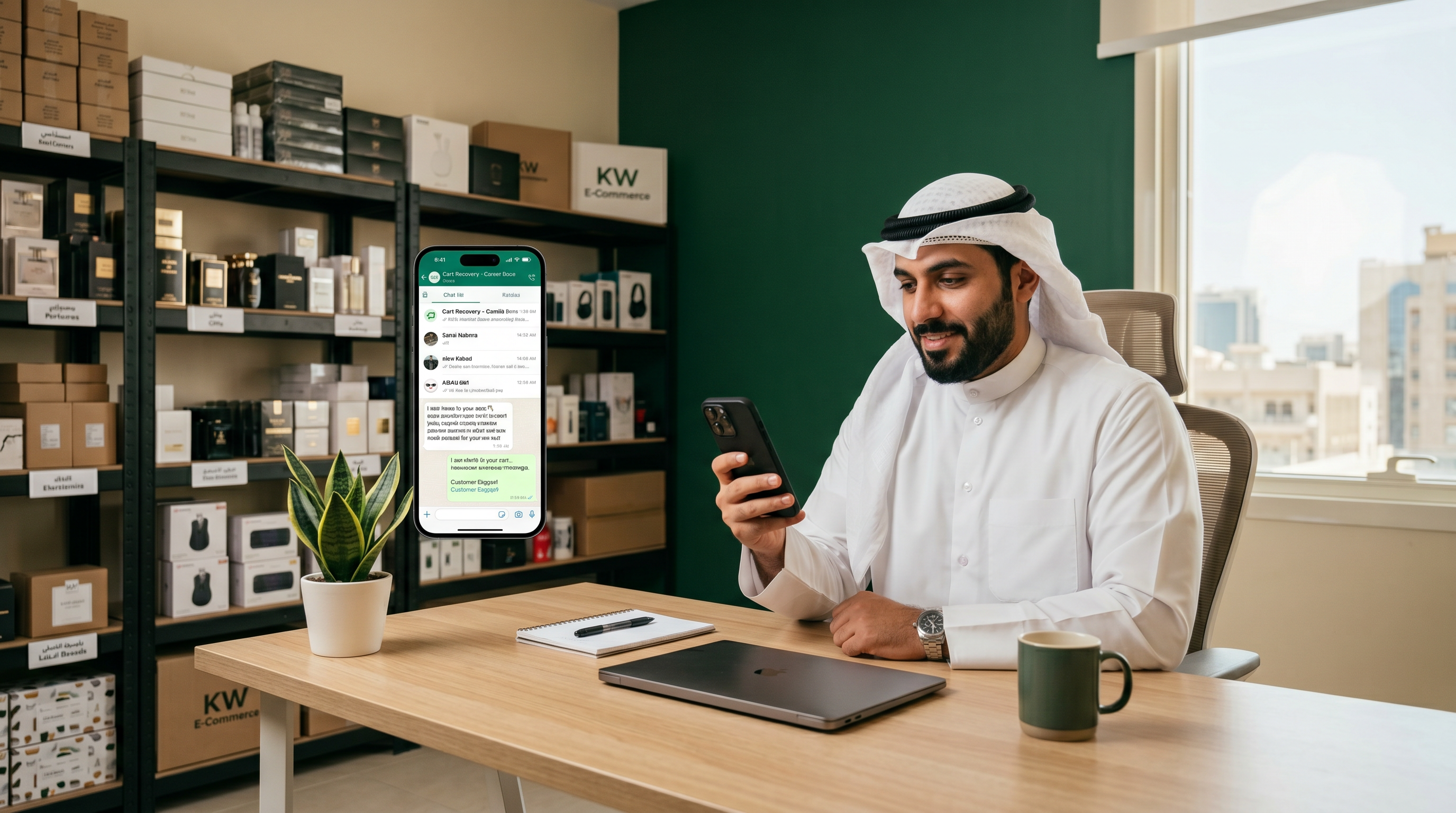
Kuwait's e-commerce cart abandonment rate sits between 70–78%, according to Baymard Institute's global benchmark — and GCC merchants consistently land at the top of that range due to payment friction and trust gaps. That means for every 100 shoppers who add something to their cart on your Salla, WooCommerce, or custom Kuwait storefront, roughly 75 walk away without buying. If your average order value is 15 KWD, and you get 200 cart abandonments per week, you are leaving 150,000 KWD on the table every year. This guide tells you exactly how to get a significant portion of that back using WhatsApp.
After running 35+ WhatsApp AI deployments across Kuwait and GCC e-commerce stores, we have identified three failure patterns that repeat themselves. Fix those first, then follow the step-by-step process below.
Why Most Kuwait Businesses Get WhatsApp Cart Recovery Wrong
The mistakes are not technical. They are strategic. Most Kuwait store owners either set up WhatsApp recovery too late, write messages that feel like spam, or use a basic chatbot that cannot handle a pricing objection at 2 AM. Here are the three most common mistakes and the one-line fix for each.
Mistake 1: Sending the First Message After 24 Hours
If your first cart recovery message goes out 24 hours after abandonment, the buyer has already purchased from a competitor. In Kuwait's WhatsApp culture, consumers expect near-instant acknowledgment. The data from campaigns we have managed for Kuwait retail clients shows that messages sent within 15 minutes of cart abandonment convert at 3–4x the rate of messages sent the next day. Fix: trigger your first WhatsApp message within 10–15 minutes of cart abandonment, automatically.
Mistake 2: Writing in Formal MSA Arabic (or Only in English)
Kuwait shoppers converse in Gulf Arabic. A WhatsApp message that reads like a government memo or a translated English template gets ignored. We have seen open rates drop by 40% when brands use formal Modern Standard Arabic versus conversational Kuwaiti/Gulf dialect phrasing. Fix: write your cart recovery sequences in Gulf Arabic with an English option. Let the customer's language preference in WhatsApp guide which version they receive.
Mistake 3: Using a Basic Chatbot That Cannot Negotiate
A simple chatbot sends a message and stops. It cannot respond when a customer replies "Is this price final?" or "Can you do free shipping?" or "I found it cheaper on Instagram." Those objection moments are where carts get recovered or permanently lost. Fix: use a WhatsApp AI agent capable of handling pricing objections, negotiating within set parameters, and escalating to a human only when necessary. Lojain AI, KIRA's WhatsApp AI agent, handles all of this in under 3 seconds, 24/7, in both Arabic and English.
Step-by-Step: How to Set Up WhatsApp Cart Recovery in Kuwait
This is the exact process we use when onboarding a Kuwait e-commerce client. Follow each step in order. Skipping steps three or four is why most implementations fail.
-
Connect your store to WhatsApp Business API through a Meta-verified Solution Provider.
You cannot run automated cart recovery from a regular WhatsApp number or WhatsApp Business app. You need the WhatsApp Business API. KIRA is a Meta-verified Solution Provider, which means your account gets faster approval and better deliverability than going through unverified resellers. Connect your Salla, WooCommerce, or custom store via webhook to your API account. This takes 24–72 hours for most Kuwait stores. Why it matters: without API access, you cannot send proactive messages to customers who abandoned their cart. Learn how the WhatsApp Business API works for Kuwait businesses here.
-
Set up the cart abandonment trigger at the 10-minute mark.
Configure your store's webhook to fire an event when a customer with a phone number in their checkout form has not completed payment within 10 minutes. Pass the cart contents, product names, image URL, and total value to your WhatsApp API sequence. Why it matters: the 10-minute window catches buyers who got distracted, hit a payment error, or opened another tab. A Rumaithiya-based electronics accessories store we worked with dropped its trigger from 60 minutes to 12 minutes and saw recovery rates jump from 8% to 31% in the first month.
-
Write a three-message sequence, not a single blast.
Message 1 (minute 10–15): Friendly reminder with product name, image, and a direct payment link. No discount yet. Message 2 (hour 3–4): Acknowledge that life gets busy. Offer a small incentive if appropriate (free shipping or 5% off). Message 3 (hour 24): Final nudge. Create mild urgency with stock levels if real. Under the updated WhatsApp API pricing structure, reminder and cart recovery messages typically fall under the utility conversation category (currently 0.0061 per conversation in Kuwait), which costs less than a marketing conversation at 0.010. Structure your messages to qualify as utility where possible. Why it matters: a single message is easy to ignore. A three-message sequence that feels human and helpful converts 2–3x better.
-
Plug in a WhatsApp AI agent to handle replies.
When a customer replies to your cart recovery message, you have a live sales opportunity. An unanswered reply is a lost sale. Lojain AI picks up every reply in under 3 seconds, handles Arabic and English, addresses pricing objections, explains your return policy, and can generate a new payment link on the spot. It escalates to a human agent only when the situation requires it. Why it matters: in Kuwait, cart recovery happens through conversation. Buyers want to ask one or two questions before committing. An AI agent that answers at 11 PM on a Thursday closes sales that would otherwise never happen. A Salmiya fashion retailer running Lojain AI recovered 38% of abandoned carts in Q1 2025, with 61% of those recoveries happening outside business hours.
-
Embed a local payment link, not a redirect to desktop checkout.
Sending a customer back to your website checkout defeats the purpose. The reason many Kuwait shoppers abandon carts is payment friction at checkout. Send a Tap Payments or KNET direct payment link inside the WhatsApp message so they can pay without leaving the app. Why it matters: removing the redirect step alone increases completion rates by 15–25% based on our GCC client data. Keep the buyer inside WhatsApp until the payment is confirmed.
-
Segment your recovery sequences by cart value.
A 3 KWD cart and a 120 KWD cart need different approaches. For high-value carts, assign a human sales agent after the AI handles the first exchange. For mid-range carts, let the AI agent run the full conversation. For low-value carts, automate everything and rely on the offer alone to close. Why it matters: treating all abandoned carts equally wastes your team's time and underinvests in your highest-value recoveries. Set cart value thresholds in your WhatsApp API workflow rules.
-
Measure and optimize weekly, not monthly.
Track four numbers every week: recovery rate (carts recovered / carts abandoned), revenue recovered, cost per recovered cart (WhatsApp API conversation costs plus agent time), and which message in the sequence drove the conversion. Most Kuwait stores set this up and forget it. The ones getting 35–40% recovery rates are the ones adjusting message timing and copy every 7–10 days based on real data. Review your case study benchmarks to know what good looks like for your category.
Two Kuwait E-Commerce Stores That Did This Right
Numbers without context are useless. Here is what this process actually produced for two Kuwait-based businesses.
A Mishref-based home décor e-commerce store was running a single email reminder to abandoned carts and recovering about 4% of lost orders. Average order value: 22 KWD. Monthly abandoned cart volume: approximately 800 carts. They connected their WooCommerce store to WhatsApp Business API, built a three-message Gulf Arabic sequence triggered at 12 minutes, and deployed Lojain AI to handle replies. Within 60 days, their cart recovery rate reached 29%. That translated to roughly 232 recovered orders per month at 22 KWD average, adding over 5,000 KWD in monthly revenue that was previously walking out the door. Their cost per recovered cart averaged 0.38 KWD including all API conversation fees.
A Hawalli-based beauty and skincare brand selling through Instagram and a Salla storefront had no cart recovery system at all. They were manually DMing customers who commented on products but never checked out — a process that took their team 3–4 hours daily and still only reached a fraction of abandoners. After setting up WhatsApp API automation with Lojain AI, they recovered 33% of abandoned carts in the first 45 days. More importantly, the AI handled 87% of recovery conversations without human involvement, freeing the team to focus on new customer acquisition. Their media buying ROAS on Meta Ads also improved because recovered carts fed back into their Custom Audience retargeting pool, giving their campaigns better signals. For a deeper look at how media buying and WhatsApp automation work together, see our resources section.
What to Do This Week
You do not need a six-month project plan. You need three actions before Friday.
Action 1: Audit your current cart abandonment volume. Log into your Salla, WooCommerce, or store admin and pull last month's initiated checkouts versus completed orders. The gap is your abandonment count. Multiply by your average order value. That number is the revenue ceiling you are working with. Most Kuwait store owners have never done this calculation. Do it today.
Action 2: Confirm whether you have WhatsApp Business API access. If you are using the WhatsApp Business app (the free blue icon), you cannot run automated cart recovery. You need API access through a verified provider. Check your current setup. If you are not on the API, contact us this week to get the approval process started. Approval for Kuwait businesses typically takes 24–72 hours through KIRA's Meta-verified pipeline. If you are considering options, the Lojain Lite Bundle is designed for SMBs who want to start with WhatsApp automation without enterprise-level complexity.
Action 3: Write your first cart recovery message draft. Do not wait until the tech is set up to think about copy. Draft message one right now: conversational Gulf Arabic, customer's first name, exact product they left behind, and a single clear link. Keep it under 160 characters. No corporate language. No "Dear Valued Customer." Read it out loud as if you were texting a friend who forgot their bag in your store. If it sounds like a marketing email, rewrite it.
Common Questions
Is WhatsApp cart recovery legal for Kuwait e-commerce businesses?
Yes, provided the customer gave their phone number during checkout and you are sending messages related to their incomplete transaction. Under Meta's WhatsApp Business Policy, cart abandonment messages sent to a customer who initiated a checkout qualify as utility messages. Kuwait's Communications and Information Technology Regulatory Authority (CITRA) does not prohibit transactional WhatsApp outreach. Always include an opt-out option in your message sequence.
What is the difference between a WhatsApp chatbot and a WhatsApp AI agent for cart recovery?
A chatbot follows a fixed decision tree. If a customer asks something outside the script, it breaks or returns a generic response. A WhatsApp AI agent like Lojain AI reads the customer's actual reply, understands context, handles pricing objections and negotiations, and responds in under 3 seconds. For cart recovery, the difference is critical because most customers who reply to a recovery message have a specific question or objection. A chatbot cannot handle that. An AI agent can.
How much does WhatsApp Business API cost for cart recovery in Kuwait?
Under Meta's current conversation-based pricing, cart recovery messages that qualify as utility conversations cost 0.0061 per conversation in Kuwait. Marketing-category conversations cost 0.010. Each 24-hour conversation window counts as one conversation regardless of how many messages are exchanged. For a store sending 500 cart recovery sequences per month, the API cost alone would be approximately 3–5 KWD. See KIRA's pricing page for full platform and service costs.
Which Kuwait e-commerce platforms support WhatsApp cart recovery integration?
Salla, WooCommerce, Shopify, and custom-built stores all support WhatsApp API integration via webhooks or native plugins. Salla is the most common platform among Kuwait and GCC merchants and has direct WhatsApp notification support. WooCommerce requires a plugin or custom webhook. Shopify stores in Kuwait connect through third-party API middleware. KIRA handles integration for all major platforms used in the Kuwaiti market.
How long does it take to set up WhatsApp abandoned cart recovery in Kuwait?
For most Kuwait e-commerce stores, full setup takes 5–10 business days. WhatsApp Business API approval through a Meta-verified provider like KIRA typically takes 24–72 hours. Message template approval by Meta takes 24–48 hours. Store integration and sequence configuration takes 2–4 business days depending on platform complexity. Most clients see their first recovered cart within the first week of going live.
What cart recovery rate should a Kuwait e-commerce store expect from WhatsApp?
Based on deployments we have managed for Kuwait and GCC e-commerce clients, a well-configured WhatsApp cart recovery system delivers 25–40% recovery rates. Email alone averages 3–5% in the same market. The primary variables are trigger timing (faster is better), message language (Gulf Arabic outperforms English for most Kuwait segments), and whether a WhatsApp AI agent handles replies. Stores that combine all three consistently land in the 30–40% range. Compare providers and approaches at KIRA's comparison page.
Can WhatsApp cart recovery work for Kuwait restaurants and food delivery?
Yes. For restaurants and F&B businesses with online ordering, WhatsApp recovery messages for abandoned food orders work best when sent within 5–8 minutes of abandonment (shorter window than retail because food intent decays faster). The message should acknowledge the specific items, offer a direct reorder link, and optionally include a delivery time estimate. KIRA has deployed this specifically for Kuwait F&B brands. See how WhatsApp automation works for Kuwait restaurants.
Cart abandonment is not a marketing problem. It is a response speed and conversation quality problem. Fix those two things through WhatsApp API automation and a capable AI agent, and the revenue is already in your pipeline waiting to be claimed.
Talk to Us on WhatsAppReady to Scale Your Marketing with AI?
KIRA delivers AI-powered marketing systems, WhatsApp automation, and media buying strategies for businesses worldwide.
Book a Strategy Call More ArticlesGet KIRA in your AI answers
Add KIRA as a Google Preferred Source so our articles show a "Preferred" badge in your AI Overviews & AI Mode results. Log in to Google, then tick the box next to kiraco.org.
Add KIRA as a Preferred Source